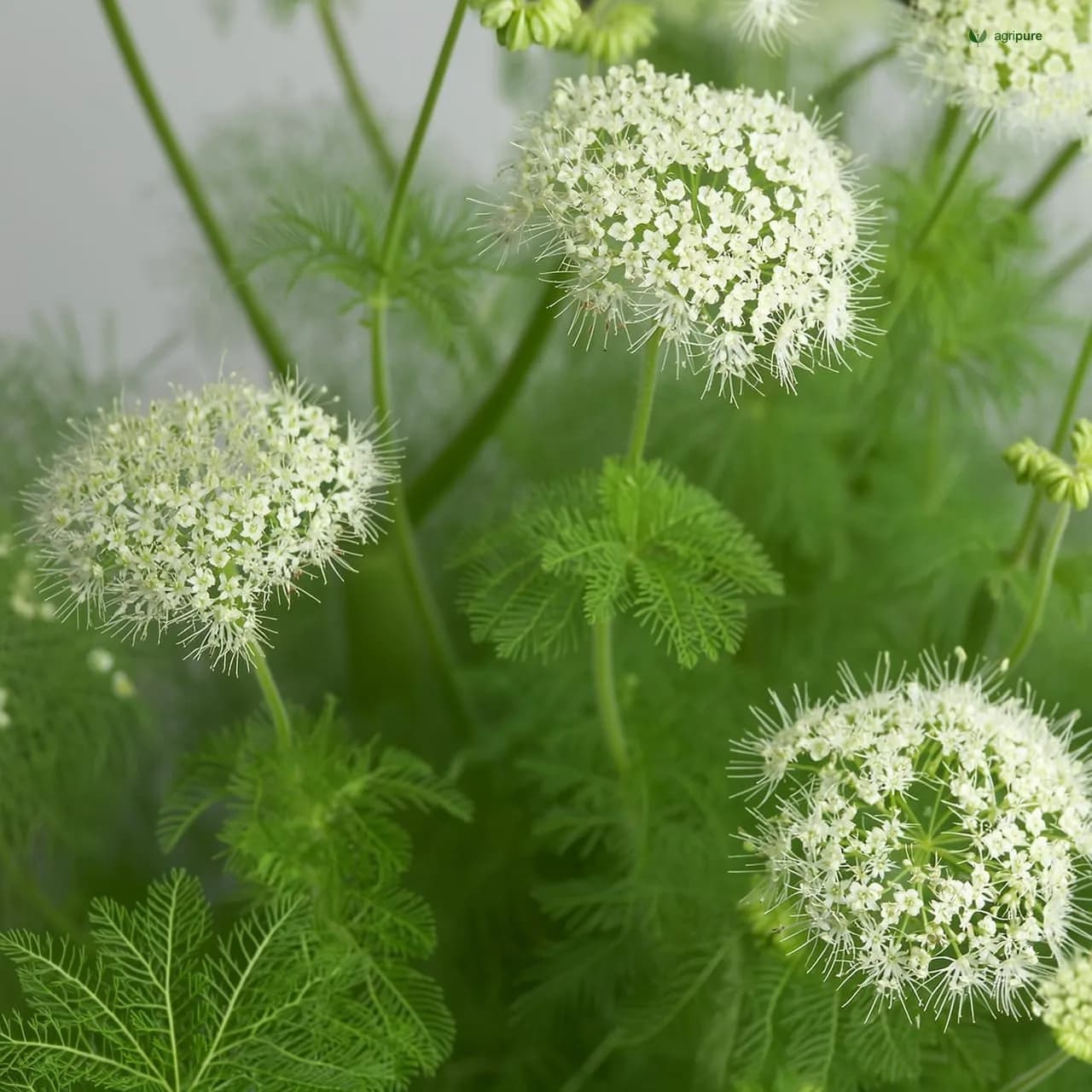
pioneer
Ajwain
ajwain
Trachyspermum ammi
Also known as Carom Seed (United States), Ajowan (Australia).
- punjab plains
- sindh coast
- pothohar
International hardiness
- USDA 9-11
- RHS H2
- AU: Subtropical, Arid / semi-arid, Mediterranean
Where it grows — regional guide
| Zones / rating | Regional notes |
|---|---|
USDA 9-11 | Grown as a frost-tender warm-season annual in USDA zones 9 to 11 for aromatic seeds; safe for culinary seasoning, but avoid concentrated herbal doses in pregnancy or if on medication. |
| Zones / rating | Regional notes |
|---|---|
H2 (1 to 5C) | No region-specific data yet |
| Zones / rating | Regional notes |
|---|---|
Subtropical, Arid / semi-arid, Mediterranean | Cultivated as a warm-season annual in Mediterranean and arid zones for aromatic spice; safe in kitchen quantities, but avoid high medicinal doses while pregnant or on medication. |
| Zones / rating | Regional notes |
|---|---|
USDA 9-11 (USDA scale) Canada uses its own zone system; Canadian zones run roughly one lower than USDA. | No region-specific data yet |
| Zones / rating | Regional notes |
|---|---|
Punjab plains, Sindh coast, Pothohar | Pakistan:A drought-tolerant winter rabi annual cultivated across Punjab and Sindh for pungent seeds; safe in everyday cooking, but avoid large medicinal doses while pregnant or on medication. India:A major rabi season spice crop grown in sunny, dryland field rotations; culinary seasoning is safe, but pregnant individuals or those on medication must avoid concentrated medicinal preparations. |
Ajwain (Trachyspermum ammi) is an annual herb in the carrot family (Apiaceae), grown for its small, pungent, thyme-scented fruits that the spice trade calls “seeds.” It carries several common names in English, including ajowan, ajowan caraway, bishop’s weed, and carom. The species is reported as native to Egypt and is cultivated across a band of dry, warm-climate countries from North Africa through the Middle East to the Indian subcontinent. For a homesteader, its appeal is that it is a fast, single-season aromatic crop suited to hot, dry ground where many herbs struggle, supplying both a kitchen spice and a plant with a long history of traditional use.
Ajwain is a profusely branched annual that typically reaches about 60 to 90 cm tall, with ridged (striated) stems. The leaves are finely divided and feathery, in the manner of its Apiaceae relatives such as coriander and fennel, and are borne alternately along the stem. The flowers are small and white, sometimes described as white to pale pink, and are carried in compound umbels at the tips of the stems; one detailed account describes an umbel made up of about sixteen umbellets, each bearing up to sixteen flowers. The fruits are small, oval, pale brown schizocarps that resemble caraway, cumin, or fennel seeds, and although the trade calls them seeds they are botanically seed-like fruits. They have a strong, thyme-like aroma owing to their thymol content, and a flavour that is bitter and pungent, comparable to anise or oregano but harsher.
Growing ajwain
Ajwain is grown from its seed-like fruits, which serve as both the commercial spice and the sowing material. It is a plant of dry, barren, semi-arid to arid conditions, occurring naturally in sandy or rocky, well-drained ground, and it favours well-drained sandy or loamy soils rather than wet, heavy, or waterlogged sites. Give it full sun, which suits its origins in hot, open country. Once established it is drought-tolerant and asks for little maintenance in a dry climate.
The retrieved sources describe cultivation mostly in qualitative terms, so the precise figures a grower might want are deliberately left out rather than invented. There is no reliably sourced germination temperature, seed pre-treatment, irrigation schedule, plant spacing, or time-to-harvest in the material here, so these are not stated. In practice, treat ajwain like other warm-season, dryland umbellifers: sow into a warm, free-draining bed, keep it on the lean and dry side, and avoid soggy soil. As a guide to layout, spacing roughly in keeping with the plant’s mature width is sensible, but no specific spacing is given in these sources, so adjust to your own conditions.
Harvest and uses
The harvest is the aromatic fruit. Ajwain is grown mainly for these pungent, thyme-scented “seeds,” which are widely used as a culinary spice and as a traditional remedy across South Asia and the Middle East. In the kitchen the fruit is prized for its thymol-driven, oregano-and-anise character, which holds up to cooking and seasons breads, pulses, and fried foods. Beyond the kitchen, ajwain has a long record of traditional medicinal use, and its oils and constituents have been the subject of scientific study. As a flowering member of the carrot family carrying flat umbels of small accessible flowers, a patch left to bloom also offers nectar and pollen to small beneficial insects, in the same way as its relatives coriander and dill.
Where it grows
Ajwain’s native and cultivated range sits firmly in warm, dry country. It is described as native to Egypt and grown indigenously in India, Iran, Afghanistan, and parts of northern Africa, typically in dry, barren soils. It is cultivated across many Indian states, including Gujarat, Rajasthan, Madhya Pradesh, Uttar Pradesh, Maharashtra, Bihar, and West Bengal, as well as in Iraq, Iran, Afghanistan, Pakistan, and other semi-arid regions. The primary sources here do not assign it USDA hardiness zones; given its success in hot, semi-arid regions and its annual life cycle, it is best treated as a warm-season annual rather than tied to a specific cited zone range.
Safety and cautions
Ajwain is a culinary spice with a long history of traditional medicinal use, but traditional use is not the same as a proven treatment, and this profile makes no claim that it treats or cures any condition. The sources here describe its uses and study rather than safe dosages, so no medicinal dose is given. As a general principle with any concentrated aromatic spice or herbal preparation, those who are pregnant or breastfeeding, and anyone taking prescription medication, should seek qualified medical advice before using it in anything beyond ordinary culinary amounts.
Sources
- Trachyspermum ammi (review) — Pharmacognosy Reviews / PMC, National Library of Medicine
- Ajwain (Trachyspermum ammi L.) oils — Monash University Research
- Ajwain — Wikipedia