Hot vs cold composting: building the right backyard pile for your US climate
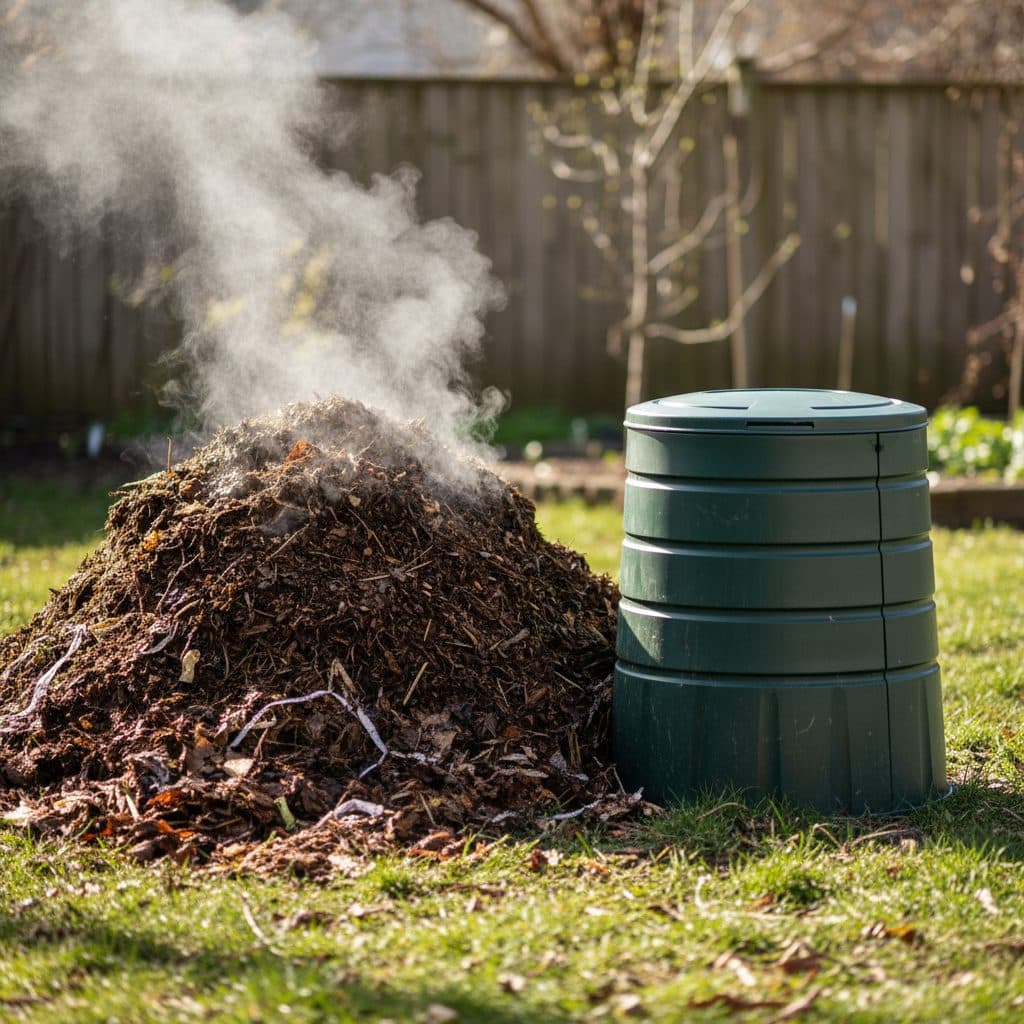
Two backyard composting piles side-by-side: one a large hot heap showing rising steam, the other a simple wire-bin passive cold pile.
Key takeaways
- Pile volume minimum: Maintain a minimum pile volume of 27 cubic feet (3 feet by 3 feet by 3 feet) for hot composting to self-insulate.
- Thermophilic temperature target: Maintain internal temperatures between 131°F and 170°F in hot piles to kill weed seeds and pathogens.
- Carbon-to-nitrogen ratio: Target a C:N ratio of 25:1 to 30:1 for active hot piles to fuel rapid microbial reproduction.
- Decomposition timeframe: Expect hot piles to produce finished compost in 14 to 28 days, compared to 6 months to 2 years for passive cold piles.
- Maintenance labor balance: Turn hot piles at least 2 times per week to supply oxygen; cold piles require zero active turning.
- Input guidelines: Exclude weeds, diseased plants, and seed heads from cold piles, as they lack the heat to neutralize pests.
Quick answer: Hot composting uses thermophilic bacteria to rapidly break down organic matter at 131-170°F, producing finished compost in 2-4 weeks. Cold composting uses mesophilic bacteria at ambient temperatures, taking 6 months to 2 years.
The Environmental Protection Agency (EPA) estimates that the average American generated 328 pounds of food waste in 2016, with households accounting for 40% to 50% of the nation’s 26.5 million tons of annual food waste. While vermicomposting and Bokashi offer indoor composting options, backyard growers require systems that can process large volumes of yard waste. Understanding the biological differences between hot (active) and cold (passive) composting allows you to build the right system for your specific US climate zone.
By selecting the correct composting method, you can recycle up to 100% of your garden trimmings and kitchen scraps. This choice determines how much time and labor you will spend managing your pile.
Biological differences between hot and cold piles
Hot and cold composting rely on different microbial communities to break down organic matter. Active hot composting uses heat-tolerant thermophilic bacteria to consume nitrogen-rich and carbon-rich materials at rapid rates. Passive cold composting, on the other hand, utilizes slow-working mesophilic bacteria and fungi that operate at ambient outdoor temperatures below 90°F.
A diagram illustrating microbial activity zones by temperature in a compost pile.
Thermophilic sanitization vs. mesophilic decay
Inside a hot compost pile, temperatures must climb to between 131°F and 170°F to sanitize the material. This intense heat kills weed seeds, plant pathogens, and insect larvae within 3 to 15 days of exposure. Cold piles, which rarely exceed 90°F, cannot destroy these pests, meaning weeds and diseased plants must be excluded from passive systems.
Carbon and nitrogen balance (C:N ratio)
To maintain this biological speed, you must keep a balanced C:N ratio between 25:1 and 30:1. When carbon (browns) and nitrogen (greens) are balanced, microbes reproduce exponentially, releasing metabolic heat. In cold piles, the C:N ratio can vary widely from 40:1 to 80:1 because decomposition occurs slowly through surface colonization.
Sizing and designing your compost pile
Physical layout determines whether a compost pile can generate and retain heat. While cold piles are highly flexible in size (often under 10 cubic feet), hot piles require strict dimensional parameters to achieve thermophilic heating.
Sizing hot compost piles
A hot compost pile must measure at least 3 feet wide, 3 feet deep, and 3 feet tall (a total volume of 27 cubic feet). This minimum volume provides enough bulk insulation to keep the core warm. Piles larger than 5 feet by 5 feet by 5 feet (125 cubic feet) should be avoided because they compress under their own weight, cutting off oxygen.
- Wire bins: Cheap 3-foot diameter cylinders made of galvanized hardware cloth hold large piles while maximizing airflow.
- Three-bin systems: Wooden pallet structures with 3 compartments allow you to have 1 pile cooking, 1 pile curing, and 1 pile receiving fresh scraps.
Sizing cold compost piles
For passive systems, a simple 1-bin structure or a 3-foot pile is sufficient. Because cold piles do not rely on self-insulation to function, they can be built in small spaces using 50-gallon plastic tumblers or simple backyard heaps.
Managing moisture and turning schedules
Moisture acts as the medium through which bacteria move and consume nutrients inside the compost pile. Piles must be kept damp with a target moisture content between 50% and 60% without becoming waterlogged.
A diagram illustrating compost moisture flow and the squeeze test.
Checking moisture levels
Compost piles require a moisture level of 50% to 60%. You can test this using a soil moisture meter or the classic squeeze test.
- Grab 1 handful of compost from the center of the pile.
- Squeeze the material firmly for 3 seconds in your hand.
- Observe if it releases only 1 or 2 drops of water.
- Add water using a garden sprayer if the moisture reading is below 40%.
- Add dry cardboard or straw if the moisture reading is above 70% and water streams out.
Composting Parameter | Hot (Active) Composting | Cold (Passive) Composting |
|---|---|---|
Minimum Pile Size | 27 cubic feet (3′ x 3′ x 3′) | None (flexible volume) |
Internal Temp | 131°F to 170°F | Ambient (near outdoor temp) |
Turning Frequency | 2 to 3 times per week | Zero turning required |
Time to Finish | 14 to 28 days | 6 months to 2 years |
Turning schedules for hot piles
To maintain active decomposition, turn your hot pile every 3 to 4 days using a pitchfork. This turning process moves cool outer materials into the hot center and replenishes oxygen levels, preventing anaerobic conditions that cause rotten odors.
Watering large compost heaps is simple with our Delixi Electric Garden Sprayer (3 / 5 / 8 L).
Climate challenges for US gardeners
Composting schedules must adjust to local weather conditions. The 13 USDA hardiness zones across the United States present unique temperature challenges for maintaining active piles.
Northern winter strategies
If you live in USDA zones 3 through 5, freezing winter temperatures will freeze backyard piles, stopping all biological activity. To keep a hot pile active in winter, wrap the bin in straw bales (creating a 12-inch insulating wall) and build the pile to a larger 4-foot by 4-foot size. Cold piles will freeze solid and remain inactive until the spring thaw.
Southern summer management
In hot climates (such as USDA zone 8 or 9), summer heat can dry out piles within 24 hours. Keep piles in shaded areas and cover them with a plastic tarp to reduce evaporation. Check moisture levels weekly using a soil tester.
Harvesting and using your compost
Decomposition is complete when the pile shrinks by 50% to 60%, leaving a dark, crumbly humus that smells like damp earth.
Testing for maturity
Before applying compost to your plants, ensure it is mature. Immature compost contains organic acids with a low pH that can stunt seedling roots by 50% or more.
- Place a handful of damp compost in a sealed plastic bag for 24 hours.
- Open the bag after 24 hours and check for foul odors like ammonia or sulfur.
- If it smells clean and earthy, the compost is ready for 100% safe application.
- Mix 1 part compost with 3 parts soil when planting tomatoes (Tomato) or growing strawberries (Strawberry).
Blending compost with soil is easy with our Garden Hand-Tool Set — Trowel, Rake, Cultivator & Weeder.
Troubleshooting compost pile issues
Composting can occasionally stall or smell sour in 10% to 15% of backyards.
Stalled cold pile (no decomposition)
- Cause: The pile is too dry (under 40% moisture) or lacks nitrogen.
- Solution: Add 1 part nitrogen-rich greens, spray with water to achieve 50% moisture, and mix.
Sour, rotten odor from hot pile
- Cause: The pile is too wet (above 70% moisture), cutting off oxygen, or has too much nitrogen.
- Solution: Turn the pile thoroughly, mix in 2 parts dry shredded leaves, and cover with a tarp.
Pile heating up but quickly cooling
- Cause: The pile is too small (under 27 cubic feet) or lacks oxygen in the core.
- Solution: Rebuild the pile to at least 3 feet tall and turn it every 3 days.
If you need to shred large woody yard waste to feed your hot pile, consider our Branch Wood Chipper (6.5 / 13 / 15 HP).
Soil Testing Reminder: Compost adds organic matter but can shift soil pH. Monitor your garden beds using a 3-in-1 Soil pH, Moisture & Light Meter to keep pH within the optimal 6.0 to 7.0 range.
Frequently asked questions
What is the minimum size for a hot compost pile?
To generate and retain enough metabolic heat for active composting, a hot pile must be at least 3 feet wide, 3 feet deep, and 3 feet tall (27 cubic feet in total volume).
How hot should an active compost pile get?
An active compost pile should maintain internal temperatures between 131°F and 170°F. This thermophilic temperature range is essential for destroying weed seeds, plant pathogens, and insect larvae.
Can I put weed seeds in a cold compost pile?
No. Cold piles only reach ambient outdoor temperatures, which are not hot enough to destroy weed seeds or plant pathogens. Adding them to a cold pile will spread weeds throughout your garden when the compost is applied.
How often should I turn a hot compost pile?
For best results, you should turn a hot compost pile every 3 to 4 days (or about 2 times per week). This introduces fresh oxygen, prevents anaerobic odor, and relocates cooler outer materials into the hot core.
References
- UGA Extension. (2026). Composting and Mulching (Circular 816). UGA Extension.
- University of Illinois Extension. (2020). Composting. Illinois Extension.
- LSU AgCenter. (2021). Backyard Composting. LSU AgCenter.
- NC State Extension. (2021). Composting Learning Lab. NC State Extension.
- University of Maryland Extension. (2023). Indoor Worm Composting or Vermicomposting. UMD Extension.