pioneer
Puncture Vine (Caltrop)
bhakra / gokhru
Tribulus terrestris
Also known as Gokhru (Pakistan, India), Goat's Head (Australia), Goathead (United States).
- punjab plains
- sindh coast
- balochistan highlands
International hardiness
- USDA 9-11
- RHS H2
- AU: Arid / semi-arid, Subtropical, Warm temperate, Mediterranean
Where it grows — regional guide
| Zones / rating | Regional notes |
|---|---|
USDA 9-11 | A prostrate summer weed in dry soils across USDA zones 9 to 11; eradicate before seeds set, as vicious burs puncture footwear and tyres, and foliage poisons sheep. |
| Zones / rating | Regional notes |
|---|---|
H2 (1 to 5C) | No region-specific data yet |
| Zones / rating | Regional notes |
|---|---|
Arid / semi-arid, Subtropical, Warm temperate, Mediterranean | A declared agricultural weed in dryland grazing areas; check local weed controls, as sharp burs puncture vehicle tyres and the plant causes fatal toxicity in sheep. |
| Zones / rating | Regional notes |
|---|---|
USDA 9-11 (USDA scale) Canada uses its own zone system; Canadian zones run roughly one lower than USDA. | No region-specific data yet |
| Zones / rating | Regional notes |
|---|---|
Punjab plains, Sindh coast, Balochistan highlands | Pakistan:A prostrate weed of arid wasteland gathered for pansari trade; manage before fruiting, as spiny burs puncture feet and tires, and green leaves poison grazing sheep. India:A common dryland herb gathered from waste ground for Ayurvedic medicine; eradicate near animal pastures, as burs puncture hooves and foliage is toxic to livestock. |
Puncture vine (Tribulus terrestris), also called caltrop or goat’s head, is a low, mat-forming summer annual native to the Mediterranean region of southern Europe and Asia, with broader accounts extending its native range across Eurasia and Africa. It has since spread far beyond that range and is now an invasive weed across much of North America (particularly the western United States and parts of Canada) and a significant weed in Australia. For a homesteader, this is a plant to recognise and manage rather than plant: it thrives on exactly the hot, dry, disturbed ground that opens up on overgrazed paddocks, driveways, and neglected corners, and its hard, spined burs puncture skin, tyres, footwear, and animals’ feet.
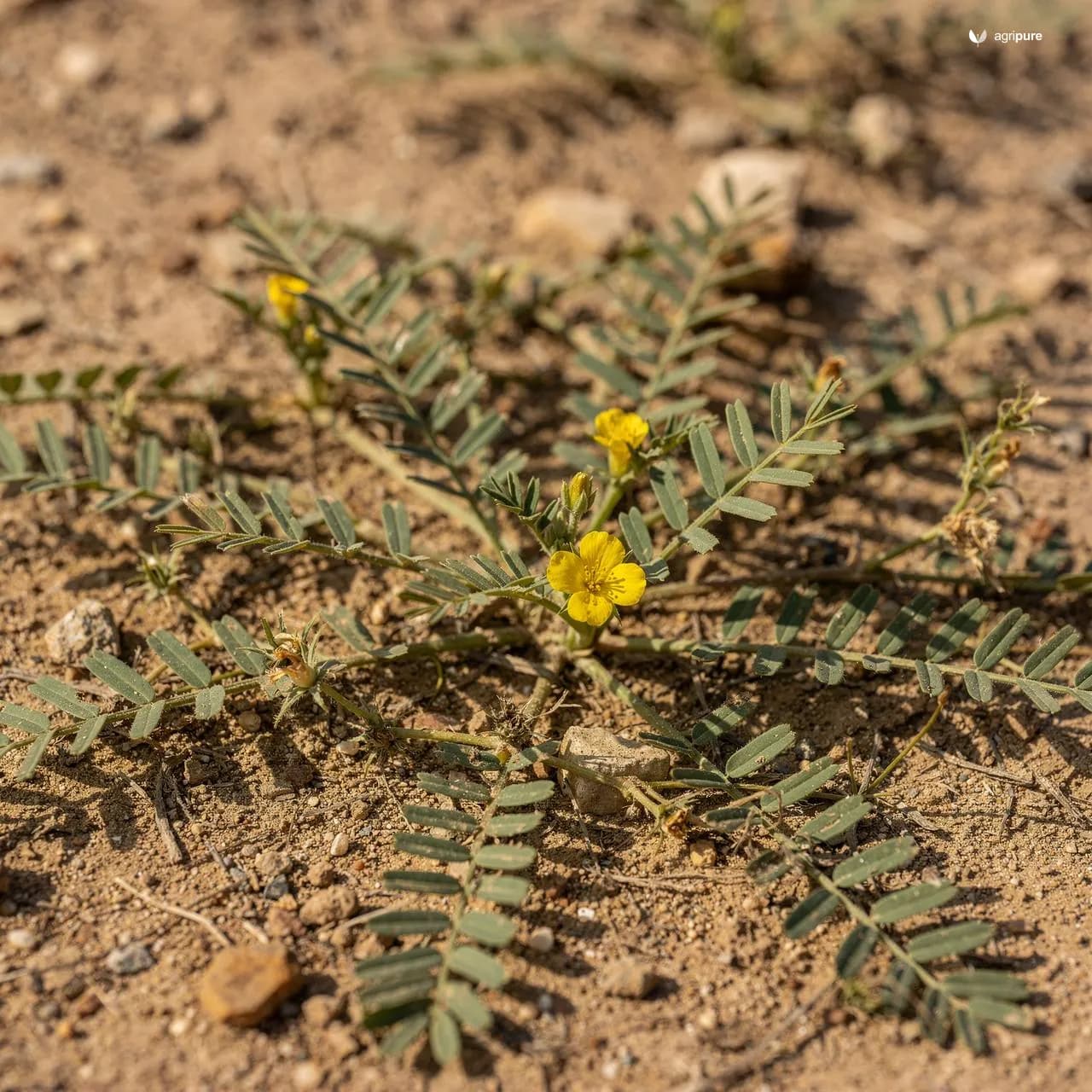
It is a prostrate, trailing forb that forms dense mats, typically 1 to 3 feet (0.3 to 1 m) across but sometimes larger, with numerous highly branched stems radiating from a central crown; individual stems can run 2 to 3 feet long. The leaves are opposite, 1 to 3 inches (2.5 to 7.5 cm) long and pinnately compound, with 3 to 8 pairs of small oval-to-oblong leaflets each about a quarter to half an inch (6 to 12 mm) long; the leaflets are densely hairy, giving the foliage a grey-green cast. Beneath the mat the plant anchors itself with a deep taproot.
Growing puncture vine
Almost all of the reliable literature on Tribulus terrestris describes how to control it, not how to cultivate it, so what follows is drawn from weed-science and extension descriptions of how it grows in the wild rather than crop instructions. The plant reproduces solely by seed. Germination occurs primarily in late spring to early summer as the soil warms, the plant flowers through the summer, and it sets seed before frost — the classic summer-annual cycle. A few older sources call it a “taprooted perennial,” but the weed-science consensus is that it behaves as an annual that comes back only from seed.
For sun, soil, and water it is unfussy and tough. It favours warm, dry climates and open, sunny sites, and it is highly drought-tolerant. It establishes on a wide range of soils — poor or rich, dry or moist, sandy through to clayey, and even compacted ground. Its strongholds are disturbed places: roadsides, walkways, railroads, waste areas, vineyards, orchards, crop fields, lawns, and pastures. Dense stands are best read as a sign that the ground is bare and disturbed; the practical response is to crowd it out with competitive cover and to stop seed set rather than to encourage it.
Identification
The most reliable field cue is the fruit. It is a woody bur composed of five wedge-shaped sections that break apart at maturity, each section armed with very hard, sharp spines (typically two longer and two shorter spines per segment) and containing 2 to 4 seeds. These burs cling to fur, clothing, and tyres and are notorious for puncturing bicycle tyres and injuring animals’ feet, which is how the plant earns its common names. Above the burs sit bright yellow, five-petalled flowers about a third to a half inch (8 to 12 mm) wide, borne singly in the leaf axils throughout the warm season. Taken together, the flat radiating mat, grey-green hairy compound leaves, small yellow flowers, and spiny five-part burs make the plant hard to confuse with anything else once it is fruiting.
Harvest and uses
Puncture vine is not a food or forage crop, and the extension sources treat it strictly as a weed to be managed; no cultivated yield figures exist for it in this research. Beyond its weed status, the species has a long record in traditional herbal practice and has been the subject of modern phytopharmacology research, with reviews surveying its reported nutritional potential and traditional uses. That body of study describes traditional use; it is not evidence that the plant treats or cures any condition, and this profile makes no such claim. For a homesteader the realistic “harvest” is removal: pulling or cutting plants before the burs harden and bagging the spiny fruit so seed does not spread on boots, tyres, and animals.
Safety and cautions
Two hazards make this plant worth respecting on a homestead. First, the burs themselves: their very hard, sharp spines readily puncture bare skin, hooves, footwear, and bicycle and cart tyres, and they hitch rides on fur and clothing to spread the seed. Second, the living plant is toxic to some livestock, especially sheep. For those reasons it is best kept well away from grazing animals and high-traffic areas, and managed down before it fruits. While the species also appears in traditional medicine and research literature, that use should not be confused with safe casual consumption; the plant here is described for identification and management, with no dosage or medical guidance given.
Sources
- Puncturevine (Tribulus terrestris) Pest Notes – University of California ANR Integrated Pest Management
- Puncturevine – Iowa State University Extension and Outreach
- Puncturevine (Tribulus terrestris) – North Dakota Department of Agriculture
- Puncturevine identification and management – Utah State University Extension
- Puncturevine weed identification and biology – Nez Perce Soil & Water Conservation District
- Tribulus terrestris (puncturevine) – Center for Invasive Species and Ecosystem Health (Invasive.org)
- Puncture Vine / Caltrop (Tribulus terrestris) – Weeds Australia
- Phytopharmacology and traditional usage of Tribulus terrestris – PMC, National Library of Medicine
Sourcing notes
Self-sown on bare arid ground everywhere; the dried fruit (gokhru) is a staple of pansari and Unani herb markets, so the medicinal harvest is gathered rather than cultivated.