secondary
Garden Sage
salvia
Salvia officinalis
Also known as Common Sage (United States, UK & Ireland, Canada, Australia).
- pothohar
- balochistan highlands
- kpk hills
International hardiness
- USDA 5-9
- RHS H5
- AU: Warm temperate, Cool temperate, Mediterranean
Where it grows — regional guide
| Zones / rating | Regional notes |
|---|---|
USDA 5-9 | A cold-hardy perennial subshrub for full sun and well-drained soil; it is usually hardy through winter across most of the country, though it tends to be short-lived and can rot in wet ground. |
| Zones / rating | Regional notes |
|---|---|
H5 (-15 to -10C) | A classic cottage garden perennial, fully hardy in open ground when planted in sunny beds with free winter drainage. |
| Zones / rating | Regional notes |
|---|---|
Warm temperate, Cool temperate, Mediterranean | Hardy in temperate and Mediterranean gardens, needing gritty soil and good air circulation to endure humid summer heat. |
| Zones / rating | Regional notes |
|---|---|
USDA 5-9 (USDA scale) Canada uses its own zone system; Canadian zones run roughly one lower than USDA. | Hardy enough to overwinter in milder Canadian gardens, especially under snow cover and in sharply drained soil; in the coldest districts it is often grown as an annual or brought indoors for winter. |
| Zones / rating | Regional notes |
|---|---|
Pothohar, Balochistan highlands, KPK hills | Pakistan:Performs well in cooler upland valleys and hill districts, but often declines in hot plains during heavy summer monsoons. India:Suited to northern hill tracts with cool summers; grown as a short-lived cool-season container herb in warmer plains. |
Grows alongside
Species that appear with Garden Sage in 43 of our published guides — a starting list for a guild, not a planting plan.
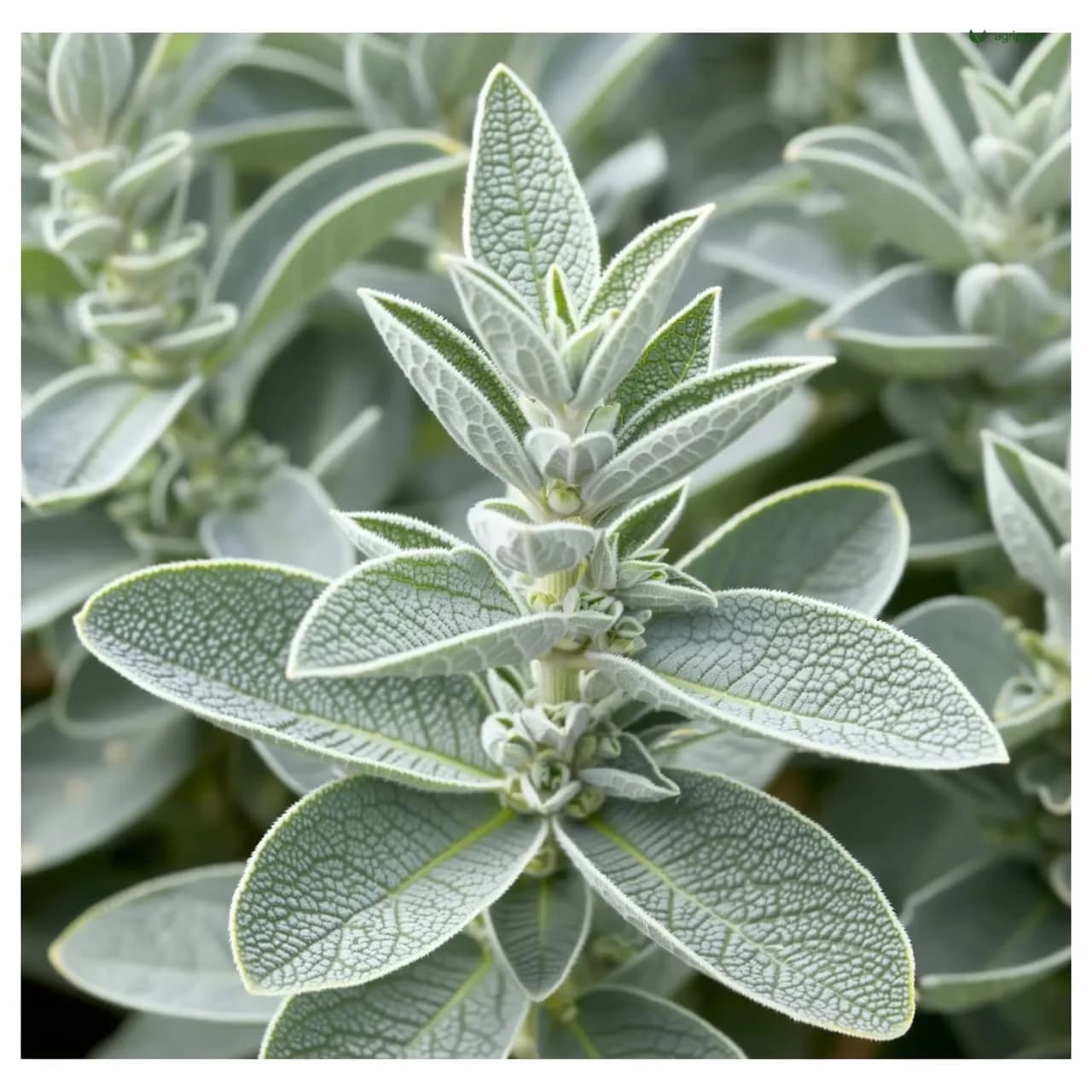
Garden sage (Salvia officinalis) is a woody, aromatic, evergreen to semi-evergreen subshrub in the mint family (Lamiaceae), grown for its gray-green, pebbly leaves and spikes of pale lavender-blue flowers. It is native to the Mediterranean region, with its natural range in the northern Mediterranean and parts of southern Europe along the coast, and some sources also include northern Africa. For a homesteader, the appeal is simple: it is a drought-tolerant perennial that turns a sunny, dry, free-draining corner into a permanent supply of culinary and herbal leaf, asking for little once it is established.
Sage is a short-lived, bushy, spreading, semi-woody perennial that commonly reaches about 2 to 2.5 feet tall and 2 to 3 feet wide, though some cultivars stay shorter. Its leaves are the giveaway: gray to gray-green, opposite, distinctly wrinkled or pebbly in texture, and slightly fuzzy to the touch. In late spring or early summer it sends up pale lavender to blue-purple flowers, a useful field cue and a magnet for visiting insects. Its native habitat is Mediterranean shrubland and grassland on hillsides and mountains, which explains its taste for sun, heat, and sharp drainage.
Growing garden sage
Sage grows best in full sun and well-drained soil. It tolerates drought and low soil fertility once established, but it is intolerant of wet or poorly drained ground, so drainage matters more than richness. Reported cold hardiness varies between sources; reliable horticultural references place it around **USDA zones 4 to 8**, with one source giving a wider range of zones 4a to 10b.
You have several ways to start it. Sage can be propagated by seed, layering, division, or softwood cuttings, and named cultivars are usually propagated vegetatively so they come true to the parent. Seed can be started indoors 6 to 8 weeks before the last frost or sown directly outdoors around the last frost date, and cuttings root readily in a moist, well-drained potting mix without rooting hormone. Space plants roughly 18 to 24 inches apart so air moves freely and the leaves dry quickly between waterings. From planting, sage takes about 75 days to its first harvest. In practice, give it the leanest, best-drained spot you have, water it in while it establishes, then ease off and let it harden into the dry-loving shrub it wants to be.
Harvest and uses
The crop is the aromatic leaf. Harvesting commonly begins about 75 days after planting, and the usual approach is to cut 6 to 8 inches from the top at least twice during the growing season, taking care never to remove more than half the plant at once. Leaves are best harvested before flowering, when their culinary flavor is at its strongest. The provided sources do not give a quantified yield per plant or per area, so no yield figure is stated here.
This species is the standard culinary sage of the kitchen. Beyond cooking, it earns its place in the wider system: it is reported to attract bees and butterflies, is noted as deer resistant, and performs well in borders and mixed herb or vegetable gardens. It is also grown as an ornamental and craft plant in addition to its kitchen role. The species epithet officinalis points to its long history in traditional herbal medicine, a record that stretches back centuries.
Safety and cautions
Normal culinary use of sage leaf is the everyday way the plant is enjoyed, but its concentrated forms warrant respect. Sage essential oil contains thujone, and the sources warn that Salvia essential oils can cause severe intoxication, including convulsions in animals and intoxication in humans. That caution applies especially to the concentrated oil and to supplemental or medicinal use, rather than to ordinary culinary leaf in the kitchen. The provided sources do not identify specific drug interactions, pregnancy warnings, or contraindicated groups for Salvia officinalis itself, so none are claimed here, and no dosage is given. The sensible homestead rule is to cook freely with the leaf, but treat distilled oil and strong herbal preparations conservatively and with informed guidance.
Sources
- Salvia officinalis (Common Sage) — NC State Extension Gardener Plant Toolbox
- Salvia officinalis — Wikipedia
- Sage, Salvia officinalis — University of Wisconsin-Madison Division of Extension
- Salvia officinalis — Missouri Botanical Garden Plant Finder