pioneer
Wheat
gandum
Triticum aestivum
Also known as Gandum (Pakistan), Common Wheat (United States).
- punjab plains
- sindh coast
- pothohar
- kpk hills
International hardiness
- USDA 3-9
- RHS H7
- AU: Cool temperate, Warm temperate, Mediterranean, Arid / semi-arid, Subtropical
Where it grows — regional guide
| Zones / rating | Regional notes |
|---|---|
USDA 3-9 | Grown as winter or spring grain across the plains in USDA zones 3 to 9; provides staple flour, but the harvested grain carries gluten that triggers celiac disease. |
| Zones / rating | Regional notes |
|---|---|
H7 (below -20C) | Hardy to RHS H7 and grown as autumn-sown winter wheat or spring wheat; produces versatile milling grain, but note that gluten causes severe reactions in celiac disease. |
| Zones / rating | Regional notes |
|---|---|
Cool temperate, Warm temperate, Mediterranean, Arid / semi-arid, Subtropical | A major winter-grown dryland cereal across southern grain belts; produces high-value milling wheat, but contains gluten proteins that trigger severe celiac reactions. |
| Zones / rating | Regional notes |
|---|---|
USDA 3-9 (USDA scale) Canada uses its own zone system; Canadian zones run roughly one lower than USDA. | A cornerstone spring cereal crop across the Canadian prairies; yields high-protein grain, but flour contains gluten that causes severe reactions in celiac individuals. |
| Zones / rating | Regional notes |
|---|---|
Punjab plains, Sindh coast, Pothohar, KPK hills | Pakistan:The primary winter rabi cereal across Punjab, Sindh, Pothohar, and KPK hills; milled for staple flour, but contains gluten that triggers celiac reactions. India:A premier winter rabi grain crop across temperate regions of the subcontinent; harvest grain when fully hard and dry, but note that it contains gluten allergens. |
Grows alongside
Species that appear with Wheat in 50 of our published guides — a starting list for a guild, not a planting plan.
Bread wheat (Triticum aestivum), also called common wheat, is a mid-tall annual or winter-annual grass in the family Poaceae, grown worldwide for its grain. It is believed to have originated in southwestern Asia, with domestication in the Fertile Crescent of the Middle East; the modern hexaploid bread wheat we grow today arose through hybridization and amphidiploidy events involving earlier diploid and tetraploid wheats. For the homesteader it is the classic cool-season cereal: frost-tolerant, easy to direct-sow from saved grain, and capable of carrying a plot through the cold months when little else is in the ground.
Wheat is now cultivated across most temperate regions of the world and is widely naturalized; in North America it occurs from Alaska to California and east across most of the continent, turning up in fields and disturbed sites well beyond where it was sown. As a crop it is treated by agronomists and regulators as a cool-season cereal adapted to temperate climates.
How to identify Triticum aestivum
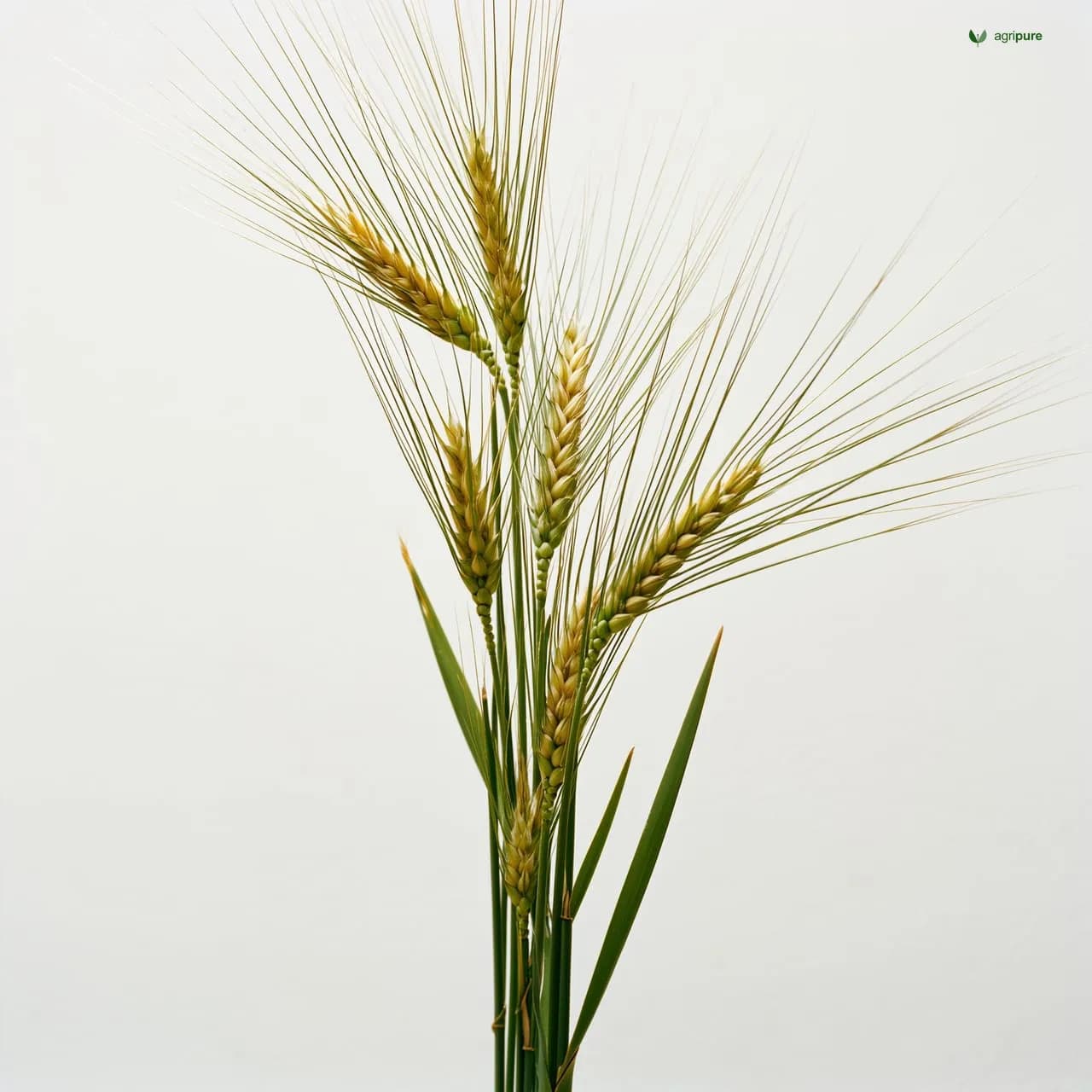
Common wheat grows as a mid-tall annual or winter-annual grass reaching up to about 1.5 metres (roughly 5 feet), with a generally fibrous root system. The stems, or culms, are typically round and hollow with swollen, solid nodes. Leaves are arranged alternately in two ranks, giving the plant the characteristic two-sided look of grasses; the blades are generally linear and flat, 5 to 20 mm wide, the sheaths are open, the ear-like auricles at the leaf collar are prominent, and the ligules are about 1 mm long.
The flower head is a terminal spike, 5 to 12 cm long, with spikelets borne in two ranks, one per node, sessile and attached flatwise to the central rachis. Individual spikelets are laterally compressed and 9 to 16 mm long, with thick, stiff, keeled glumes 6 to 12 mm long; the spike may be awned or awnless depending on the variety. Each spikelet usually carries two to five florets, occasionally up to nine, and the flowers are perfect (bisexual). The grain, a caryopsis, is generally naked and free-threshing, roughly 5 to 9 mm long and 1.8 to 4.5 mm wide, with plump rounded “cheeks” on either side of the crease. Those plump, rounded cheeks, and the absence of a pinched rim around the embryo, are the easiest way to tell bread wheat grain from durum wheat (Triticum turgidum subsp. durum).
Growing Triticum aestivum
Wheat is propagated almost exclusively by seed, that is, by sowing the grain itself. The flowers are wind-pollinated and largely self-pollinated, with only some potential for cross-pollination by wind, which is why saved grain comes reasonably true and why a homestead patch needs no special pollination management.
Depending on climate and cultivar, the crop is grown in one of two ways. Winter wheat is sown in autumn; the seedlings overwinter in the field, head in late spring, and are harvested in early summer. Spring wheat is sown in spring and harvested in summer. The two are not interchangeable: winter types require vernalization, a sustained period of cold, before they will switch from leafy growth into reproductive growth and produce a head. Matching the type to your winters is therefore the first decision, sow a winter type where the cold season is long enough to vernalize it, and a spring type where it is not.
Harvest and uses
Harvest timing follows the growing pattern: a fall-sown winter crop overwinters and is cut in late spring or early summer, while a spring-sown crop is cut in summer. The product is the grain, the free-threshing caryopsis that separates cleanly from the chaff, which is the basis of wheat’s value as the staple cereal of temperate agriculture.
Wheat is widely edible and is grown the world over as a food grain. Beyond the homestead kitchen, its naturalized spread from Alaska to California and across most of North America shows how readily the plant establishes itself in fields and disturbed ground once introduced.
Safety and cautions
While wheat is widely edible, it causes serious adverse reactions in some people. Those with celiac disease, non-celiac gluten sensitivity, a wheat allergy, or certain metabolic disorders can react badly to it and must either avoid wheat entirely or consume it only under medical supervision. If you grow and mill your own grain to share, keep this in mind for anyone in these groups. This is general information, not medical advice; anyone with a known sensitivity should follow the guidance of their own clinician.
Sources
- “Triticum aestivum L. subsp. aestivum” – Seed ID Guide (idseed.org)
- “Triticum aestivum” – Jepson eFlora, University of California, Berkeley
- “The Biology of Triticum aestivum L. (Wheat)” – Canadian Food Inspection Agency
- “Triticum aestivum” – Burke Herbarium, University of Washington
- “Triticum aestivum” – NatureServe Explorer
- “Triticum aestivum L.” – Global Biodiversity Information Facility (GBIF)
- “Triticum aestivum (Taxonomy)” – National Center for Biotechnology Information (NCBI)