secondary
Sweet Indrajao
indarjau
Wrightia tinctoria
Also known as Indarjau (Pakistan), Pala Indigo (India).
- punjab plains
- sindh coast
International hardiness
- USDA 10-11
- RHS H1c
- AU: Tropical, Subtropical
Where it grows — regional guide
| Zones / rating | Regional notes |
|---|---|
USDA 10-11 | No region-specific data yet |
| Zones / rating | Regional notes |
|---|---|
H1c (5 to 10C) | No region-specific data yet |
| Zones / rating | Regional notes |
|---|---|
Tropical, Subtropical | No region-specific data yet |
| Zones / rating | Regional notes |
|---|---|
USDA 10-11 (USDA scale) Canada uses its own zone system; Canadian zones run roughly one lower than USDA. | No region-specific data yet |
| Zones / rating | Regional notes |
|---|---|
Punjab plains, Sindh coast | Pakistan:A small deciduous tree suited to frost-free areas of the Punjab plains and Sindh coast; handle cut stems with care due to latex, and avoid heavy dietary or unguided medicinal use. India:Native deciduous tree cultivated across dry and moist tropical forests for timber and blue dye; handle cut stems with care due to latex, and avoid heavy dietary or unguided medicinal use. |
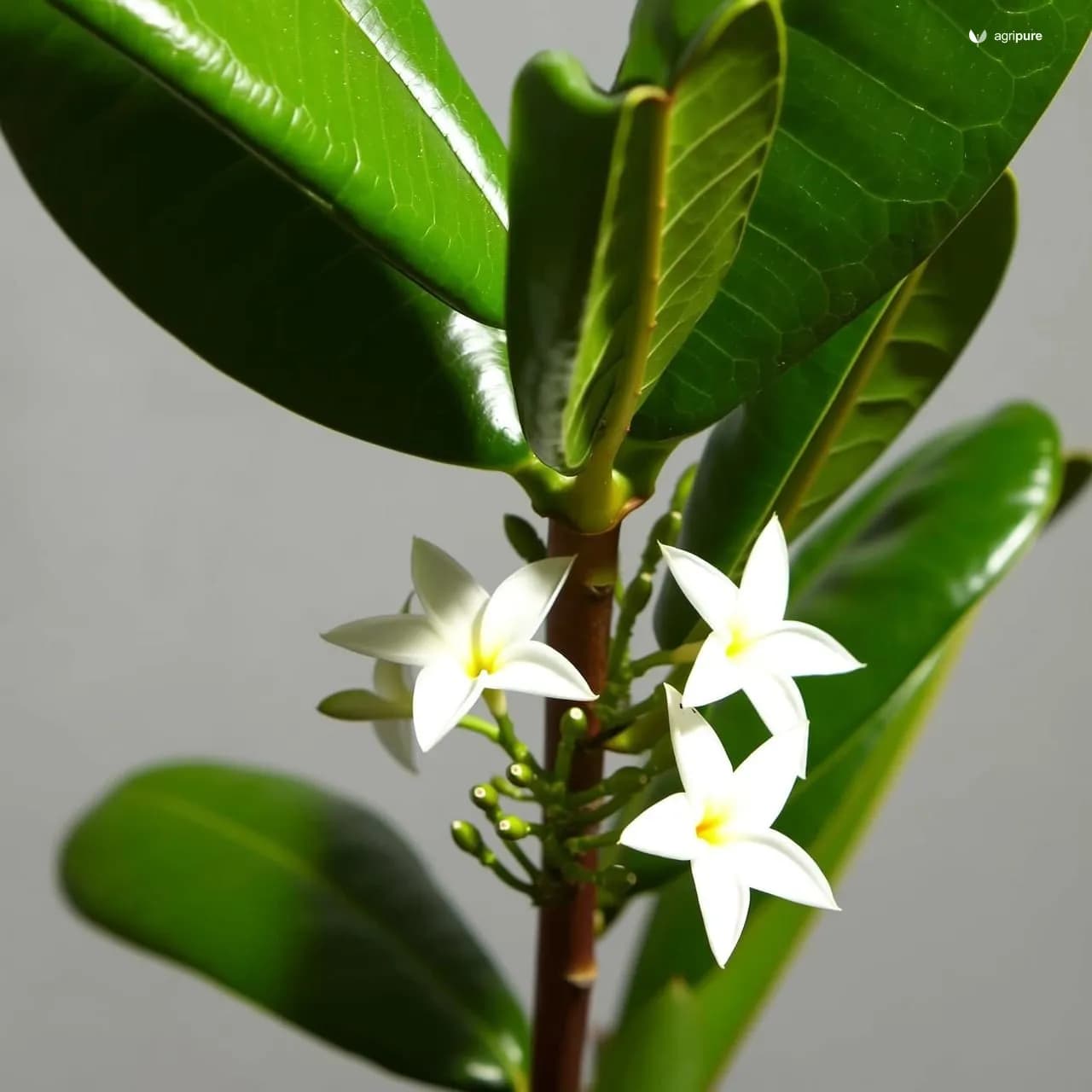
Sweet indrajao (Wrightia tinctoria) is a small deciduous tree in the dogbane family (Apocynaceae), the same family as oleander and frangipani.12 It is native to the dry and moist tropical regions of India and Myanmar and ranges more widely across Australia, Nepal, Timor, and Vietnam.23 For a homesteader working warm, frost-free ground, its appeal is that it does several jobs at once: it carries masses of white star-shaped flowers, its leaves yield a blue indigo-like dye, and it has a long history as a timber and traditional-medicine tree.123 Its flowers, leaves, fruits, and seeds are reported as edible, but because the tree also exudes latex and contains various bioactive compounds, any heavy dietary or medicinal use should be approached cautiously.2
How to identify it
Sweet indrajao is a deciduous tree that grows to roughly 6 to 18 m tall, with a bole up to about 20 cm in diameter.3 Several features help separate it from other dry-woodland trees:123
- Bark: light grey, smooth and scaly, on a small, often light-crowned tree.1
- Leaves: simple and opposite; they yield a blue dye known as “Pala indigo,” which points to a healthy leaf mass.13
- Flowers: small, white and star-like, massed so heavily in bloom that the tree is often described as looking “like snow flakes.”1
- Fruit: long, pendulous paired follicles (pods) joined at their tips, holding hairy, wind-dispersed seeds.13
- Sap: like other members of Apocynaceae, a cut stem exudes white latex.2
Together, the grey scaly bark, opposite leaves, white star flowers, long paired pods, and milky latex are a reliable field signature.123
Growing sweet indrajao
This is a tree of arid, semi-arid, and moist tropical regions, found growing in dry deciduous forests, sometimes as undergrowth.3 The sources record its climate envelope rather than USDA hardiness zones: it occurs from about 25 up to 1,200 m (occasionally 1,300 m) in elevation, in areas with 400 to 2,500 mm of mean annual rainfall and a mean temperature of about 17 to 25 °C.3 No minimum temperature or frost tolerance is given in the sources, so for a homestead context it is best treated as a tropical-to-warm-subtropical tree that is not reliably frost-hardy.
Practical site notes that the sources do support:
- Soil: it succeeds in a wide range of soil types, doing especially well on dry sandy sites, hillsides, and valleys.3 Notably, it tolerates high uranium levels in the soil, which makes it useful on otherwise difficult ground.3
- Light: it tolerates moderate shade and is often found as undergrowth in deciduous forest, but it is also widely planted as an open-grown ornamental in the tropics, so full sun is also workable.3
- Water: despite occurring in dry regions, plants are reported as intolerant of drought, which implies they rely on seasonal rains or deep soils that hold subsoil moisture. On a homestead, give it a site with good stored moisture or some irrigation rather than leaving it on the driest, shallowest ground.3
The provided sources give no reliable detail on propagation method, seed pretreatment, germination time, spacing, growth rate, or time to maturity. Rather than invent figures, those are left out here. Most trees in this family are grown from seed, but that is a general expectation, not something documented for this species in the sources, so treat any specific propagation protocol as unverified.3
Harvest and uses
Sweet indrajao is grown chiefly as a dye, timber, and medicinal tree rather than a food crop.23 Its best-known cottage use is the blue, indigo-like dye extracted from the leaves, the “Pala indigo” that gives the species its botanical name (tinctoria, meaning “used in dyeing”).13 The wood is valued as timber, and the bark, leaves, fruits, and seeds all feature in traditional medicine across its native range.23 The long paired follicles produce hairy seeds that disperse on the wind, so a mature tree supplies its own seed generously for anyone wanting to raise more.13 The sources do not give a measured yield for dye, timber, or seed, so no quantity is stated here.
Safety and cautions
While the flowers, leaves, fruits, and seeds are reported as edible, the sources are clear that this is not a casual food plant.2 The tree exudes latex and contains a range of bioactive compounds, and the sources advise that any medicinal or heavy dietary use be approached cautiously and under professional guidance.2 A few grounded points:
- The milky latex typical of the dogbane family is a reason to handle cut stems and raw plant parts with care, and not to assume “edible” means freely eaten in quantity.2
- The tree has a long record of traditional medicinal use, but that is not the same as a proven treatment; this profile makes no claim that it treats or cures any condition.23
- As with any potent plant carrying latex and bioactive compounds, anyone considering medicinal use should seek qualified guidance first, and no dosage is suggested here.2