pioneer
Maize
makai
Zea mays
Also known as Corn (United States, UK & Ireland, Canada, Australia), Makai (Pakistan).
- punjab plains
- sindh coast
- pothohar
- kpk hills
International hardiness
- USDA 10-11
- RHS H2
- AU: Tropical, Subtropical, Warm temperate, Cool temperate, Mediterranean, Arid / semi-arid
Where it grows — regional guide
| Zones / rating | Regional notes |
|---|---|
USDA 10-11 | A frost-sensitive warm-season annual grown across all states; sow densely in rows after frost, cook grain properly, and do not eat raw plant parts. |
| Zones / rating | Regional notes |
|---|---|
H2 (1 to 5C) | Rated RHS H2, it is grown as a summer annual in sunny, sheltered beds; plant densely in rows for wind pollination, cook cobs properly, and do not eat raw plant parts. |
| Zones / rating | Regional notes |
|---|---|
Tropical, Subtropical, Warm temperate, Cool temperate, Mediterranean, Arid / semi-arid | Cultivated as a warm-season annual crop planted densely in rows across temperate and subtropical zones; cook grain properly, and do not eat raw plant parts. |
| Zones / rating | Regional notes |
|---|---|
USDA 10-11 (USDA scale) Canada uses its own zone system; Canadian zones run roughly one lower than USDA. | Grown as a fast summer annual across Canadian kitchen gardens; plant densely in rows after the last frost, cook grain thoroughly, and do not eat raw vegetative parts. |
| Zones / rating | Regional notes |
|---|---|
Punjab plains, Sindh coast, Pothohar, KPK hills | Pakistan:A major summer and spring cereal grown across the plains and northern valleys; sow densely in rows, cook grain properly, and do not eat raw plant parts. India:A major kharif and summer cereal cultivated for grain and fodder; grow in fertile ground, cook grain properly, and do not eat raw plant parts. |
Grows alongside
Species that appear with Maize in 13 of our published guides — a starting list for a guild, not a planting plan.
Maize (Zea mays), the plant most of the English-speaking world also calls corn, is a tall annual grass in the Poaceae and one of the most widely grown cereal crops on the planet. It was domesticated roughly 9,000 years ago in southern and southwestern Mexico from a wild grass called teosinte (Zea mays subsp. parviglumis), in what the evidence points to as a single domestication event. From that Mesoamerican origin it has been carried around the world and is now cultivated throughout the Americas, Europe, Asia, Africa, Australia, and the South Pacific islands. For a homesteader it is the classic summer staple: a fast, vigorous, full-sun grass that turns a long warm season into a heavy crop of grain you can store, grind, or feed out.
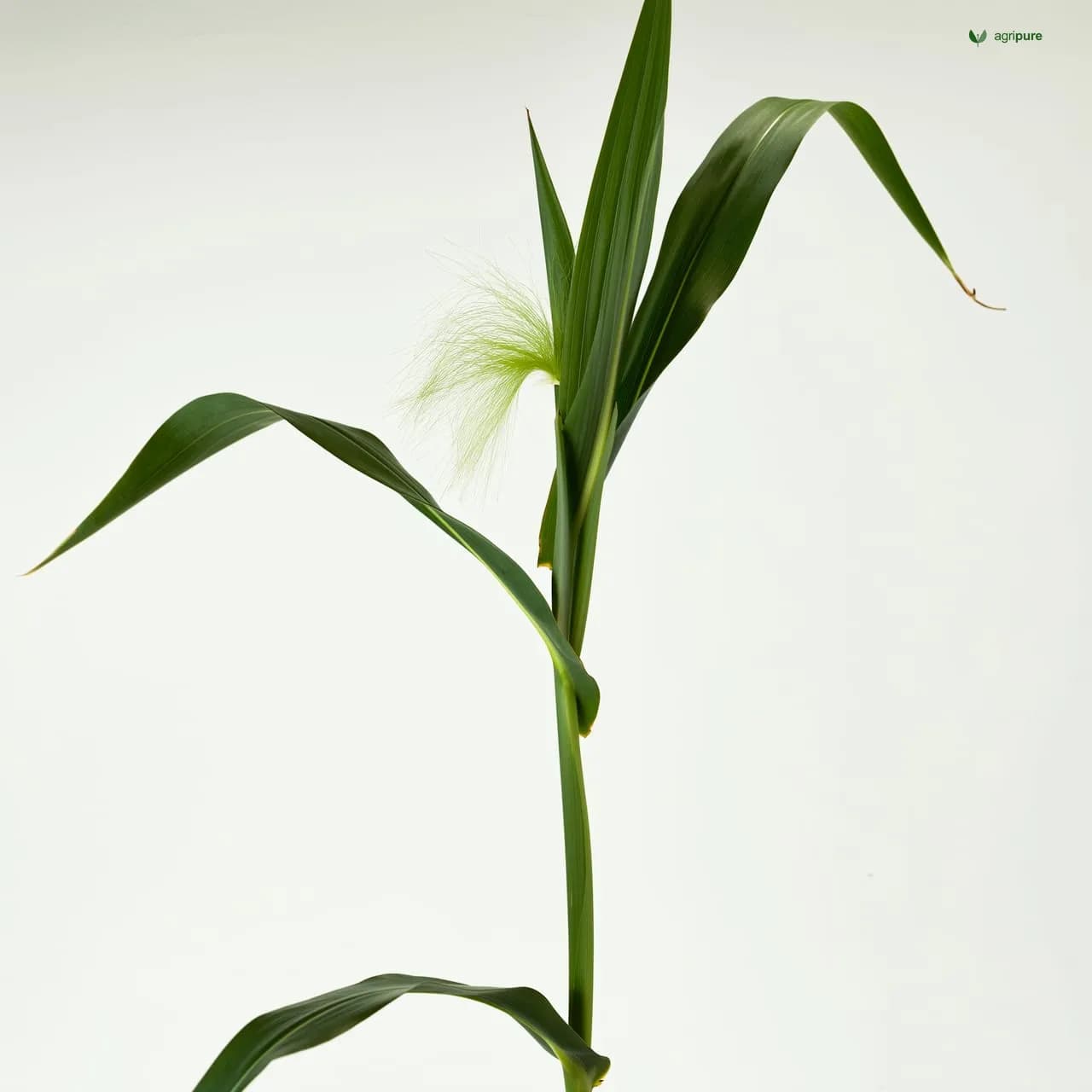
Maize is a robust, erect annual grass, typically 1 to 4 metres tall, growing on a stout jointed stem (the culm) divided into nodes and internodes. Its leaves are large and linear-lanceolate with parallel veins, arising alternately from the nodes; they are usually green but can flush purple or reddish where anthocyanins build up. Below ground it builds a complex fibrous root system: a primary and a few seminal roots come from the embryo, but it is the extensive shoot-borne (adventitious) roots and their laterals that do most of the water and nutrient uptake. The plant carries separate male and female flowers. The male flowers form the terminal tassel at the very top of the stem and shed pollen, while the female flowers sit in lateral ears down in the leaf axils, wrapped in husks, with the silk threads being elongated stigmas that emerge from the ear tip. Each fertilised ear fills with kernels (botanically a caryopsis or grain) borne in rows on a central cob; the kernels are relatively large, often trapezoidal in cross-section, and come in yellow, white, red, blue, and multicoloured types depending on variety.
Growing maize
Maize is propagated exclusively by seed, sown as the kernels themselves; vegetative propagation is not used in normal cultivation. It is a warm-season annual and is frost-sensitive, so it is sown in spring or at the start of the rainy season once the danger of frost has passed, depending on your region. Give it full sun: as a C4 grass its photosynthesis is built for high light, and strong yields depend on it. It grows successfully on a wide range of soils, but yields are strongly shaped by nutrient supply and soil structure, and the crop needs adequate nitrogen, phosphorus, and potassium; a well-developed root system and a healthy rhizosphere of beneficial microbes both improve how efficiently it takes those nutrients up. On water, maize is adapted to warm conditions but is especially sensitive to drought during flowering and grain filling, when water stress sharply cuts yield, so that is the window to keep moisture steady. Maize is normally planted relatively densely in rows; commercial field densities run on the order of tens of thousands of plants per hectare, which gives a sense of how close-set the rows are compared with a sprawling vegetable crop.
Pollination and seed saving
Maize is wind-pollinated: pollen drifts down from the tassel to fertilise the silks on the ears, with each silk leading to one potential kernel. Because pollen travels on the wind, cross-pollination between nearby varieties happens readily, which is the key thing to understand for seed saving. If you want a variety to come true, you need to keep it from sharing pollen with other maize flowering at the same time, whether by distance or by timing, since two patches in bloom together will freely interbreed.
Harvest and uses
Maize is grown above all for its grain. It is primarily edible and non-toxic when properly processed, which is why it sits among the world’s leading cereal crops alongside wheat and rice. The kernels are harvested from the ears once filled, and the range of kernel colours, from yellow and white through red and blue, reflects the diversity of varieties bred for different food, feed, and ornamental uses. Beyond the grain itself, maize is one of the most studied of all crops for the beneficial plant growth-promoting microbes in its root zone, which researchers link to improved water and nutrient use efficiency, so it rewards attention to soil life and a good rotation.
Safety and cautions
Maize is primarily edible and non-toxic when it is properly processed, and that qualifier matters: the research notes that, while the crop is fundamentally a food grain, some parts and preparations carry specific safety considerations. Treat it as the food staple it is, prepare and cook the grain in the normal way, and do not eat plant parts or improperly handled material on the assumption that everything about the plant is freely edible. Beyond that, the sourced research does not document any particular toxin, dosage, or medicinal use, so no medical or therapeutic claims are made here.
Sources
- “Zea mays” (topic overview) – ScienceDirect
- Maize, plant growth-promoting microbes and nutrient/water use efficiency – Frontiers in Nutrition
- “Maize” – Wikipedia
- USDA NRCS. “Zea mays L.” – USDA PLANTS Database
- National Center for Biotechnology Information. Maize root system biology – NCBI / PMC
- Canadian Food Inspection Agency. “The Biology of Zea mays (L.) (Maize)” – CFIA