climax
Almond (Pakistani local)
badaam (بادام)
Prunus dulcis
Also known as Badaam (Pakistan).
- kpk hills
- balochistan highlands
- pothohar
International hardiness
- USDA 7-9
- RHS H5
- AU: Mediterranean, Warm temperate, Cool temperate
Where it grows — regional guide
| Zones / rating | Regional notes |
|---|---|
USDA 7-9 | No region-specific data yet |
| Zones / rating | Regional notes |
|---|---|
H5 (-15 to -10C) | No region-specific data yet |
| Zones / rating | Regional notes |
|---|---|
Mediterranean, Warm temperate, Cool temperate | No region-specific data yet |
| Zones / rating | Regional notes |
|---|---|
USDA 7-9 (USDA scale) Canada uses its own zone system; Canadian zones run roughly one lower than USDA. | No region-specific data yet |
| Zones / rating | Regional notes |
|---|---|
KPK hills, Balochistan highlands, Pothohar | Pakistan:Selected in dry upland valleys of Balochistan and KPK for sweet nuts; seed-grown trees can yield toxic bitter kernels, and nuts can trigger tree-nut allergies. |
The almond (Prunus dulcis) is a small deciduous nut tree native to western Asia, in a belt running from Pakistan across Iran to the eastern Mediterranean, and now cultivated wherever a Mediterranean-type climate occurs. It is grown for its edible seed, the familiar kernel sold as a nut, which sits inside a hard, pitted shell. The locally grown almonds of Pakistan are not a separate botanical form; they are ordinary Prunus dulcis selected and adapted to local conditions, so what holds for the species holds for them. For a homesteader, the appeal is straightforward: a long-lived tree that turns a hot, dry summer and a cool winter into a durable, high-value crop on ground too lean and arid for thirstier fruit.
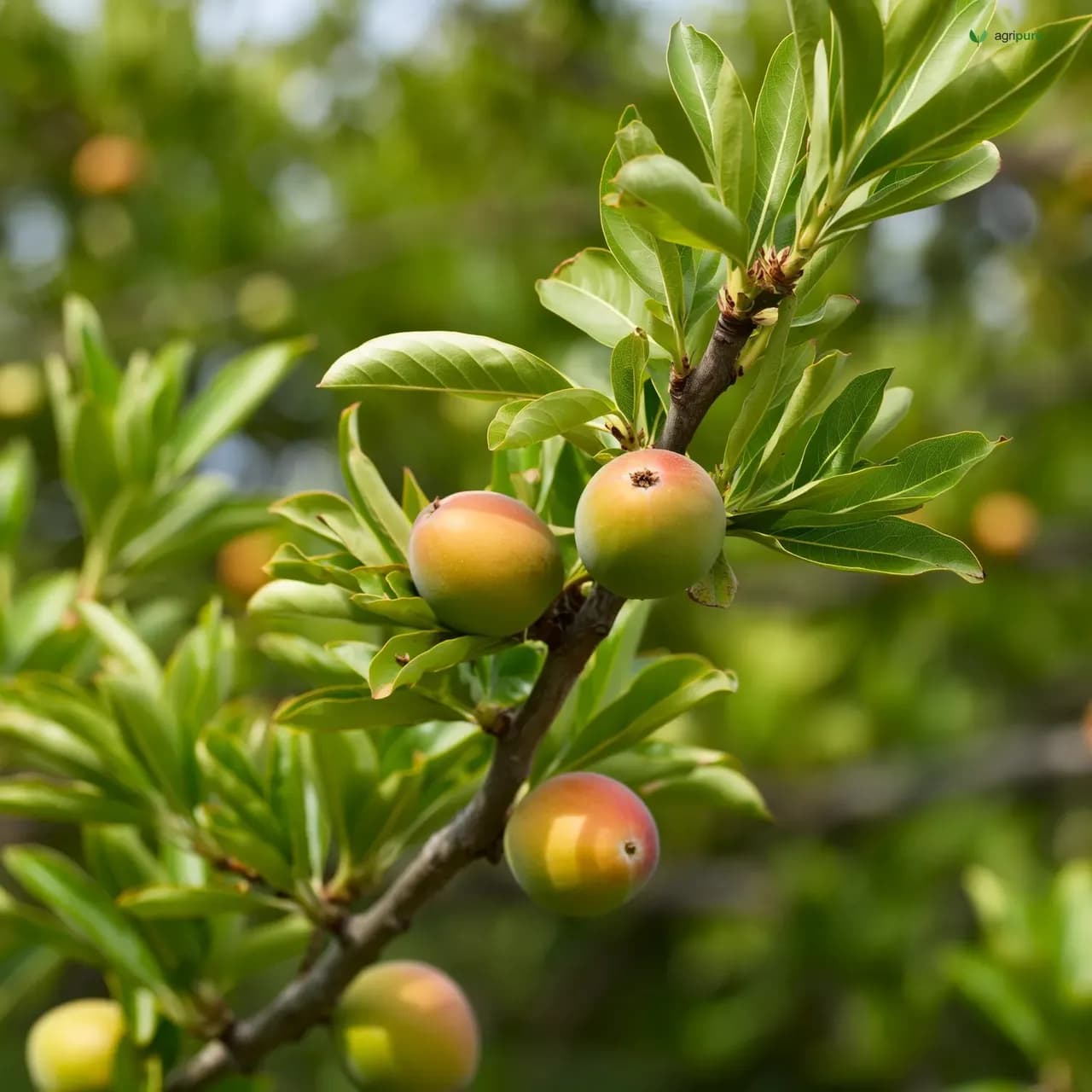
Almond is a small tree, typically 4 to 10 m tall with a trunk up to about 30 cm across, often with a spreading crown; structurally it closely resembles peach, to which it is related. The leaves are lanceolate to oblong-lanceolate, finely serrated, green, and reach roughly 12 cm long, turning an unshowy yellow-green in autumn. Botanically the fruit is a drupe: a green, downy outer hull encloses a layer that dries and splits open at maturity, revealing a hard, pitted shell around the seed. The “almond” we eat is that seed, or kernel, extracted from the shell.
Growing almond
Almond thrives in Mediterranean-type climates with hot, dry summers and cool, relatively dry winters, and it needs a long growing season to ripen its nuts. Primary references place it broadly in **USDA zones 7 to 9**, with one ecology source extending the warmer end to zone 8a to 10b. The limiting factors at each extreme are clear: it dislikes very cold winters (roughly below -15 to -18 degrees C) yet still requires warm, dry conditions to mature a clean crop and avoid disease. The most practical risk is frost timing rather than winter hardiness, because almond flowers very early in spring, before or as the leaves emerge, which leaves the open blossom exposed to late frosts.
For planting material there are two routes. Orchard trees are usually grafted, a named cultivar worked onto a rootstock (often peach or almond stock) chosen for vigor and soil adaptation. The species can also be grown from seed, but seedlings are variable and may not match the parent, and a proportion come up bitter, which is a toxicity concern covered below.
On soil, almond does best in deep, fertile, well-drained loams and clearly prefers sandy, free-draining ground; it performs poorly on heavy clays. It is tolerant of acid, neutral, and basic (alkaline) soils, and will grow on light, medium, or even heavy soils provided drainage is good, though its best performance comes on well-drained sandy loams. Give it an open, sunny position to suit its need for warmth and a long, dry ripening season. Detailed spacing and time-to-harvest figures are not consistently given in the general botanical sources here, so they are left out rather than stated with false precision.
Pollination
Pollination is the single decision that most often makes or breaks an almond crop. The flowers are hermaphrodite and insect-pollinated, chiefly by bees. Most commercial almonds are self-incompatible, meaning a tree cannot set a useful crop with its own pollen and needs cross-pollination from a different, compatible cultivar flowering at the same time; some cultivars are self-fertile, but these are the exception. In practice this means planting at least two compatible varieties together and ensuring active bees are present while the trees are in bloom.
Harvest and uses
The harvest is the kernel inside the shell, reached once the drupe matures and the outer layer dries and splits to expose the hard endocarp. That kernel, eaten as a nut, is the entire reason the tree earns its place: it is grown for the edible seed across its native range and in every Mediterranean-climate region where it is now cultivated, from southwest and central Asia to southern Europe, North Africa, and California. Because the tree is long-lived and the crop is high-value, almond suits a homestead as a slow but durable orchard tree rather than a quick annual return.
Safety and cautions
Almond carries one genuine safety point worth understanding before you grow it from seed. While the sweet cultivated kernel is the familiar edible nut, a proportion of seed-grown trees produce bitter kernels, which are toxic. The reliable way to avoid this is to plant a known sweet cultivar (typically grafted) rather than gambling on unselected seedlings, and to treat any bitter-tasting kernel as something not to eat. Beyond that, the sweet kernel is a common food and, as with any nut, can trigger reactions in people with tree-nut allergies, so introduce it with the usual caution. This profile makes no medical claims about the plant.
Sources
- Prunus dulcis (Almond) – Missouri Botanical Garden
- Prunus dulcis – Balkan Ecology Project
- Almond – Wikipedia
- Nutritional Characteristics of Almond – Researchers Links (Pakistan Journal of Agricultural Research)
- Almond (Food Science topic overview) – ScienceDirect
- Almond (Prunus dulcis) review – PMC (National Library of Medicine)
- Prunus dulcis (almond) datasheet – CABI Compendium
- Almond (Prunus dulcis) cultivation and biology – IntechOpen