Key takeaways
- Divide most perennials every three to five years to boost vigor and bloom production.
- Time division based on bloom season: spring for summer/fall bloomers, fall for spring bloomers.
- Use sharp tools like a spade or garden fork to minimize root damage during separation.
- Replant divisions promptly to ensure proper spacing and consistent watering for the first six weeks.
- Not all perennials benefit from division; some, like peonies, prefer to remain undisturbed for decades.
- Expect to multiply a single mature plant into two to five new plants, depending on its size and type.
Quick answer: Dividing perennials involves separating mature plants into smaller sections to create new plants, boost vigor, and increase bloom production. This practice is typically done in spring or fall, using sharp tools to minimize root damage.
Across many US gardens, from USDA zone 4 to 9, dividing perennials is a time-honored practice that offers substantial rewards. Gardeners in states like Ohio and Pennsylvania often find they can double or even triple their plant stock without spending a dollar, simply by splitting existing plants [1]. This method saves money and rejuvenates mature plants so they continue to thrive and produce abundant blooms year after year.
A mature clump of daylilies, for instance, can yield three to five new plants from a single purchase over a few seasons. The following sections explain when and how to divide various perennials to keep beds full and productive.
Why divide your perennials?
Many gardeners in the Midwest, especially those in USDA zone 5, notice their mature perennials, like hostas or daylilies, becoming less vigorous over time. A healthy clump of daylilies might produce 20 to 30 blooms in its first few years, but after five to seven seasons, that number can drop to 10 or 15 [3]. This decline often signals that the plant is overcrowded, with too many stems competing for limited nutrients and water in the soil. Dividing these plants addresses this issue directly, providing more space and resources for each section to grow robustly, potentially increasing bloom count by 50% in the following season.
Signs your perennials need dividing
Beyond reduced flowering, other indicators suggest a perennial needs dividing. You might observe a large, dense clump with a “doughnut hole” in the center where growth has died out, a common sight with plants like ornamental grasses after four to six years. This central die-out can leave a bare patch 6 to 12 inches across. Another sign is when the plant’s size begins to overwhelm its neighbors or encroach on pathways, requiring frequent pruning to keep it in check; for example, a mature clump of coneflowers can spread 24 inches wide, potentially overshadowing smaller plants nearby. Dividing these plants can also help manage the spread of aggressive varieties, keeping them within their designated garden areas and preventing them from taking over a 3-foot by 3-foot bed. This practice is supported by research indicating that regular division can extend the productive life of many perennials by 10 to 15 years [1].
- Reduced flower production, sometimes by 50% or more.
- A noticeable bare spot or “doughnut hole” in the center of the plant.
- Overall weaker growth or smaller leaves compared to previous years.
- The plant is outgrowing its allocated space, spreading 12 to 18 inches beyond its original footprint.
- Signs of pest or disease issues becoming more frequent due to stress.
Timing your perennial division
Timing directly affects perennial division and how quickly the plant recovers and establishes new roots. Most perennials are best divided during their dormant or semi-dormant periods, typically in spring or fall. In regions like the Pacific Northwest, where spring arrives early, gardeners in USDA zone 8 might start dividing as early as late February, while those in colder USDA zone 4 states like Minnesota might wait until April or May [2]. The general rule is to divide spring-blooming plants in the fall and summer or fall-blooming plants in the spring, aiming for temperatures between 45 and 65 degrees Fahrenheit for optimal root development.
Spring division for summer and fall bloomers
For plants that bloom from summer through fall, such as coneflowers, hostas, and ornamental grasses, spring is the ideal time for division. This should occur when new growth is just beginning to emerge, usually reaching 2 to 6 inches in height, before the plant expends significant energy on flowering [2]. Dividing at this stage allows the plant to focus its energy on root development in the cooler, moister spring soil, minimizing transplant shock by up to 25%. For instance, a mature clump of daylilies, which typically blooms in July, can be safely divided in April in USDA zone 6, giving it 10 to 12 weeks to establish before summer heat. Fall division, for spring bloomers like bearded iris, should be completed at least six weeks before the first hard frost, typically by mid-October in USDA zone 5, to allow roots to anchor before winter dormancy.
- Spring: For summer and fall bloomers (e.g., hostas, daylilies, astilbe). Divide when new growth is 2-6 inches tall.
- Fall: For spring bloomers (e.g., bearded iris, primrose). Divide six weeks before the first hard frost.
- Summer: Generally avoid, unless absolutely necessary and with careful aftercare.
- Winter: Avoid, as frozen ground makes division impossible and plants are fully dormant.
- Year-round: Some hardy plants like sedum can tolerate division almost any time, but spring or fall is still preferred for best results.
Tools and techniques for dividing perennials
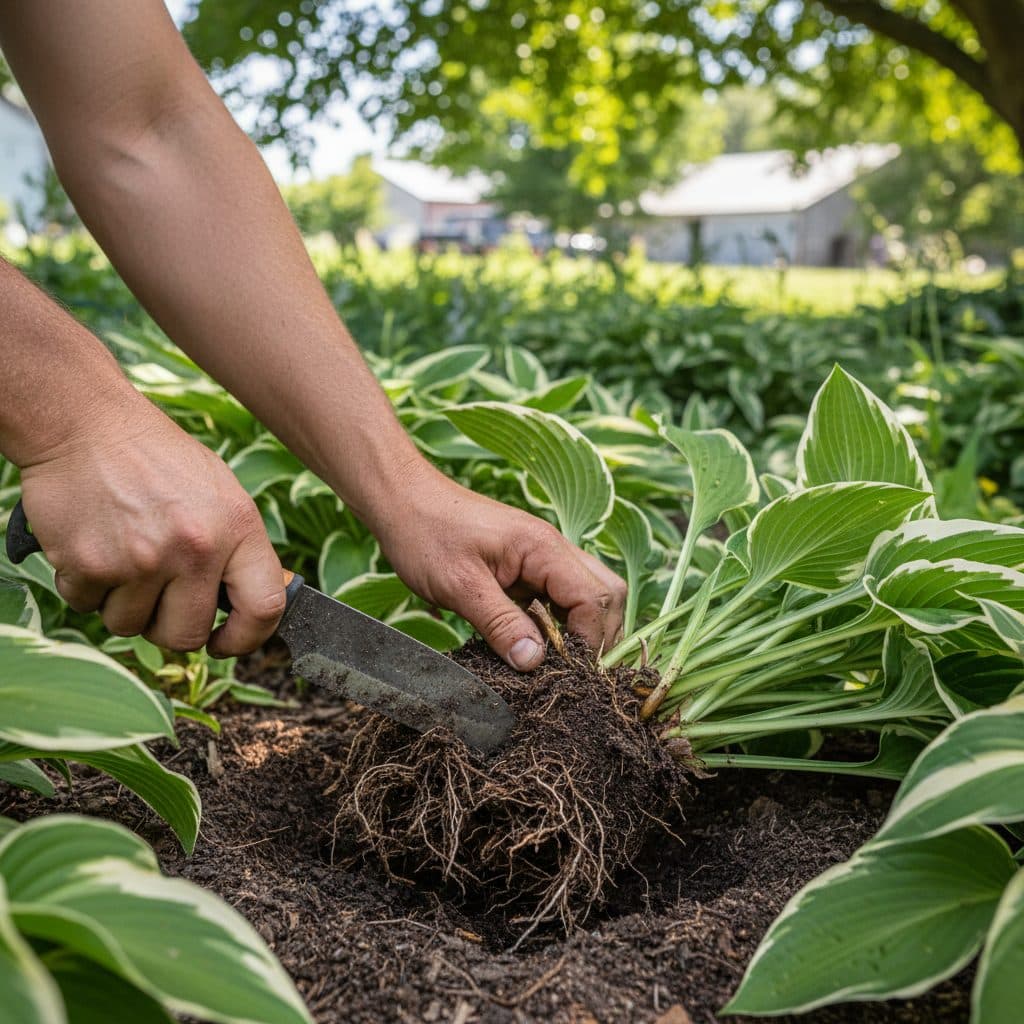
Before you begin, gather the right tools to make the division process efficient and minimize stress on your plants. A sharp spade or garden fork is essential for lifting the plant, while a hori hori knife or a sturdy knife is helpful for separating smaller clumps. In areas with dense clay soil, common in parts of the Northeast, a digging fork can be particularly effective for loosening the soil around the root ball, which might be 18 inches or more in diameter [6]. Having a tarp or wheelbarrow nearby is also useful for holding the lifted plant and any excess soil, preventing roots from drying out for more than 30 minutes.
The division process step-by-step
First, water the plant thoroughly one to two days before division to hydrate the roots, making them more pliable and reducing shock by up to 20%. Next, use your spade or fork to carefully dig around the perimeter of the plant, about 6 to 8 inches from the base, creating a circle. Gently pry the entire root ball from the ground. For large, fibrous root systems like those of ornamental grasses, you might need to use two garden forks inserted back-to-back to leverage the clump apart, which can be 12 to 18 inches across. Smaller plants, such as coral bells, can often be pulled apart by hand or cut with a sharp knife. Aim for divisions that have at least three to five healthy shoots and a substantial root system, typically 4 to 6 inches in diameter to ensure a high success rate of 80% or more. For plants like hostas, which can be quite dense, a sharp knife can cleanly cut through the crown to ensure each division has a good portion of the root system.
- A sharp spade or digging fork for lifting.
- A hori hori knife or sturdy kitchen knife for cutting through roots.
- Gloves to protect your hands from soil and plant sap.
- A tarp or wheelbarrow for holding plant material and soil.
- A bucket of water to keep roots moist if replanting is delayed by more than 30 minutes.
Replanting divisions and ensuring establishment
Once your perennial has been divided, replant promptly to minimize root stress. Prepare the new planting sites by amending the soil with 2 to 4 inches of compost, especially in areas with poor drainage or heavy clay, common in parts of the Southeast, to improve soil structure by up to 50%. Dig holes that are twice as wide as the root ball of your division and just as deep to ensure the crown of the plant sits at the same level as it did in its original location. For instance, a hosta division with a 6-inch root spread will need a hole roughly 12 inches wide and 6 inches deep to accommodate its root system properly.
Post-division care for new plants
After placing the division in its new home, backfill with soil, gently firming it around the roots to remove air pockets. Water thoroughly immediately after planting, providing at least one gallon of water per plant to settle the soil. Consistent watering is important for the first four to six weeks, especially in USDA zones 7 and 8 where temperatures can rise quickly to 80 degrees Fahrenheit or more. Aim for 1 to 2 inches of water per week, either from rainfall or irrigation, to encourage strong root development [3]. Applying a 2-inch layer of mulch around the base of the plant can help retain soil moisture and regulate soil temperature, reducing the need for frequent watering by up to 30%. You can also use a soil moisture meter to accurately gauge soil hydration to ensure the top 2 to 3 inches of soil remain consistently moist.
- Prepare planting holes before dividing the parent plant.
- Ensure new sites have well-draining soil, potentially amending with 2-4 inches of compost.
- Plant divisions at the same depth as the original plant, with the crown at soil level.
- Water deeply immediately after planting, providing 1-2 gallons per division.
- Monitor soil moisture closely for the first six weeks, especially during dry spells.
Dividing specific perennial types
While many perennials benefit from division, some species respond better than others, and a few prefer to be left undisturbed. Hostas are excellent candidates for division, often producing two to three new plants from a mature clump every three to four years. Their fibrous root systems make them relatively easy to separate by hand or with a sharp knife, often yielding divisions with 4 to 6 inches of root mass. Daylilies also divide readily, often every three to five years, and can be split into multiple fans, each capable of growing into a full plant that blooms within one to two seasons. Ornamental grasses, like ‘Karl Foerster’ feather reed grass, typically need division every three to five years to maintain their vigor and prevent central die-out, which can occur after five to six seasons [3].
Plants to divide and plants to leave alone
For hostas and daylilies, spring division is usually preferred, when new shoots are 4 to 6 inches tall. With ornamental grasses, you might need a sturdy spade or even a saw for very dense root balls, which can be 18 inches in diameter and weigh 20 pounds or more. On the other hand, some perennials, such as peonies, columbine, and delphiniums, generally dislike division and can take several years to recover, often delaying flowering for two to three seasons [4]. Peonies, in particular, can live for 50 years or more without needing division, thriving when left undisturbed. Always research the specific needs of your plant before attempting division to ensure success, aiming for an 85% or higher success rate. For starting new plants from scratch, consider seed starting for beginners or exploring propagation trays.
- Hostas: Divide in early spring when shoots are 2-4 inches tall. Expect 2-3 new plants per division.
- Daylilies: Divide in early spring or early fall. Each fan can become a new plant.
- Bearded Iris: Divide in late summer, 4-6 weeks after flowering, replanting rhizomes with exposed tops.
- Ornamental Grasses: Divide in spring as new growth appears. May require a sturdy spade or saw for dense clumps.
- Coneflowers (Echinacea): Divide in spring or fall, every 3-4 years to maintain vigor.
Common perennials: division timing and frequency
Plant type | Ideal division time | Frequency (Years) | Notes |
|---|---|---|---|
Hostas | Early Spring | 3-4 | Divide when new shoots are 2-4 inches tall. |
Daylilies | Early Spring or Early Fall | 3-5 | Each fan can become a new plant. |
Bearded Iris | Late Summer (4-6 weeks post-bloom) | 3-5 | Replant rhizomes with tops exposed. |
Ornamental Grasses | Early Spring | 3-5 | May require sturdy tools for dense clumps. |
Coneflowers (Echinacea) | Spring or Fall | 3-4 | Helps maintain vigor and bloom size. |
Peonies | Never / Rarely | 20+ | Dislike disturbance; can take 2-3 years to re-establish. |
Free Plants: Dividing a single mature perennial can yield two to five new plants, saving $20 to $100 on nursery purchases.
Rejuvenate Growth: Overcrowded perennials often see a 50% reduction in bloom count; division can restore 100% vigor within one season.
Frequently asked questions
How often should I divide perennials?
Most perennials benefit from division every three to five years to maintain vigor and bloom production. Some fast-growing varieties, like certain ornamental grasses, might need division every two years, while slow growers can go five to seven years.
What are the best tools for dividing perennials?
Essential tools include a sharp spade or garden fork for lifting, and a sturdy knife or hori hori knife for separating roots. For very dense clumps, two garden forks used back-to-back can provide the necessary leverage, especially for root balls over 12 inches in diameter.
Can I divide perennials in the summer?
Dividing perennials in summer is generally not recommended due to heat stress, which can significantly reduce success rates by up to 40%. If unavoidable, provide ample water, shade, and consistent aftercare for at least six weeks.
How many new plants can I get from one division?
A single mature perennial can typically yield two to five new plants, depending on its size and type. A large hosta clump, for example, might be divided into three to four viable sections, each growing into a full plant within a season.
What should I do if my divided perennial looks stressed?
If a newly divided perennial shows signs of stress, such as wilting, ensure it receives consistent moisture, about 1 to 2 inches of water per week. Provide temporary shade during the hottest parts of the day, and avoid fertilizing for the first six weeks to allow root establishment.
Are there any perennials I should not divide?
Yes, some perennials, such as peonies, delphiniums, and Baptisia, prefer to be left undisturbed. Dividing them can set them back for two to three years, delaying flowering and potentially weakening the plant significantly.
References
- Multiplying and Dividing Irrationally (2021). Multiplying and Dividing Irrationally.
- How Come We Multiply by Dividing? (2025). How Come We Multiply by Dividing?.
- Perennials (2012). Perennials.
- Delphinium, perennials, rock plants, evergreens, shrubs, bedding plants, garden aids, landscaping / (1932). Delphinium, perennials, rock plants, evergreens, shrubs, bedding plants, garden aids, landscaping /.
- 1932, hardy perennials, rock plants, annuals, gladioli, vegetable plants, cut flowers / (1932). 1932, hardy perennials, rock plants, annuals, gladioli, vegetable plants, cut flowers /.
- New handbook for standardised measurement of plant functional traits worldwide (2013). New handbook for standardised measurement of plant functional traits worldwide.