secondary
Plum — Satsuma
aloo bukhara — Satsuma (آلو بخارا)
Prunus salicina cv. Satsuma
- pothohar
- kpk hills
International hardiness
- USDA 5-9
- RHS H6
- AU: Cool temperate, Warm temperate, Mediterranean
Where it grows — regional guide
| Zones / rating | Regional notes |
|---|---|
USDA 5-9 | A low-chill Japanese blood plum grown across USDA zones 5 to 9 in full sun; it requires a compatible Japanese plum pollinizer nearby to set good crops of red-fleshed fruit. |
| Zones / rating | Regional notes |
|---|---|
H6 (-20 to -15C) | No region-specific data yet |
| Zones / rating | Regional notes |
|---|---|
Cool temperate, Warm temperate, Mediterranean | Grown in cool-temperate, warm-temperate and Mediterranean orchards on modest chill; pair it with another Japanese plum cultivar to ensure consistent fruit set. |
| Zones / rating | Regional notes |
|---|---|
USDA 5-9 (USDA scale) Canada uses its own zone system; Canadian zones run roughly one lower than USDA. | No region-specific data yet |
| Zones / rating | Regional notes |
|---|---|
Pothohar, KPK hills | Pakistan:Cultivated in higher Pothohar and KPK hill orchards where modest winter chill triggers flowering; plant alongside another Japanese plum for cross-pollination. |
The Satsuma plum (Prunus salicina cv. ‘Satsuma’) is a low-chill Japanese plum cultivar prized for its dark red “blood plum” flesh, mid-season harvest, and reliable cropping in mild-winter climates. The parent species, Prunus salicina, is the Japanese plum, native to Japan and more broadly to East Asia. The cultivar itself traces to material that the breeder Luther Burbank received from Yokohama, Japan, in 1885; he named it for the Japanese province of Satsuma, sold buds under the name “Blood Plum of Satsuma” in 1887, and the first trees were sold in 1889.2 It later became an important parent of other plums, including the cultivar ‘Mariposa’. For the home grower in a mild-winter region, Satsuma is the rare plum that fruits dependably on modest chill while delivering a deeply colored, richly flavored fruit that is as good for preserving as it is for fresh eating.
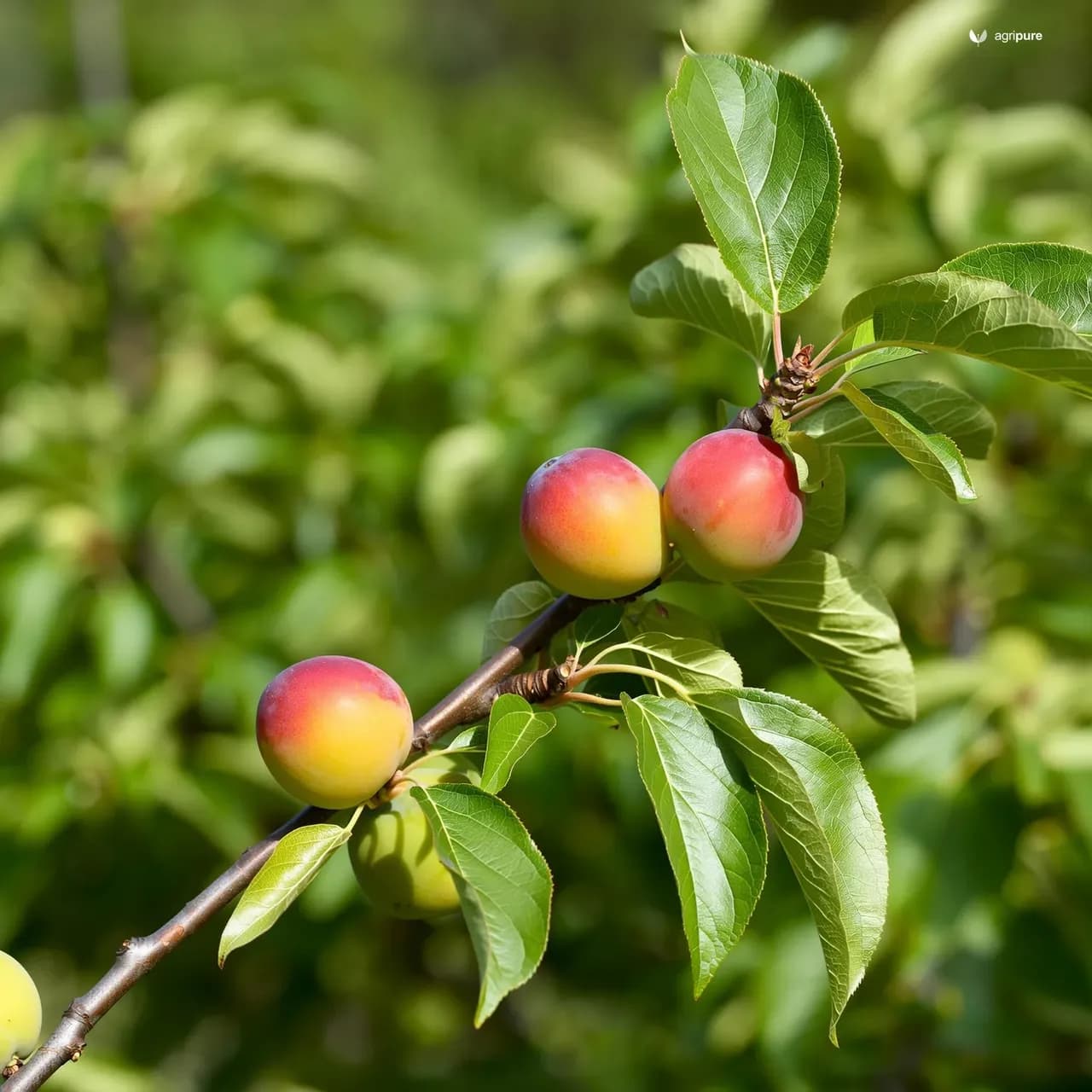
Satsuma is a deciduous, perennial fruit tree with a medium-to-large, upright-spreading, vigorous habit; it tends to be moderately productive and bears heavier crops as it ages. Reported mature dimensions vary with pruning and age: many nurseries cite roughly 12 to 15 feet tall and wide, others 15 to 20 feet, and some listings of older or unpruned trees reach 25 to 30 feet. The fruit is small to medium and round to slightly flattened, about 6 to 7 cm across. Its skin is a mottled dull red over green, somewhat tough, and can be bitter, while the flesh is deep dark red, firm, and juicy, with a rich, almost almond-like flavor that is sweet with balanced acidity. The pit is small and the fruit is semi-clingstone to semi-freestone; the dark red flesh is what earns it the “blood plum” name.
Growing Satsuma plum
Satsuma is supplied commercially as a grafted tree on plum rootstock, the nursery standard for Japanese plums, though the sources do not name specific rootstocks. It needs full sun for best growth and fruiting, and it requires well-drained soil; recommendations favor amended, well-drained ground and specifically warn against planting in rock mulch, which can impair root health and the soil’s moisture balance. Water needs are described as regular to moderate: like any orchard plum it wants consistent watering during establishment and through fruit development, though the sources do not give exact irrigation intervals. Because mature spreads run from about 12 to 20 feet, trees should be spaced to accommodate that eventual canopy.
Satsuma is adapted to areas with low winter chill and is popular in southern California; it needs only about 300 to 400 hours of cool temperatures to fruit, which is why it is grown chiefly in mild-winter regions of Australia, Europe, and the United States, California especially. It is reported cold-hardy to roughly USDA zones 5 to 10, while individual nursery listings commonly recommend zones 5 to 9 or 6 to 8 for landscape use.
Pollination
Satsuma is listed as partially self-compatible, but yields improve markedly with cross-pollination, and several sources simply state that it requires a pollinator for best crops. The recommended pollenizers are other Japanese plum cultivars, including ‘Beauty’, ‘Burbank’, ‘Methley’, ‘Santa Rosa’, ‘Shiro’, ‘Toka’, and ‘Wickson’. A common nursery instruction is to pair Satsuma with ‘Santa Rosa’, so planting a compatible Japanese plum nearby is the simplest way to secure a full set.
Harvest and uses
Satsuma is a mid-season Japanese plum whose appeal is the fruit itself: small-to-medium, round blood plums with firm, deep red, juicy flesh and a rich, almond-like, sweet-tart flavor. The skin’s mottled dull-red-over-green color, slightly tough texture, and occasional bitterness contrast with the sweet interior, and the small semi-clingstone pit makes the fruit easy to work with for eating fresh and for the kitchen. The tree is moderately productive and grows more generous as it matures, so an established, well-pollinated Satsuma rewards patience with progressively heavier crops. The sources describe it as a dessert and culinary plum rather than attributing any medicinal or material use to it.
Sources
- “Satsuma Plums” – Specialty Produce
- “Prunus Cultivar: Satsuma” – UC Davis Foundation Plant Services
- “Prunus salicina Satsuma Plum” – Dragonfly Farm
- “Plum Satsuma” – Devil Mountain Wholesale Nursery
- “Satsuma Plum” – Star Nursery