pioneer
Mustard Greens
sarson saag
Brassica juncea
Also known as Brown Mustard (United States), Rai (India), Sarson Saag (Pakistan), Leaf Mustard (UK & Ireland), Indian Mustard (Australia).
- punjab plains
- pothohar
- kpk hills
International hardiness
- USDA 6-11
- RHS H4
- AU: Cool temperate, Warm temperate, Subtropical, Mediterranean
Where it grows — regional guide
| Zones / rating | Regional notes |
|---|---|
USDA 6-11 | Grown as a fast cool-season salad and cooking green; manage seedheads to prevent weedy escape, and avoid concentrated seed extracts. |
| Zones / rating | Regional notes |
|---|---|
H4 (-10 to -5C) | Hardy under RHS H4: direct-sow in spring and autumn for spicy greens; prevent unchecked seeding to stop weedy spread on allotments. |
| Zones / rating | Regional notes |
|---|---|
Cool temperate, Warm temperate, Subtropical, Mediterranean | Grown as an autumn and winter leafy green across temperate zones; control seeding to prevent it escaping as an agricultural weed. |
| Zones / rating | Regional notes |
|---|---|
USDA 6-11 (USDA scale) Canada uses its own zone system; Canadian zones run roughly one lower than USDA. | No region-specific data yet |
| Zones / rating | Regional notes |
|---|---|
Punjab plains, Pothohar, KPK hills | Pakistan:Grown across the plains and hills during winter for pungently flavoured leaves and oilseed; prevent seed from scattering to stop weedy escape, and note concentrated seed extracts affect thyroid function. India:A primary rabi oilseed and leafy vegetable across northern plains; manage seedheads to prevent it becoming an agricultural weed, and note concentrated seed preparations alter thyroid metabolism. |
Grows alongside
Species that appear with Mustard Greens in 24 of our published guides — a starting list for a guild, not a planting plan.
Mustard greens (Brassica juncea) are a cool-season leaf and seed crop in the mustard and cabbage family, Brassicaceae, grown around the world for their pungent edible leaves and, in seed form, for condiment mustard and oil. The species traces to Central Asia and the Himalayan region, with early domestication in India and China, and it is now naturalized far beyond that range. It also goes by brown mustard, Chinese mustard, Indian mustard, leaf mustard, Oriental mustard and vegetable mustard. For a homesteader it earns its bed twice over: a fast, forgiving green to direct-sow in cool weather, and, grown on longer, the source of the seed behind table mustard, with a useful turn as a cover crop too.
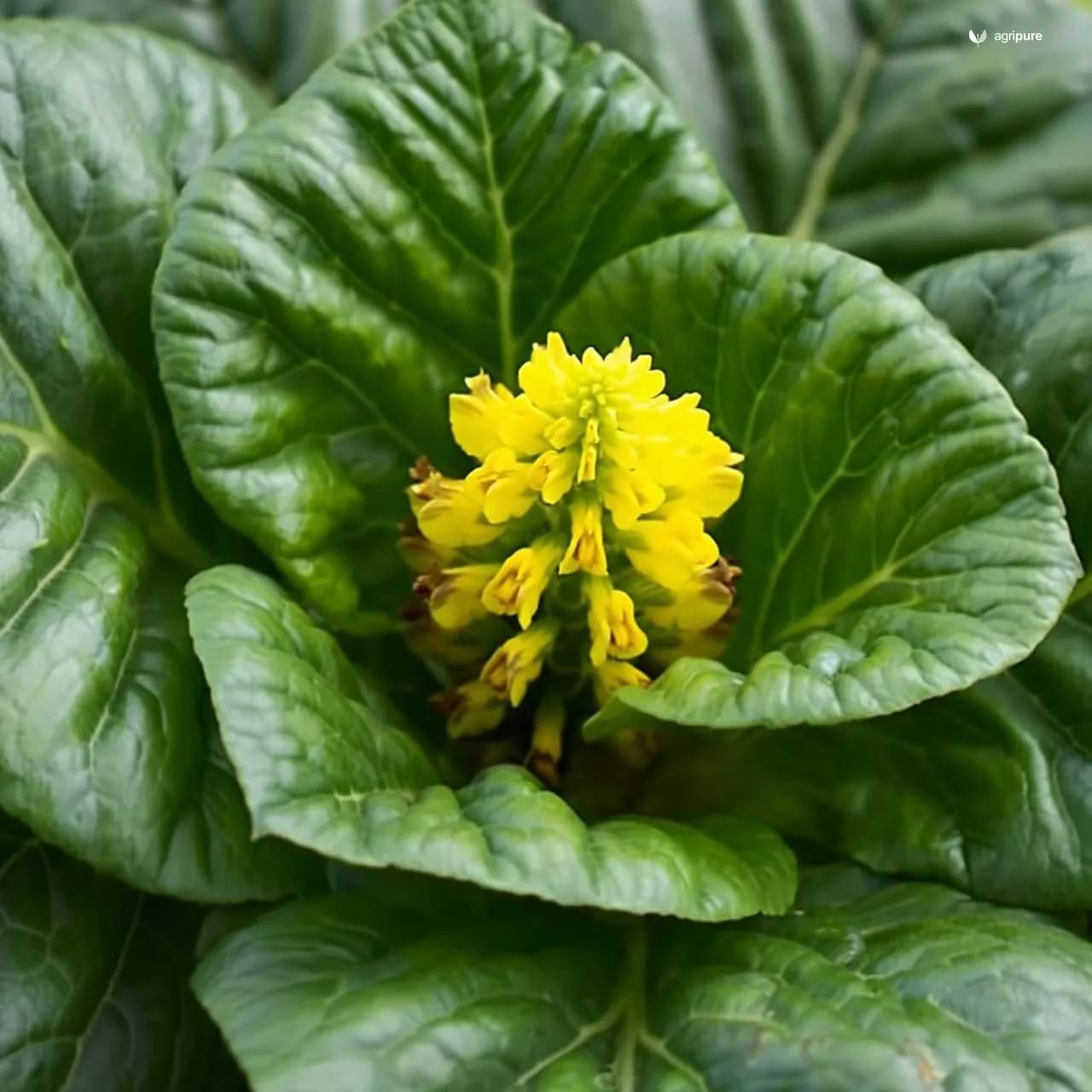
Most horticultural sources describe it as an annual herb, though agronomic references note it can behave as a perennial that is cultivated as an annual or biennial. It is an upright plant, typically in the range of about 0.3 to 1 metre tall depending on variety and conditions. The leaves are the headline feature: large and generally a dark green colour, but they “vary considerably in shape” from one type to the next. Cultivated leaf forms range from curled, crisped leaves and large wavy-margined leaves to oblong leaves with narrow forward-pointing lobes and leaves cut into thread-like lobes. Like other mustards it carries small four-petalled yellow flowers, which give way to small, round, brown to dark-brown seeds used for condiment mustard and oil. Because it closely resembles other mustards, confident identification usually means checking leaf form together with seed or pod characters, or comparing against a local flora.
Growing mustard greens
Mustard greens are propagated by seed, sown directly where they are to grow rather than transplanted. For a leaf crop, commercial growers use roughly 3 to 4 pounds of seed per acre, while seed crops grown for condiment mustard are sown more thickly at about 5 to 7 pounds per acre. Seed is sown shallow, around half an inch to one inch (roughly 1 to 1.5 cm) deep for quick, even emergence, after which seedlings are thinned to their final in-row spacing.
The crop will grow on a wide variety of soils but does best on a well-drained loam with good organic matter. For mustard greens specifically, a soil pH of 6.0 to 6.8 is recommended for top yields. As a cool-season Brassica it tolerates light frosts and is grown across both temperate and subtropical climates as a fall-to-spring crop rather than a summer one. Rather than a fixed USDA hardiness zone, the practical guide is temperature: the plant is widely grown wherever the annual mean temperature is above about 43°F (6°C), and most extension guidance treats it as a cool-season annual vegetable slotted into the mild shoulders of the year. Figures for plant spacing, watering and exact time to maturity are not consistently documented in the sources here, so they are left out rather than stated with false precision; in practice, sow into the cool season, thin to give each plant room, and harvest the leaves young.
Harvest and uses
Mustard greens are grown chiefly for their pungent leaves, which are eaten cooked or raw and are a familiar green across many cuisines. Grown on for seed, the same species supplies the small brown seeds pressed for oil and ground or processed into condiment mustard, which is why a single planting can serve both the kitchen and the pantry. Beyond food, B. juncea is valued as a cover crop and used in phytoremediation, where its capacity to take up contaminants helps clean affected soils. The general sources here give no reliable per-plant or per-bed yield figure, so none is invented: in short, it is a quick, high-turnover green for the cool season and a dual-purpose plant if you let part of the crop run to seed.
Distribution and a note on weediness
From its Central Asian and Himalayan origin the species has spread widely: it was introduced to North America from Eurasia and is now recorded in every U.S. state. That vigour has a flip side. It is listed as invasive in some midwestern U.S. states, so a grower where it readily escapes should be mindful about letting plants set and shed seed unchecked, particularly when growing it on for seed.
Safety and cautions
As a leafy vegetable, mustard greens are generally safe to eat when cooked and consumed in normal food amounts. The caution attaches to concentrated forms rather than the salad bowl: like other brassicas, the plant contains glucosinolates, and concentrated seed preparations and medicinal uses warrant more care because of potential effects on the thyroid and on drug metabolism. This profile makes no medical claims and gives no dosages; anyone considering concentrated seed or medicinal preparations, especially if pregnant, breastfeeding or taking prescription medication, should seek qualified guidance first. Eaten as a vegetable, though, mustard greens are simply a sharp, nutritious cool-season green.
Sources
- Brassica juncea – Missouri Botanical Garden, Plant Finder
- Brassica juncea (Mustard Greens) – NC State Extension, Plant Toolbox
- Mustard Greens and Condiment Mustard – Oregon State University Extension
- Brassica juncea – Wikipedia
- Brassica juncea (Chinese Mustard) – University of Florida IFAS Extension
- Brassica juncea – ScienceDirect Topics