pioneer
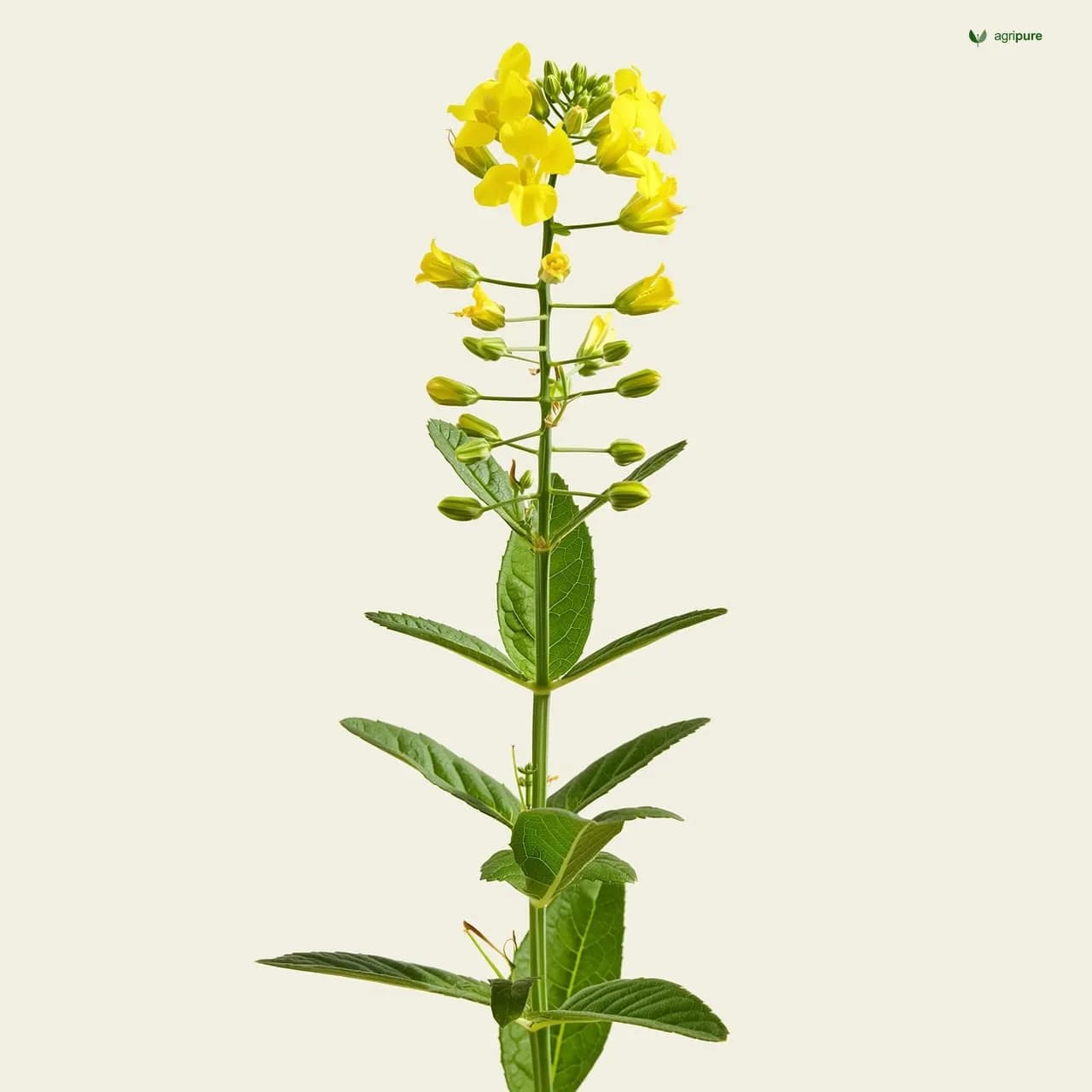
Black Mustard
raee
Brassica nigra
Also known as Raee (Pakistan).
- punjab plains
- pothohar
- kpk hills
International hardiness
- USDA 5-10
- RHS H5
- AU: Warm temperate, Cool temperate, Mediterranean, Arid / semi-arid
Where it grows — regional guide
| Zones / rating | Regional notes |
|---|---|
USDA 5-10 | Listed as a noxious weed in several states; harvest seed pods before shattering to prevent aggressive invasion, and mind skin irritation. |
| Zones / rating | Regional notes |
|---|---|
H5 (-15 to -10C) | Hardy under RHS H5 for cool-season seed production; harvest pods before they shatter to prevent weedy colonisation, and mind skin irritation. |
| Zones / rating | Regional notes |
|---|---|
Warm temperate, Cool temperate, Mediterranean, Arid / semi-arid | Grown as an autumn-sown annual for pungent seeds; prevent volunteer seeding to avoid weedy spread, as crushed seeds irritate mucous membranes. |
| Zones / rating | Regional notes |
|---|---|
USDA 5-10 (USDA scale) Canada uses its own zone system; Canadian zones run roughly one lower than USDA. | Regulated as an invasive agricultural weed across parts of Canada; collect seed heads before shattering, as crushed seeds irritate skin. |
| Zones / rating | Regional notes |
|---|---|
Punjab plains, Pothohar, KPK hills | Pakistan:Grown as a winter rabi spice crop across the plains; harvest before pods shatter to limit weedy spread, and beware irritant crushed seeds. |
Grows alongside
Species that appear with Black Mustard in 2 of our published guides — a starting list for a guild, not a planting plan.
Black mustard (Brassica nigra) is an annual herb in the cabbage family (Brassicaceae), grown for its pungent dark seeds and edible young greens. It is native to the cooler regions of North Africa, temperate Europe, and parts of Asia, with its early centres of cultivation generally placed in the Middle East, southern Europe, or southern Asia. For a homesteader it is a fast, undemanding cool-season crop: sow it on disturbed, fertile ground and it returns mustard seed for the kitchen, tender greens for the table, and a froth of yellow bloom that pulls in pollinators before bolting and setting seed. The same vigour that makes it useful also makes it weedy, so it pays to know the plant before you turn it loose.
It is a tall, branching annual, usually 40 to 80 cm in wild European stands but capable of reaching 0.6 to 2.4 m (2 to 8 ft) under favourable conditions. The stems are erect and often much-branched, hairy toward the base and nearly hairless higher up. Lower leaves are large (to about 25 cm), stalked, and divided into three to five lobes with a noticeably larger terminal lobe; the upper leaves are smaller and less deeply cut. The small, bright-yellow, four-petalled flowers form the cross typical of the family and are carried in elongating racemes at the stem tips. These give way to slender seed pods (siliques) holding small seeds that ripen dark brown to black. The plant has a fibrous root system that generally does not exceed about a metre in depth. Crushed foliage gives off a distinct mustard or horseradish odour, a quick way to confirm identity in the field.
Growing black mustard
Black mustard is propagated by seed; no reliable vegetative methods are documented for ordinary cultivation. Its seeds readily germinate in disturbed ground and along field edges, roadsides, and floodplains, which tells you most of what you need about its needs. In Mediterranean climates it commonly behaves as a winter annual, germinating with the cool, rainy season and flowering in late spring; in temperate gardens it is grown as a cool-season annual.
It prefers moist, nutrient-rich soils and is most abundant on disturbed, fertile sites such as cultivated fields, floodplains, and roadsides, performing best where nitrogen is relatively high. Give it full sun: in the wild it dominates open ground and field margins rather than shade. For water, it regenerates with the rainy season and is common near rivers and coastal regions, which points to a preference for consistent soil moisture through establishment and vegetative growth; once established it tolerates some drying, but drought stress makes it bolt and set seed more quickly. Formal agronomic spacing is not clearly given in the available sources, but its tall, branching habit and tendency to form dense, competitive stands suggest moderate density on a homestead, on the order of 15 to 30 cm between plants in rows.
Harvest and uses
The primary product is the seed, harvested from the slender pods once they ripen and the seeds turn dark brown to black. Those seeds contain roughly 30 to 40 percent vegetable oil along with the enzyme myrosinase, which is responsible for the seed’s characteristic pungency when crushed and moistened. The young greens are also edible, making the plant broadly useful in the kitchen as both a spice crop and a leaf crop. Its profuse yellow racemes are attractive to pollinators while in bloom, an incidental benefit on any homestead with fruit or vegetable beds nearby. No reliable per-plant or per-area yield figures are given in the sourced research, so none are stated here rather than inventing them.
Common problems: a weedy, competitive habit
Black mustard’s vigour is a double-edged trait. It is widely naturalized throughout North America and is listed as a noxious or invasive weed across much of the continental United States and Canada. In California it ranges from coastal plains and foothills up to about 2,100 m (7,000 ft), favouring disturbed habitats. Because it germinates freely in disturbed soil and can form dense stands that outcompete other plants, it can escape a planted bed and naturalize aggressively. If you grow it, treat seed set as something to manage deliberately: harvest pods before they shatter, and avoid letting it run on open ground where it can establish unwanted populations.
Safety and cautions
Black mustard is broadly edible, but the sources are explicit that it can irritate the skin and mucous membranes, and that concentrated medicinal use requires caution and professional guidance. The pungency that makes mustard useful in the kitchen comes from compounds released when the seed is crushed; handle and use it as the strong spice it is. This profile describes the plant’s traditional and culinary use only and makes no medical claims and gives no dosages. Anyone considering concentrated or medicinal preparations should seek qualified guidance first.
Sources
- Rhamphospermum nigrum (Brassica nigra, black mustard) – Wikipedia
- Brassica nigra Profile – California Invasive Plant Council (Cal-IPC)
- Brassica nigra – UC Irvine Invasive Species Handbook
- Black Mustard (Brassica nigra) – NatureGate (Luontoportti)
- Black mustard seed composition and properties – Journal of Food Science (IFT / Wiley)
- Black Mustard (non-indigenous) – Nature Collective Plant Guide