A vibrant US homestead garden thriving in late summer heat, featuring lush okra plants and sprawling sweet potato vines under bright sunshine.
Key takeaways
- Select specific heat-tolerant varieties like sweet potatoes, okra, and cowpeas that thrive in temperatures above 90°F (32°C) and require less water.
- Implement mulching with 3 to 4 inches of organic material to reduce soil temperature by 10 to 20°F (5.5 to 11°C) and conserve 25% or more soil moisture.
- Utilize efficient irrigation methods such as drip systems to deliver 1 inch of water per week directly to roots, saving 30% to 50% more water than overhead sprinklers.
- Build healthy soil by increasing organic matter to 3% to 5% through compost and cover crops, enabling soil to hold an additional 20,000 gallons of water per acre for every 1% increase.
- Consider perennial and alternative crops like asparagus, artichokes, or fig trees for long-term resilience, as they often have deeper root systems and require less annual maintenance in USDA zones 7-11.
Quick answer: To grow resilient crops in hot US summers, select heat-tolerant varieties like sweet potatoes and okra, implement mulching, use efficient irrigation, and build healthy soil with increased organic matter.
In parts of the American Southwest, like Arizona’s Sonoran Desert, summer temperatures regularly climb past 110°F (43°C), making traditional gardening a significant challenge. Even in regions like the Southeast, sustained heatwaves combined with unpredictable rainfall are becoming the norm, pushing many common garden vegetables past their limits.
As growers across USDA zones 6 through 10 adapt to these changing conditions, selecting the right plants and employing smart cultivation techniques are more important than ever. This guide explores options and strategies to keep your garden productive, even when the mercury consistently hits 95°F (35°C) or higher.
Understanding the challenge: heat, drought, and soil
In the summer of 2023, parts of Texas experienced 45 consecutive days with temperatures over 100°F (38°C), pushing many gardens past their breaking point. High temperatures directly impact plant physiology, often leading to reduced yields. Research indicates that crop yields can decrease by 17% for every 1.8°F (1°C) increase above a plant’s optimal growing temperature [5].
When temperatures climb above 90°F (32°C), many common vegetables like tomatoes and beans suffer from blossom drop, preventing fruit set. This is particularly true in USDA zones 7 through 10, where summer averages can easily exceed 85°F (29°C). Drought conditions exacerbate this stress, as plants struggle to cool themselves through transpiration, a process that requires significant water. A single mature corn plant can transpire 2 gallons of water per day during peak summer heat.
Resilient garden
Poor soil conditions further compound these issues. Compacted soils or those with low organic matter content hold less moisture, making plants more susceptible to water stress during dry spells. For instance, soil with 1% organic matter holds about 16,500 gallons of plant-available water per acre-foot, while soil with 5% organic matter can hold over 80,000 gallons. Understanding these interconnected challenges is the first step toward building a resilient garden that can withstand increasingly harsh summers across the US.
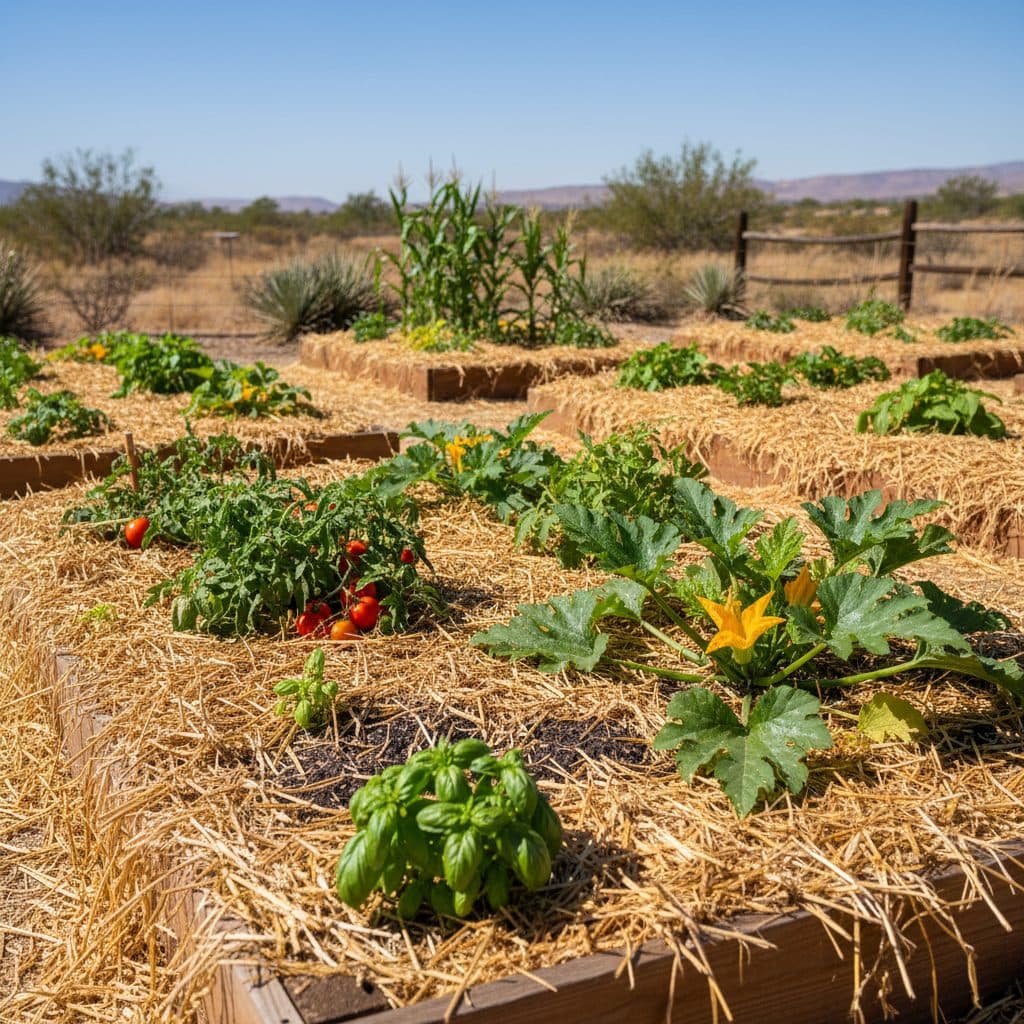
Adopting strategies like deep watering and mulching can mitigate some of these effects. For instance, a 3-inch layer of mulch can reduce soil temperature by 10 to 20°F (5.5 to 11°C) and conserve 25% or more soil moisture [6]. You can monitor soil moisture effectively with a soil moisture meter to ensure plants receive adequate water without overwatering.
- High air temperatures affecting pollination and fruit set.
- Insufficient soil moisture leading to wilting and plant death.
- Increased pest pressure on stressed plants.
- Reduced nutrient uptake in dry, hot soils.
Raised garden beds heavily mulched with straw, protecting healthy vegetable plants from intense summer sun in a hot US climate.
Top heat-tolerant vegetables for US gardens
When planning for hot US summers, selecting the right varieties is paramount. Some vegetables naturally possess genetic traits that allow them to thrive in conditions that would cause others to fail. Sweet potatoes (Ipomoea batatas) are a prime example, flourishing in temperatures up to 95°F (35°C) and requiring a long, warm growing season of 90 to 120 days [2]. They are a staple in Southern gardens, particularly in USDA zones 8 through 10, where they produce abundant yields even in sandy soils.
Another excellent choice is okra (Abelmoschus esculentus), which performs exceptionally well in regions with average summer temperatures above 85°F (29°C) [1]. Varieties like ‘Clemson Spineless’ or ‘Burgundy’ can produce pods consistently from early summer until the first frost, often yielding 20 to 30 pods per plant over the season. Planting okra in full sun, at least 6 hours daily, ensures robust growth.
Cowpeas
Cowpeas (Vigna unguiculata), also known as black-eyed peas, are remarkably drought-tolerant and can produce viable yields with as little as 10 to 12 inches of rainfall annually [1]. They also enrich the soil by fixing nitrogen, making them a dual-purpose crop for growers in arid regions like parts of Arizona and New Mexico. Other resilient options include Malabar spinach (Basella alba), which tolerates temperatures above 90°F (32°C) and provides a leafy green alternative to traditional spinach that bolts in heat.
Consider planting these heat-loving crops in late spring after soil temperatures consistently reach 65°F (18°C) to ensure strong establishment. For more general advice on plants that handle dry conditions, explore our guide on drought tolerant plants.
- Sweet Potato (Ipomoea batatas): Thrives in 95°F (35°C).
- Okra (Abelmoschus esculentus): Prefers 85°F (29°C) and above.
- Cowpea (Vigna unguiculata): Tolerates 10 to 12 inches of annual rainfall.
- Malabar Spinach (Basella alba): Withstands temperatures over 90°F (32°C).
Drought resilience strategies beyond plant choice
Even with heat-tolerant varieties, smart cultural practices are essential for managing water scarcity during hot US summers. Mulching is one of the most effective strategies, reducing soil temperature by 10 to 20°F (5.5 to 11°C) and conserving 25% or more soil moisture [6]. A 3 to 4 inch layer of organic mulch, such as straw or wood chips, around plants can significantly decrease evaporation, especially in regions like the Central Valley of California, where summer temperatures frequently exceed 100°F (38°C).
Efficient irrigation techniques are also critical. Drip irrigation systems deliver water directly to the plant roots, minimizing waste from evaporation and runoff. This method can reduce water usage by 30% to 50% compared to overhead sprinklers, making it ideal for gardens in arid USDA zones 8 and 9. Watering deeply and less frequently encourages roots to grow deeper, making plants more resilient to dry spells. Aim for 1 inch of water per week, applied slowly.
Temporary shade
Providing temporary shade during the hottest parts of the day can protect sensitive plants and extend the growing season. Shade cloth that blocks 30% to 50% of sunlight can reduce leaf temperatures by several degrees, preventing scorch and improving fruit set. This is particularly beneficial for crops like peppers and eggplant in areas like Florida, where humidity and heat combine to create intense growing conditions. Consider installing shade structures over raised beds from 11 AM to 4 PM.
Implementing these strategies can significantly improve your garden’s chances of success, even when rainfall is scarce and temperatures soar for weeks on end. For more detailed guidance on water management, refer to our article on drought tolerant plants and their watering needs.
- Apply 3 to 4 inches of organic mulch.
- Utilize drip irrigation for 30% to 50% water savings.
- Water deeply and infrequently, about 1 inch per week.
- Provide 30% to 50% shade cloth during peak heat.
Building healthy soil for climate resilience
The foundation of any resilient garden, especially in hot and dry climates, is healthy soil. Soil rich in organic matter acts like a sponge, significantly increasing its water-holding capacity. For example, increasing soil organic matter by just 1% can allow the soil to hold an additional 20,000 gallons of water per acre [1]. This is crucial for gardens in USDA zones 6 and higher, where summer droughts are becoming more common.
Incorporating compost and aged manures annually can steadily build organic matter. Aim for a soil organic matter content of 3% to 5% over several seasons. Cover crops are another powerful tool, protecting the soil from erosion, suppressing weeds, and adding biomass when tilled in. Species like cowpeas or sunn hemp, grown in rotation, can add significant organic matter and fix nitrogen, reducing the need for synthetic fertilizers by 20% to 30%.
Minimizing soil disturbance through no-till gardening practices helps preserve soil structure and microbial life, which are vital for nutrient cycling and water infiltration. Over time, this approach can lead to a more stable soil ecosystem, better able to withstand temperature extremes and irregular rainfall patterns. Studies show that no-till fields can retain 15% more moisture than conventionally tilled fields during dry periods.
These soil-building practices improve water retention, add nutrients, and support stronger root systems. Learn more about selecting and managing cover crops in your region by visiting our guide on cover crops for the home garden.
- Increase soil organic matter by 1% to hold 20,000 gallons more water per acre.
- Incorporate compost and aged manures annually.
- Plant cover crops like cowpeas or sunn hemp.
- Practice no-till gardening to preserve soil structure.
Beyond annuals: perennial and alternative crops
While annual vegetables form the backbone of most gardens, considering perennial crops and less common alternatives can add significant resilience, especially in warmer climates. Many perennials are deeply rooted and can withstand prolonged dry periods and high temperatures that would devastate annuals. For instance, asparagus (Asparagus officinalis) can produce for 15 to 20 years from the same crowns, thriving in a wide range of USDA zones from 3 to 8, and tolerating summer heat once established.
Another excellent choice is artichoke (Cynara scolymus), which performs well in USDA zones 7 to 11, particularly in California’s coastal regions where it’s a major commercial crop. While it prefers cooler summers for optimal production, many varieties can survive hot summers and produce in subsequent, milder seasons. Establishing these perennials requires initial care, but their long-term productivity and low maintenance make them attractive options for sustainable gardening.
Beyond traditional vegetables, explore native plants and edible shrubs that are naturally adapted to your local climate. For example, prickly pear cactus (Opuntia spp.) is native to the American Southwest and produces edible pads (nopales) and fruit (tunas) with minimal water in USDA zones 4 through 9. Similarly, certain varieties of fig trees (Ficus carica) are incredibly heat and drought tolerant, thriving in USDA zones 8 to 10 and producing abundant fruit with minimal irrigation once mature.
Integrating these long-lived, resilient species can create a more stable and productive food system in your garden, reducing the annual effort of replanting and providing consistent yields even in challenging conditions. Explore more options for robust, low-water plants in our guide to drought-tolerant trees and shrubs by zone.
- Asparagus: Produces for 15 to 20 years.
- Artichoke: Thrives in USDA zones 7 to 11.
- Prickly Pear Cactus: Native to the Southwest, edible pads and fruit.
- Fig Trees: Heat and drought tolerant in USDA zones 8 to 10.
Heat and drought tolerance of common garden crops
Crop | Heat Tolerance | Drought Tolerance |
|---|---|---|
Tomato | Low | Low |
Sweet Potato | High | High |
Okra | High | Medium |
Lettuce | Low | Low |
Cowpea | High | High |
Corn (Traditional) | Medium | Medium |
Yield Impact: High temperatures can reduce crop yields by 17% for every 1.8°F (1°C) increase above optimal levels [5].
Moisture Savings: Mulching with 3 to 4 inches of organic material can conserve 25% or more soil moisture [6].
Soil Water Capacity: Increasing soil organic matter by just 1% can allow the soil to hold an additional 20,000 gallons of water per acre [1].
Frequently asked questions
What temperature is considered too hot for most garden vegetables?
Most common garden vegetables begin to experience significant stress and reduced production when temperatures consistently exceed 90°F (32°C), with many struggling to set fruit above 95°F (35°C).
How much water do heat-tolerant plants need during a drought?
Even heat-tolerant plants need consistent moisture. Aim for about 1 inch of water per week, delivered deeply to encourage a robust root system, especially in USDA zones 7-10.
Can shade cloth really make a difference in hot climates?
Yes, shade cloth blocking 30% to 50% of sunlight can significantly reduce leaf temperatures by several degrees, preventing sunscald and improving fruit set for sensitive crops during peak heat from 11 AM to 4 PM.
What is the easiest heat-tolerant vegetable for beginners?
Okra is often considered one of the easiest heat-tolerant vegetables for beginners, thriving in temperatures above 85°F (29°C) and producing pods consistently for several months with minimal pest issues.
How long does it take to improve soil organic matter for better water retention?
Building soil organic matter takes time and consistent effort. You can expect to see noticeable improvements, such as a 0.5% to 1% increase in organic matter, over three to five years with regular additions of compost and cover cropping [1].
References
- Field crops and vegetables (2017). Field crops and vegetables.
- Upland Crops, Vegetables and Some Tree Crops (1961). Upland Crops, Vegetables and Some Tree Crops.
- 3 Herbicide-Tolerant Crops (2006). 3 Herbicide-Tolerant Crops.
- 4 Virus-Resistant and Drought-Tolerant Crops (2006). 4 Virus-Resistant and Drought-Tolerant Crops.
- Heat-Tolerant Crops: Genetics and Agronomic Solutions (2025). Heat-Tolerant Crops: Genetics and Agronomic Solutions.
- The commercial storage of fruits, vegetables, and florist and nursery stocks (1986). The commercial storage of fruits, vegetables, and florist and nursery stocks.