climax
Deodar Cedar
deodar
Cedrus deodara
- kpk hills
- balochistan highlands
International hardiness
- USDA 7-9
- RHS H5
- AU: Cool temperate, Warm temperate, Mediterranean
Where it grows — regional guide
| Zones / rating | Regional notes |
|---|---|
USDA 7-9 | Hardy in USDA zones 7 to 9 as an evergreen specimen; requires sharp drainage to avoid root rot, and parts are not edible. |
| Zones / rating | Regional notes |
|---|---|
H5 (-15 to -10C) | Hardy under RHS H5 as a large specimen tree; plant in full sun away from frost pockets, and treat as non-edible landscape cover. |
| Zones / rating | Regional notes |
|---|---|
Cool temperate, Warm temperate, Mediterranean | Grown in cool-temperate and mediterranean zones as a drought-tolerant conifer; provide deep drainage, and note it is not a food tree. |
| Zones / rating | Regional notes |
|---|---|
USDA 7-9 (USDA scale) Canada uses its own zone system; Canadian zones run roughly one lower than USDA. | No region-specific data yet |
| Zones / rating | Regional notes |
|---|---|
KPK hills, Balochistan highlands | Pakistan:Native to highland valleys and mountain slopes as a timber and shelter tree; protect young trees from frost, and do not consume parts. India:Grown across western Himalayan slopes as an evergreen timber tree; site on well-drained slopes, and note it is not an edible plant. |
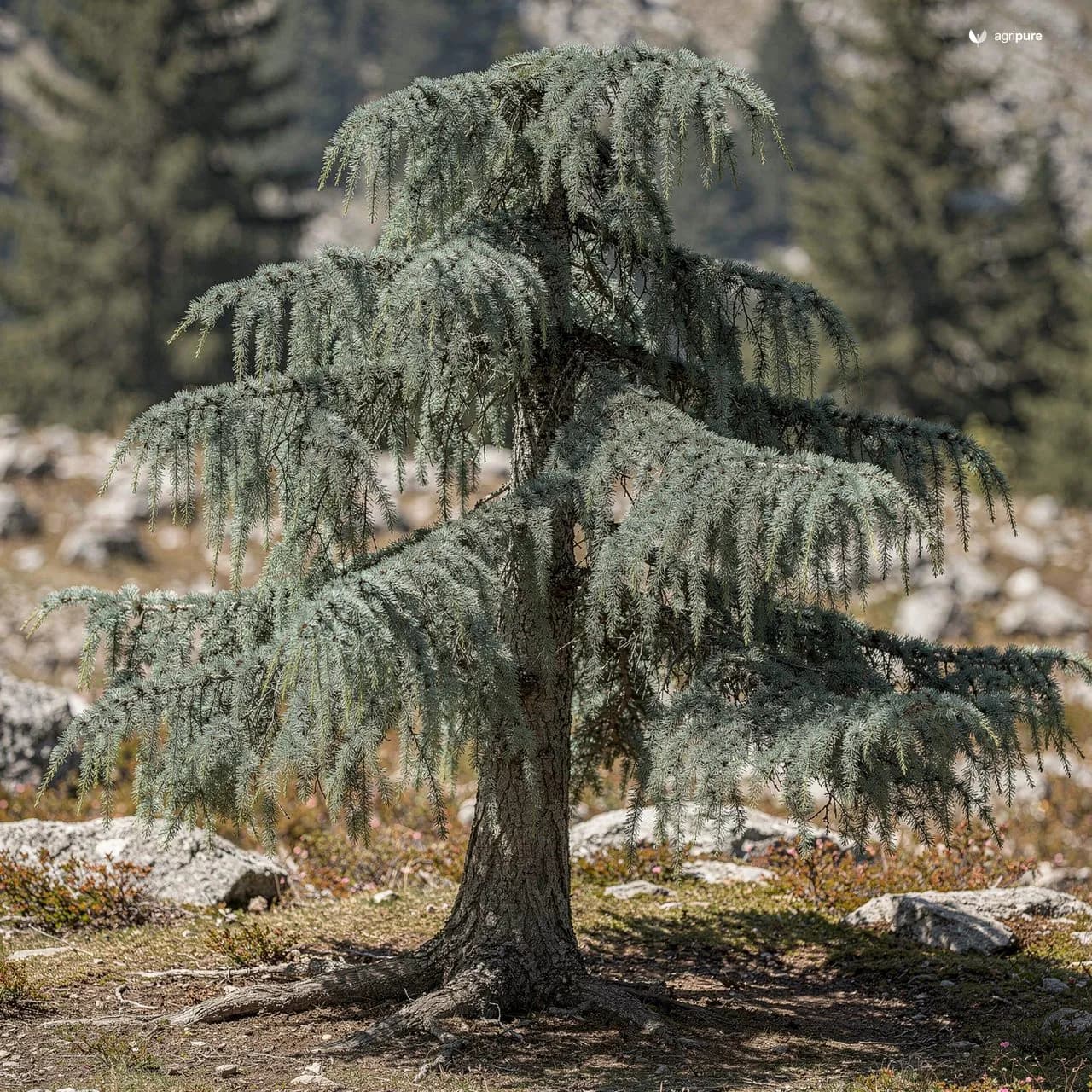
The deodar cedar (Cedrus deodara) is a large, long-lived evergreen conifer in the pine family (Pinaceae), native to the western Himalayas and grown worldwide as an ornamental and timber tree. It is not a food plant, so a homesteader should think of it as a landscape and shelter tree rather than a crop. Where it has room, it makes a striking specimen: a broadly pyramidal conifer with gracefully drooping branch tips, a soft blue-green canopy, and the kind of stature that anchors a property line or windbreak row for generations.
In the wild the deodar is a forest giant, typically 40 to 50 m (about 130 to 165 ft) tall and exceptionally to 60 m (197 ft), on a trunk up to 3 m (10 ft) across. In cultivation it is more modest, usually around 40 to 70 ft tall and broadly pyramidal, with a soft, drooping or pendulous central leader that spreads and flattens at the top with age. Older trees throw out wide, spreading branches whose twigs hang in the cascading, swooping habit that makes the species easy to spot. The needles are evergreen, soft and fine, roughly triangular to four-sided in cross-section, 1 to 2 in (2.5 to 5 cm) long, and carried in whorls of about 15 to 20 on short spur shoots as well as singly on the long shoots; their colour ranges from blue-green to grey-green, often with a light bluish cast toward the tips. The bark is dark grey and grows more scaled and fissured with age.
Growing deodar cedar
Deodar cedar is native to the western Himalayas, from eastern Afghanistan through northern Pakistan, north-central India, western Nepal and into southwestern Tibet, where it grows naturally at elevations of 1,500 to 3,200 m (about 5,000 to 10,000 ft). That mountain origin shapes what it wants in cultivation: cool but not bitterly cold conditions, deep soil, and good drainage. Oregon State University rates it hardy to USDA Zone 6, while landscape sources commonly place it in USDA zones 7 to 9, noting that it is somewhat less hardy than some other cedars and prefers mild winters without extreme heat. In the western United States it has proved well adapted to dry, Mediterranean-type climates and is used as a drought-tolerant substitute for coast redwood. A practical homestead range is roughly USDA 6 on sheltered sites up to about Zone 9, avoiding both hard winter cold and very hot, humid lowland conditions.
Give the tree full sun for the best growth and form; it will tolerate partial shade but performs best with ample light. It prefers rich, well-drained, somewhat dry soil and will grow in loam, sand, or clay as long as drainage is adequate, with a leaning toward slightly acidic ground. The one condition it will not tolerate is wet feet: it is intolerant of poorly drained, soggy soils and is prone to Phytophthora root rot on waterlogged sites. Because the species can be damaged by frost, avoid planting into frost pockets in Zone 6 and other marginal areas, and shelter it from sweeping, windy exposures, especially in colder climates. Young trees need regular watering through their first few years to establish in dry climates, after which the species shows good drought tolerance. Propagation is from seed. Slow but very long-lived, deodar is a tree you plant once and site carefully, since it will hold that spot for decades.
Cones and uses
Deodar cedar carries separate male and female cones on the same tree. The male cones are large and erect, borne mainly on the lower branches, and release their pollen in autumn. The female seed cones are barrel-shaped and sit upright on top of the branches; they start green, turn brown as they ripen, reach about 3 to 6 in long, and take roughly 12 to 13 months to mature before releasing their seed. For the homesteader, the tree’s value is practical rather than edible: it is an ornamental and shade tree, an evergreen windbreak, and a slow-grown timber conifer. Its main return is the standing tree itself, which once established provides lasting shelter and structure on the landscape.
How to identify it
A few features taken together make deodar cedar straightforward to recognise: a large, broadly pyramidal conifer with a drooping or pendulous central leader and gracefully cascading, swooping branch tips; soft, slender, blue-green to grey-green needles 1 to 2 in long, clustered in whorls of about 15 to 20 on short spur shoots and borne singly on long shoots; upright, barrel-shaped female cones sitting on the upper surfaces of the branches and ripening from green to brown; and dark grey bark that becomes scaled and fissured with age.
Safety and cautions
Deodar cedar is not an edible species. Current horticultural and ethnobotanical references do not list it as a food plant, and homesteaders should treat it as non-food. While the tree has a history of traditional use, there are no reliable modern clinical data supporting self-medication with it, and any medicinal preparations should be used only under qualified guidance; this profile makes no claim that it treats or cures anything. Grow it as the ornamental, shade, and shelter tree it is, and do not consume parts of it.
Sources
- Cedrus deodara – North Carolina State Extension
- Cedrus deodara – Wikipedia
- Cedrus deodara – Oregon State University Landscape Plants
- Tree of the Month: Deodar Cedar – Nashville Tree Conservation Corps
- Deodar Cedar – Sacramento Tree Foundation
- Cedrus deodara – iNaturalist
Sourcing notes
Raise from autumn-collected seed; deodar nursery stock is widely available through KPK and Azad Kashmir forest department nurseries. Use seed from healthy local high-elevation trees and shelter seedlings from frost in their first seasons.