secondary
Lesser Yam
choti zamin kand
Dioscorea esculenta
Also known as Choti Zamin Kand (Pakistan), Asiatic Yam (India, Australia, United States).
- sindh coast
- punjab plains
International hardiness
- USDA 9-12
- RHS H2
- AU: Tropical, Subtropical
Where it grows — regional guide
| Zones / rating | Regional notes |
|---|---|
USDA 9-12 | Grown in frost-free USDA zones 9 to 12 as a trellised starch crop; plants are spiny and tubers must be cooked before eating. |
| Zones / rating | Regional notes |
|---|---|
H2 (1 to 5C) | No region-specific data yet |
| Zones / rating | Regional notes |
|---|---|
Tropical, Subtropical | Suited to the humid tropical north on sturdy supports; stems carry sharp spines and the tubers must be thoroughly cooked. |
| Zones / rating | Regional notes |
|---|---|
USDA 9-12 (USDA scale) Canada uses its own zone system; Canadian zones run roughly one lower than USDA. | No region-specific data yet |
| Zones / rating | Regional notes |
|---|---|
Sindh coast, Punjab plains | Pakistan:Grown on frost-free plains as a staked climbing vine; the spiny stems yield sweet tubers that must be cooked before eating. India:Cultivated in warm humid districts on climbing stakes; stems are spiny and tubers must be cooked rather than sampled raw. |
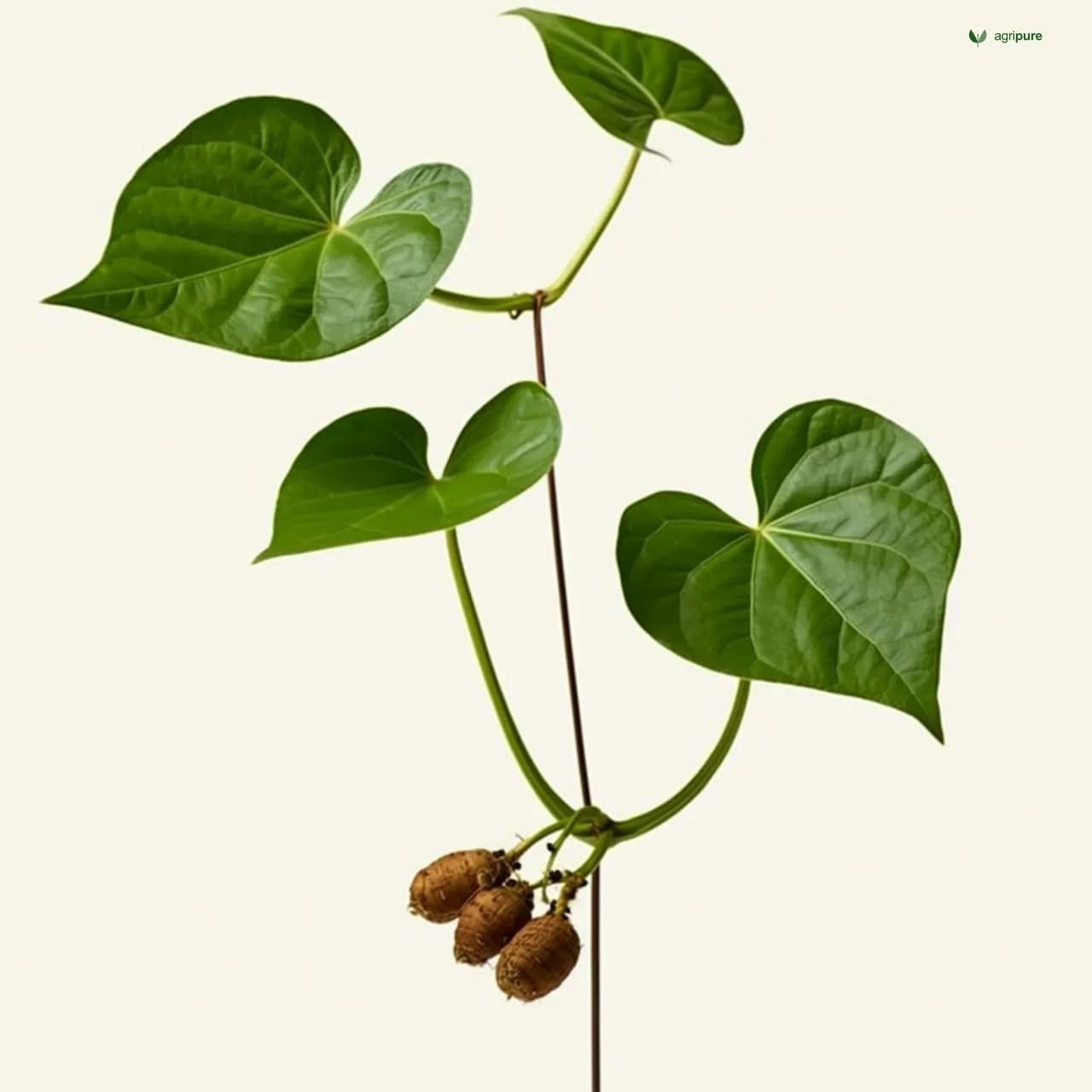
Lesser yam (Dioscorea esculenta) is a cultivated tropical yam grown for its edible tubers, a climbing vine in the family Dioscoreaceae. It is native to Island Southeast Asia; one major ethnobotanical reference describes its native range more specifically as Thailand and Indo-China, with wild populations also reported from northern India, Myanmar, and New Guinea, though those may be escapes or relicts rather than part of the original range. For a homesteader in a warm, humid climate, its appeal is straightforward: it is a starch crop that produces a cluster of small, manageable tubers underground while the vine climbs a stake or trellis, and it is reported to be relatively free of the major pests and diseases that trouble other cultivated yams.
The plant is a twining vine grown for the edible tubers it forms at the root. It is usually spiny, and its tubers are smaller than those of the better-known greater yam (Dioscorea alata), which is one reason it carries the common name “lesser yam.” Among the minor cultivated yams it is regarded as having the highest agro-economic potential, a reflection of both its productivity and its comparatively low pest and disease burden.
Growing lesser yam
Lesser yam is a plant of the warm tropics. Its natural habitat is the humid and subhumid tropics, and one major reference notes that it performs best with well-distributed rainfall of roughly 875 to 1,750 mm per year. That points to a long, warm, reliably moist growing season as the basic requirement: even, year-round-style rainfall rather than a single short wet burst, and warmth throughout.
Beyond climate and habitat, the reliable sources here do not give specific, verifiable figures for propagation method, soil type, sun exposure, watering schedule, plant spacing, or home-garden time-to-maturity for this species. Rather than fill those gaps with guesses, this profile leaves them out. What the sources do support is clear enough to act on: site lesser yam where it gets tropical warmth and steady moisture, and give the climbing vine something to twine up so it can put its energy into the tubers below.
Harvest and uses
Yield responds strongly to support. A review notes that when the plants are staked, yields of 30 to 40 tonnes per hectare are frequent. Staking is therefore not optional dressing but a practical lever on the size of the harvest, which fits the plant’s habit as a vigorous twining climber.
The tubers are the harvest, and they are eaten as a starchy staple after cooking or roasting; their taste is described as sweet and pleasant. Beyond simple table use, flour and starch are also extracted from the tubers, giving the crop a processing and storage dimension as well as a fresh-eating one. Ecologically, the species’ value to a smallholding lies in its agro-economic standing among the minor yams and its relative freedom from major pests and diseases, which keeps it a low-trouble crop within a mixed planting.
Traditional medicinal use
Alongside its role as food, lesser yam has a recorded traditional medicinal application: grated raw tubers are applied as a poultice on swellings, especially on the throat. This is documented as a traditional external use only, and this profile makes no claim that it treats or cures any condition.
Safety and cautions
In the sources consulted here, there is no species-specific statement that Dioscorea esculenta tubers, or any part of the plant, are poisonous; on the contrary, the tubers are explicitly described as edible and used as food. As a sensible general practice with any yam, the tubers are eaten cooked or roasted rather than raw.
No reliable source in this set gives interaction warnings, contraindicated groups, or other medical safety precautions for lesser yam preparations. Because of that, no such guidance can be stated, and the single medicinal use noted above should be understood strictly as a traditional poultice application rather than an endorsed remedy. Anyone considering a medicinal use of the plant should seek qualified advice.
Sources
- Dioscorea esculenta (Lour.) Burkill — GBIF (Global Biodiversity Information Facility)
- Dioscorea esculenta — Wikipedia
- Review of lesser yam (Dioscorea esculenta) agronomy and uses — HAL / INRAE
- Dioscorea esculenta — PROSEA (Plant Resources of South-East Asia)