secondary
Wild Yam
kanis
Dioscorea deltoidea
Also known as Kanis (Pakistan).
- kpk hills
International hardiness
- USDA 7-9
- RHS H4
- AU: Cool temperate, Warm temperate
Where it grows — regional guide
| Zones / rating | Regional notes |
|---|---|
USDA 7-9 | No region-specific data yet |
| Zones / rating | Regional notes |
|---|---|
H4 (-10 to -5C) | Hardy under RHS H4 in shaded woodland collections; wild populations are endangered and tubers contain bioactive saponins. |
| Zones / rating | Regional notes |
|---|---|
Cool temperate, Warm temperate | No region-specific data yet |
| Zones / rating | Regional notes |
|---|---|
USDA 7-9 (USDA scale) Canada uses its own zone system; Canadian zones run roughly one lower than USDA. | No region-specific data yet |
| Zones / rating | Regional notes |
|---|---|
KPK hills | Pakistan:Native climber of moist hill forests; it is strictly protected as an endangered plant and rhizomes carry bioactive saponins. India:Native to temperate western Himalayan forests; harvesting wild stands is restricted and rhizomes hold medicinal saponins. |
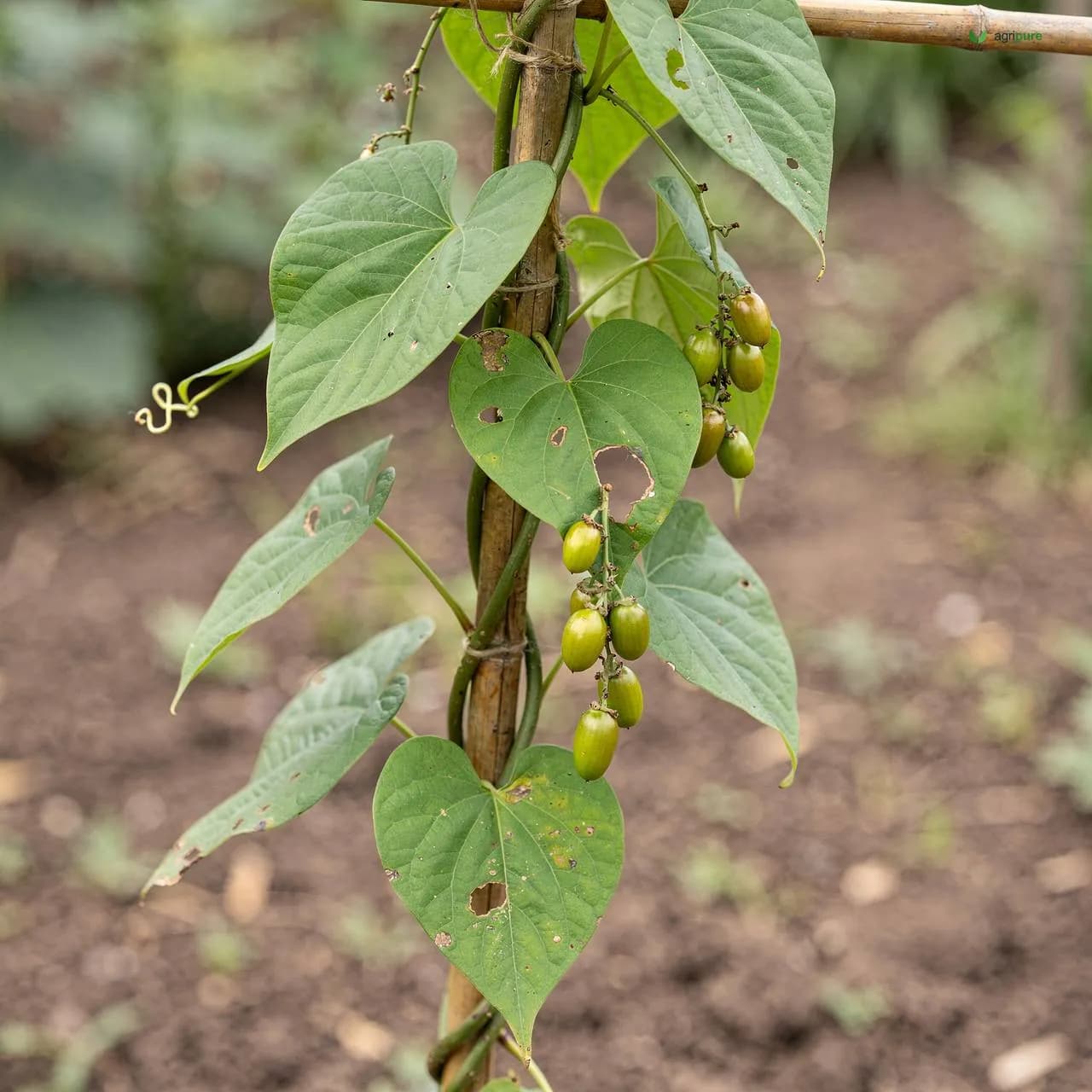
Wild yam (Dioscorea deltoidea, called kanis locally) is the twining temperate yam of the Khyber Pakhtunkhwa forests, a shade-tolerant climber whose rhizomes are a high-value medicinal. It is also a plant under real pressure: rising commercial demand has pushed it into the endangered category in Pakistan, Nepal, and India. For a grower the responsible path is clear — treat it as a species to propagate and protect in cultivation, not to dig out of the wild.
Where it thrives
Dioscorea deltoidea is a perennial herbaceous climber with slender, unarmed stems that twine around supports, native across a broad band including Pakistan and the wider Himalaya and growing at elevations of roughly 450 to 3,100 m. In the northwestern Himalaya its populations are most abundant in the moist temperate belt, with the richest rhizomes carrying up to 8% diosgenin. That places it firmly in the moist KPK hill forests rather than the dry plains. As a forest climber it tolerates shade and uses the trees around it for support, storing its reserves in long, woody, horizontal rhizomes underground.
Role in the system
This is a shade-tolerant mid-storey climber for an established, moist woodland. Unlike sun-demanding vines, it works within the forest understorey, twining up through standing trees and producing in shade — which makes it a candidate for the lower-light layers of a mature guild where many crops fail. Its value is concentrated below ground in the rhizome, while the plant occupies vertical space that would otherwise go unused. The richest material comes from the moist northwestern Himalayan belt, where rhizomes can carry up to 8% diosgenin, so site and provenance matter as much as the growing itself.
Harvest
The rhizome is the product, and this is where care matters most. Because wild populations are endangered, harvest only from plants you have grown, and lift rhizomes in a way that leaves sections to regrow rather than clearing a stand. The tubers are also eaten as a vegetable and rank among the most important wild edibles of the region, so a cultivated stand can serve both food and medicine — but only if it is managed to persist.
What you get
A diosgenin-rich medicinal rhizome and an edible tuber. The diosgenin and steroidal saponins in the rhizome are industrially important precursors for synthesising steroid hormones such as cortisone and progesterone, which is what drives the plant’s commercial demand, and traditional use spans gastrointestinal, urogenital, respiratory, and joint complaints. Grown deliberately, it offers a high-value crop for the shaded layers of a hill system. Demand for that diosgenin is exactly what has drawn down the wild populations, which is the strongest argument for raising your own rather than gathering, and for treating any harvest as a long-term, managed return.
Cautions
This species is endangered in Pakistan and a recognised conservation concern across its range, so wild digging adds to the pressure; propagate it instead and harvest only cultivated stock. The rhizome is rich in steroidal saponins, which are bioactive compounds, so it is a medicinal raw material to handle knowingly rather than a casual food.
Sources
- Kashyap, P., et al. (2024). “An overview on pharmacological significance, phytochemical potential, traditional importance and conservation strategies of Dioscorea deltoidea.” PMC / Heliyon.
Sourcing notes
Do not wild-harvest: this is endangered in Pakistan. Source rhizome sets or tissue-cultured plantlets from a nursery or conservation programme and build your own stock from cultivated material.