secondary
Intermediate Joint-Pine (Ephedra)
oman / asmania
Ephedra intermedia
Also known as Oman (Pakistan).
- balochistan highlands
- kpk hills
International hardiness
- USDA 5-9
- RHS H6
- AU: Arid / semi-arid, Cool temperate
Where it grows — regional guide
| Zones / rating | Regional notes |
|---|---|
USDA 5-9 | No region-specific data yet |
| Zones / rating | Regional notes |
|---|---|
H6 (-20 to -15C) | No region-specific data yet |
| Zones / rating | Regional notes |
|---|---|
Arid / semi-arid, Cool temperate | No region-specific data yet |
| Zones / rating | Regional notes |
|---|---|
USDA 5-9 (USDA scale) Canada uses its own zone system; Canadian zones run roughly one lower than USDA. | No region-specific data yet |
| Zones / rating | Regional notes |
|---|---|
Balochistan highlands, KPK hills | Pakistan:Native shrub of cold arid mountain slopes; stems contain potent ephedrine alkaloids and wild stands must not be uprooted. India:Native to dry cold Himalayan mountain slopes; stems carry potent ephedrine alkaloids and wild stands face collection limits. |
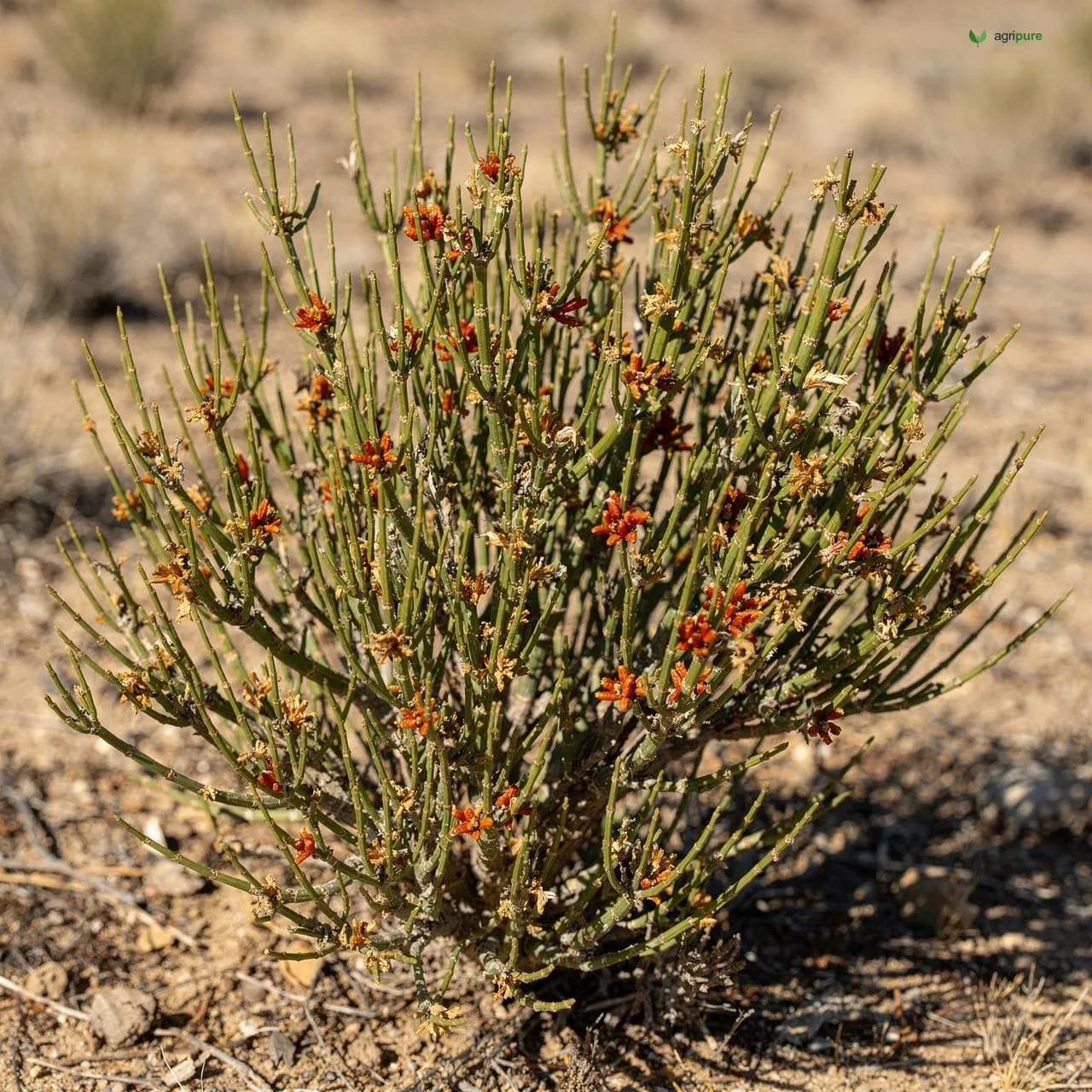
Intermediate joint-pine (Ephedra intermedia, oman or asmania) is a broom-like, leafless shrub of the cold arid highlands of Balochistan and the dry KPK hills. It is a gymnosperm, not a flowering plant, and its jointed green stems are a long-used decongestant in hill medicine, the source of the alkaloid ephedrine. On a syntropic site it sits as a hardy secondary-stage shrub on dry upland ground, valued chiefly as a standing medicinal plant and a source of woody fuel.
Where it thrives
Oman is found through China, Central Asia, the Himalayas, Iran, and Pakistan, and in Balochistan the local shrubs go by that name. It grows in dry, sandy, or rocky places, on mountain slopes in gravelly and sandy soil, and across grassland, desert, river valleys, and floodland in arid country. Surveys have found it a major Ephedra species in the northern parts of Pakistan, which fits it to the cold, dry Balochistan highlands and the drier KPK hills rather than to wet or low ground.
Role in the system
In a highland guild this is a secondary-stage shrub for dry, exposed ground, the kind of broom-like, drought-hardy plant that holds gravelly slopes where little else establishes. Being a gymnosperm, it carries no true foliage to speak of: the leafless green stems do the photosynthesis and also hold the active compounds, so the whole plant is effectively the product. Its return is almost entirely medicinal rather than caloric, so it earns its place as a standing pharmacy plant and a soil-holding shrub more than as forage. It takes a wide spread of harsh sites, from gravelly mountain slopes to sandy desert and dry river valleys, which is part of why surveys found it the major Ephedra of the northern country. Read it as a tough, slow component for the arid edges of a highland system, set where its tolerance of cold and drought is the point and harvested in moderation.
Uses
The stems contain the alkaloid ephedrine and are valued for treating asthma and respiratory complaints, a use that goes back millennia for fever, nasal congestion, and asthma. The species is a notably rich source: most specimens surveyed in northern Pakistan carried more than 0.7% ephedrine alkaloids, enough to meet pharmacopoeial standards, which is why it is harvested from the wild for both local and wider use. Beyond the medicine, the woody stems are burned as fuel in a fuel-poor landscape, so the shrub serves a second, everyday purpose.
Cautions
Ephedrine is a potent stimulant, so this is a medicinal plant to use knowledgeably and sparingly, not a casual remedy, and it is the active chemistry rather than the plant’s abundance that warrants the caution. Wild stands are harvested for that alkaloid, so collect stems in moderation and leave the plant to regrow rather than uprooting it, and protect existing shrubs on dry slopes where they also hold thin soil. Plant it only where the cold, arid highland climate genuinely suits it.
Sources
- Caveney, S., et al. (2001). “Survey of Ephedra resources in the Northern Areas of Pakistan and their genetic diversity.” Journal of Natural Medicines.
- Wikipedia contributors. [“Ephedra — ephedrine and medicinal use.”](https://en.wikipedia.org/wiki/Ephedra_\(plant\))
Sourcing notes
Oman is gathered from wild highland stands and can be propagated from seed for dry, cold sites. Harvest stems in moderation rather than uprooting plants, since wild stands are under collection pressure for their ephedrine and also help hold thin upland soil.