support
Willow-Leaved Sea Buckthorn
drali / chuk
Hippophae salicifolia
- kpk hills
International hardiness
- USDA 6-8
- RHS H5
- AU: Cool temperate
Where it grows — regional guide
| Zones / rating | Regional notes |
|---|---|
USDA 6-8 | No region-specific data yet |
| Zones / rating | Regional notes |
|---|---|
H5 (-15 to -10C) | Grown as a nitrogen-fixing shrub for cold climates and rough ground, bearing tart orange berries on female plants. |
| Zones / rating | Regional notes |
|---|---|
Cool temperate | No region-specific data yet |
| Zones / rating | Regional notes |
|---|---|
USDA 6-8 (USDA scale) Canada uses its own zone system; Canadian zones run roughly one lower than USDA. | No region-specific data yet |
| Zones / rating | Regional notes |
|---|---|
KPK hills | Pakistan:Native deciduous shrub of high-altitude valleys; fixes nitrogen on rough alluvial ground and bears edible orange berries. India:Native across high-altitude Himalayan valleys; acts as a nitrogen fixer and soil stabilizer yielding tart orange berries. |
Grows alongside
Species that appear with Willow-Leaved Sea Buckthorn in 1 of our published guides — a starting list for a guild, not a planting plan.
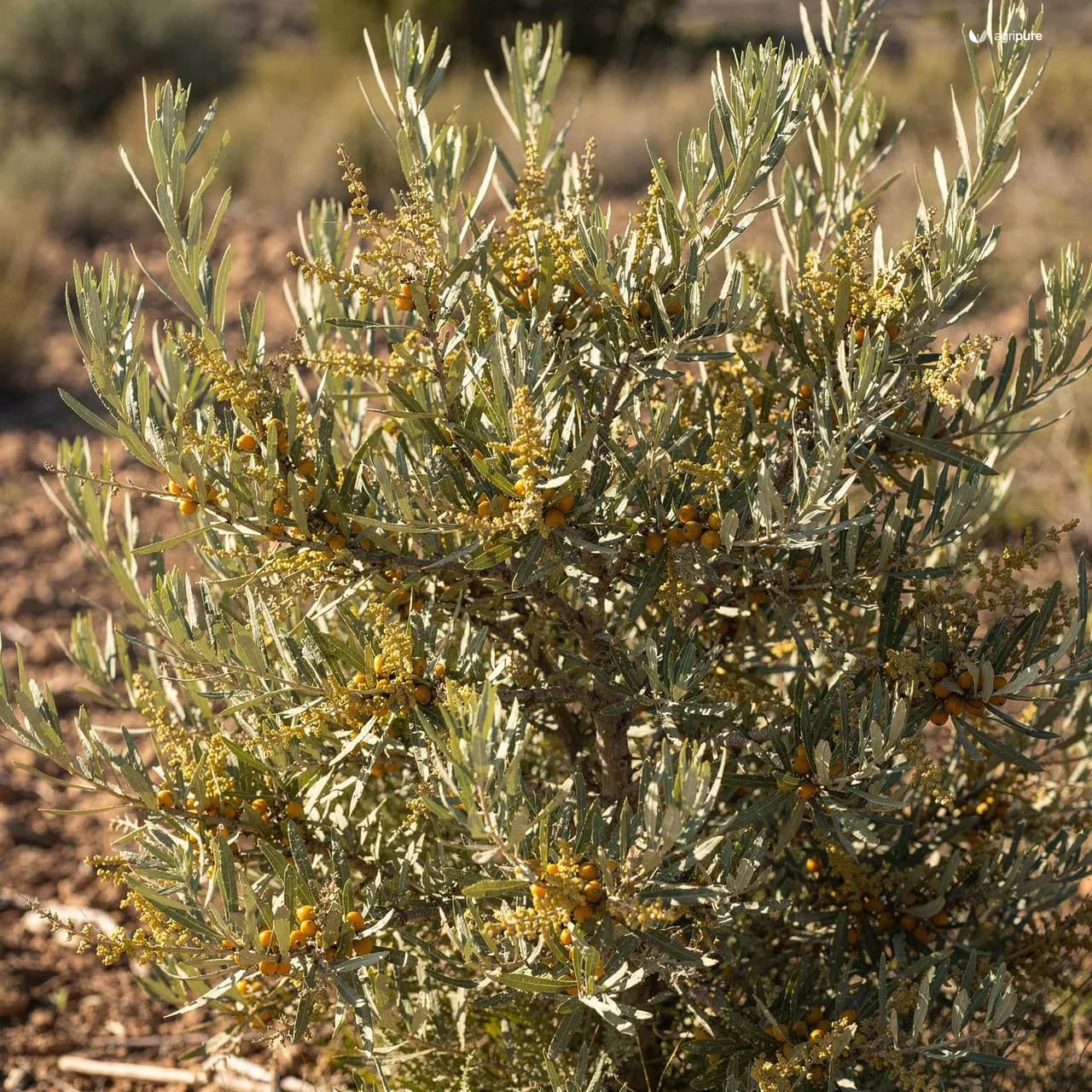
Willow-leaved sea buckthorn (Hippophae salicifolia, locally drali or chuk) is the nitrogen-building, vitamin-rich shrub of the high KPK valleys. It is an actinorhizal species — it fixes nitrogen in partnership with Frankia bacteria rather than the rhizobia that legumes use — and it carries heavy crops of tart, vitamin-C-rich orange berries. On cold, thin mountain ground where the bean-family nitrogen fixers struggle, it is one of the few plants that both feeds the soil and feeds the household, which makes it unusually valuable in high country.
Where it thrives
It is restricted to the Himalayas, growing as a tall shrub or small tree of 4 to 10 m from about 1,500 to 3,200 m, often in dry valleys and along mountain streams. This is a high-elevation plant of the KPK hills, hardy to hard mountain cold and tolerant of poor, stony ground that holds little fertility. It wants full sun and free-draining soil, and it does particularly well on the rough alluvial ground beside watercourses, where it can spread by suckering and stabilise the banks. It is a plant of the harsh, open, high valley, not of warm or shaded ground.
Role in the system
This is a support and pioneer shrub for cold-climate plantings, and its first job is fertility on ground that has almost none. Its root nodules host Frankia actinobacteria that fix atmospheric nitrogen, so it enriches the thin soils of high valleys where most nitrogen fixers simply will not grow. Because it suckers freely it forms thickets that bind loose riverbank and slope, controlling erosion in steep, fast-draining country where bare ground washes away. The way to use it is much like a legume pioneer at lower elevations: establish it early to build nitrogen and hold the ground, run it through shelterbelts and along streams, and bring fruiting and timber trees in behind it once the soil it has improved can carry them. As the longer-lived trees close in, the sea buckthorn has already done the founding work.
What you get
The female plants carry numerous edible berries in autumn, very high in vitamin C with a sharp, lemony flavour, usually cooked into juice, syrup, or preserves, and rich in minerals and essential fatty acids. That fruit is a genuine nutritional asset in remote high valleys where fresh produce is scarce through a long winter. Prunings and thinnings give firewood in country where fuel is hard to come by, and the nitrogen the shrub adds is a standing return that compounds season after season.
Establishment
One detail decides whether you get fruit: the plant is dioecious, so male and female grow on separate plants and you must plant both to set a berry crop. Source seed or seedlings from established mountain stands, plant a few males among the females, and where possible use soil from an existing stand so the Frankia partner is present from the start. Give it sun and sharp drainage and it establishes readily on rough high ground.
Sources
- Plants For A Future. “Hippophae salicifolia — Willow-Leaved Sea Buckthorn.” PFAF Plant Database.
- Bisht, M. S., et al. (2009). “Ecology of Hippophae salicifolia D. Don of temperate and sub-alpine forests of North Sikkim Himalayas — a case study.” Symbiosis, Springer.
Sourcing notes
A high-altitude species; source seed or seedlings from established mountain stands and plant both sexes, as fruit needs male and female plants. Seedlings benefit from Frankia already present in soil from existing stands.