pioneer
Cogon Grass
dab
Imperata cylindrica
- punjab plains
- kpk hills
- sindh coast
International hardiness
- USDA 5-11
- RHS H5
- AU: Tropical, Subtropical, Warm temperate, Cool temperate
Where it grows — regional guide
| Zones / rating | Regional notes |
|---|---|
USDA 5-11 | Regulated as a Federal Noxious Weed; extremely aggressive invasive grass that displaces native plants and fuels intense wildfires. |
| Zones / rating | Regional notes |
|---|---|
H5 (-15 to -10C) | No region-specific data yet |
| Zones / rating | Regional notes |
|---|---|
Tropical, Subtropical, Warm temperate, Cool temperate | Aggressive invasive grass of warm climates; sharp spreading rhizomes crowd out forage and dry stands fuel intense wildfires. |
| Zones / rating | Regional notes |
|---|---|
USDA 5-11 (USDA scale) Canada uses its own zone system; Canadian zones run roughly one lower than USDA. | No region-specific data yet |
| Zones / rating | Regional notes |
|---|---|
Punjab plains, KPK hills, Sindh coast | Pakistan:Persistent rhizomatous weed of warm climates; difficult to eradicate from crops and dry foliage increases wildfire risks. India:Widespread aggressive weed of disturbed soils; sharp creeping rhizomes crowd out crops and dry thatch fuels intense wildfires. |
Grows alongside
Species that appear with Cogon Grass in 1 of our published guides — a starting list for a guild, not a planting plan.
Cogon grass (Imperata cylindrica) is a warm-season, rhizomatous perennial grass native to the Old World tropics — including southern Europe, Africa, and Southeast Asia — that has become one of the most notorious invasive weeds in the world. For a homesteader, the honest framing is the opposite of most plant profiles: this is not a plant to grow but one to recognize, refuse, and remove. It spreads aggressively by wind-blown seed and by dense, sharp-tipped rhizomes, forming highly flammable, nearly single-species stands that crowd out crops and native vegetation. In the United States it is a regulated Federal Noxious Weed, so authoritative sources treat it in terms of eradication and prevention, not cultivation.
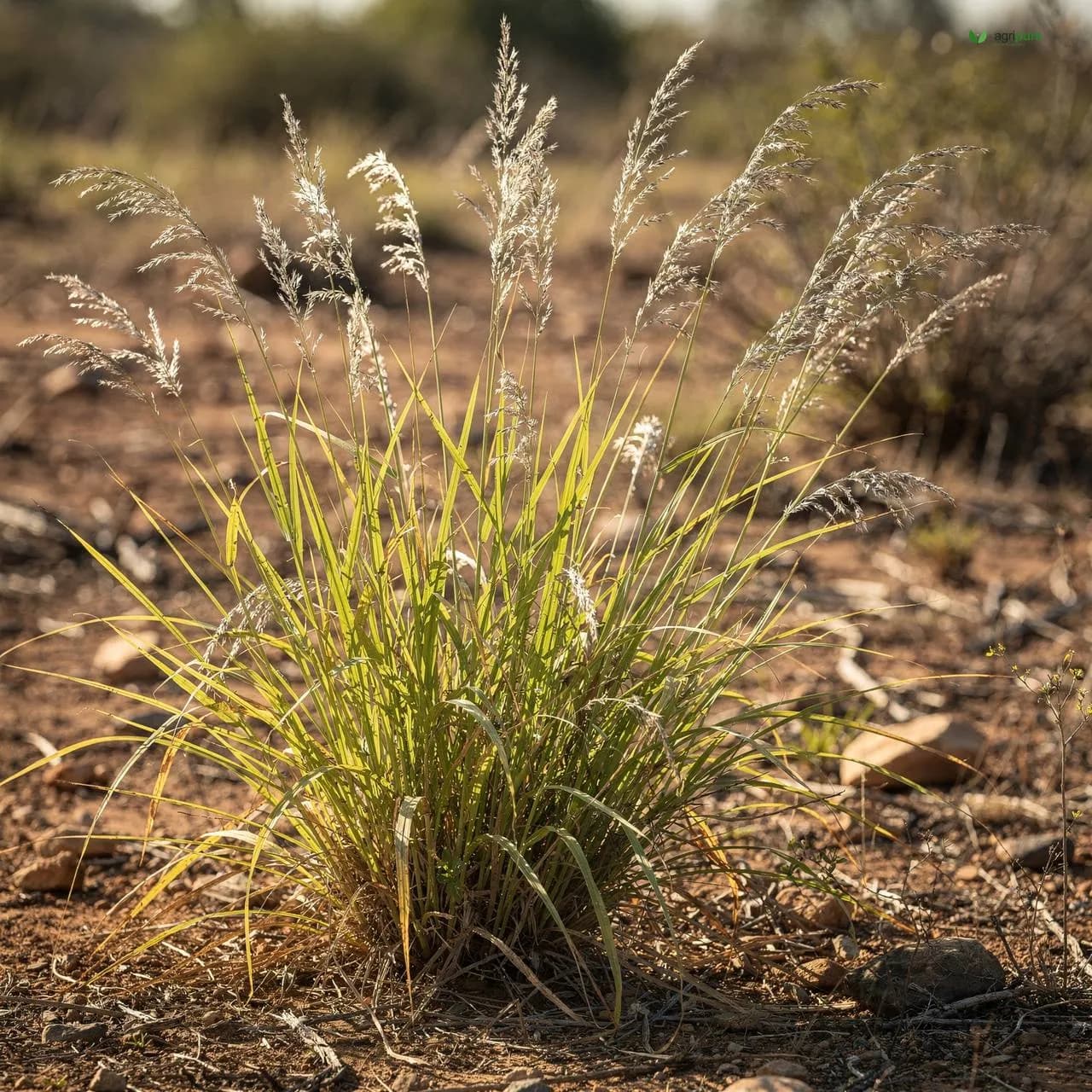
Cogon grass is a coarse, upright grass whose leaves arise in bunches directly from or close to ground level, giving stands a loose, spreading look rather than a tight clump. The leaf blades run roughly 1 to 4 feet (30 to 120 cm) long, light green to yellowish and sometimes tinged reddish, and they are coarse and very rough to the touch — noticeably so if you run a hand downward along the blade. The most reliable field cue is the leaf’s prominent, off-center white midrib, which sets it apart from look-alike grasses. Below ground, the plant builds a mat of sharp-tipped, white to yellowish rhizomes that is the engine of its spread.
How cogon grass grows and spreads
Cogon grass reproduces in two ways, both efficient and hard to interrupt. It spreads vigorously by creeping rhizomes, and even small fragments can generate new plants — which is why disking, logging, or tillage readily moves infestations to new ground when equipment is not cleaned between sites. It also produces abundant wind-dispersed seed: light, fluffy, dandelion-like seed carried from silvery panicles, with each flower head capable of releasing on the order of thousands of seeds. In the southeastern United States it blooms from late March to mid-June, with seed maturing and dispersing shortly after flowering.
It is a warm-season grass most problematic in warm, humid climates, and its presence across tropical Asia and Africa confirms its adaptation to tropical and subtropical conditions. In the United States it is established across the Gulf Coast and Southeast — Virginia, the Carolinas, Georgia, Florida, Alabama, Mississippi, Louisiana, and Texas, plus Oregon — and occurs in all 67 counties of Florida. That spread implies tolerance of roughly USDA zones 7b through 10, with parts of zone 11 in the tropics; this is an inference from the listed regions’ climate, not a formally published rating. No agronomic yield or cultivation figures exist for this species, because the documented work is invasive-species control, not crop trials.
How to identify it
Use a combination of features rather than any single one, since several native and ornamental grasses look similar:3457
- Habit: Dense stands commonly 1 to 4 feet tall, leaves in loose bunches from at or near the ground rather than a tidy clump.
- Leaves: Blades about 1 to 4 feet long, light green to yellowish (sometimes reddish), coarse and very rough to the touch.
- Midrib: A distinctive off-center, whitish midrib down each blade — the classic field-ID feature.
- Seed heads: Cylindrical, silvery-white, cottony plumes roughly 2 to 8 inches long, held above the foliage.
- Rhizomes: Sharp-tipped, white to yellowish rhizomes forming dense underground mats.
Safety and cautions
The main caution with cogon grass is ecological and legal rather than medicinal. It is listed as a Federal Noxious Weed in the United States and as a Florida Noxious Weed, so deliberately planting, transporting, or propagating it can be unlawful and is in every case ill-advised. Do not introduce it to a homestead under any circumstances. Its highly flammable litter increases fire frequency and intensity and makes established stands a genuine wildfire hazard near buildings and woodland, with stands carrying hot fires even under relatively moist conditions. If you find it on your land, identify it early, confirm with a local extension or agriculture authority, and follow regional control guidance rather than disturbing it in ways — moving soil or uncleaned equipment — that spread the rhizomes.
Sources
- Identification and Control of Cogongrass (Imperata cylindrica) — Mississippi State University Extension
- Imperata cylindrica — University of Florida IFAS Plant Directory
- Field Guide to the Identification of Cogongrass — Alabama Cooperative Extension System
- Cogongrass Identification — Cogongrass.org
- Imperata cylindrica (Cogongrass) — Invasive Plant Atlas of the United States
- Weed Risk Assessment for Imperata cylindrica — USDA APHIS
- Identification and Control Methods for Cogongrass in Tennessee — University of Tennessee Extension
Sourcing notes
Spreads on its own from rhizome fragments and wind-blown seed, so it almost never needs planting and is hard to remove once in. Treat it as a weed to manage rather than a species to source, and clear rhizomes thoroughly if replacing it.