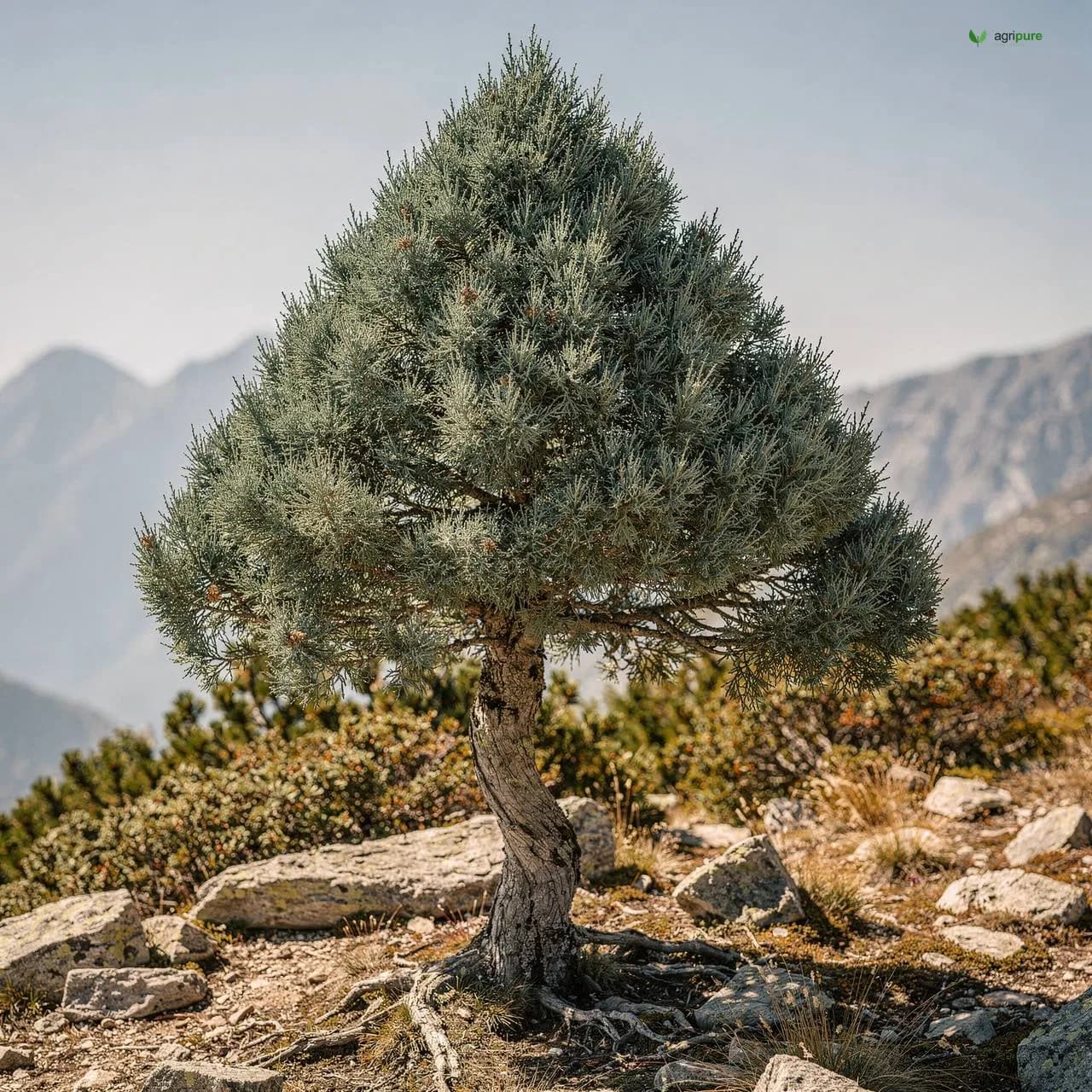
climax
Pashtun Juniper (Obusht / Ziarat Juniper)
صنوبر / اوبشت
Juniperus excelsa subsp. polycarpos
Also known as Obusht (Pakistan).
- balochistan highlands
- kpk hills
International hardiness
- USDA 6-9
- RHS H6
- AU: Arid / semi-arid, Warm temperate, Mediterranean
Where it grows — regional guide
| Zones / rating | Regional notes |
|---|---|
USDA 6-9 | No region-specific data yet |
| Zones / rating | Regional notes |
|---|---|
H6 (-20 to -15C) | No region-specific data yet |
| Zones / rating | Regional notes |
|---|---|
Arid / semi-arid, Warm temperate, Mediterranean | No region-specific data yet |
| Zones / rating | Regional notes |
|---|---|
USDA 6-9 (USDA scale) Canada uses its own zone system; Canadian zones run roughly one lower than USDA. | No region-specific data yet |
| Zones / rating | Regional notes |
|---|---|
Balochistan highlands, KPK hills | Pakistan:Ancient, slow-growing conifer of cold arid highlands; wild stands face conservation limits and cones are not safe to consume. India:Native across cold western Himalayan ridges; slow evergreen shelter tree whose wild stands face conservation limits and whose cones are not safe to consume. |
Juniperus excelsa subsp. polycarpos (the Pashtun or Persian juniper, known as obusht in Pashto and apurs in Balochi) is an extraordinarily long-lived, drought-hardy evergreen conifer of the Cupressaceae family. In Pakistan, it forms the famous high-elevation dry juniper forests of Ziarat, Zarghoon, Harboi, and Loralai in Balochistan, as well as dry inner valleys of Chitral, Gilgit-Baltistan, and Kurram between 2,000 and 3,300 metres.
Ecology of Balochistan’s ancient juniper woodlands
Growing on skeletal calcareous and rocky mountain soils under 200 to 400 mm of erratic annual precipitation (mostly winter snow), Juniperus excelsa subsp. polycarpos endures extreme summer insolation and winter temperatures below -20°C (USDA Zones 5–9, RHS H6). Radial trunk growth averages scarcely 1 to 2 mm per decade on arid ridges, producing multi-century and millennial patriarch trees that regulate snowmelt infiltration and recharge highland karez and spring aquifers.
Establishment, conservation, and agroforestry use
Because natural seed viability is low (often 5% to 15% filled seed due to drought stress and berry-mining insects) and seeds exhibit deep morphophysiological dormancy, natural regeneration requires nurse-shrub microclimates (such as Caragana ambigua, Berberis baluchistanica, or Cotoneaster nummularius) that shield seedlings from desiccation and livestock trampling.
- Site requirements: Full mountain sun and sharply draining gravelly or limestone substrates; intolerant of waterlogged clay or humid lowland monsoon heat.
- Seed stratification: Extract seeds from mature dark-purple/blue-black female cones in autumn, scarify lightly, and provide 60–90 days of warm stratification followed by 90 days of cold moist stratification at 2–4°C.
- Watershed protection: Never clear-fell or strip bark from living trees; establish thorny nurse shrubs on degraded contour micro-catchments to shelter young juniper outplantings.
- Livestock caution: Essential oils in juniper foliage and cones can cause gastrointestinal irritation and abortion in pregnant small ruminants if browsed heavily during forage shortages.
Sources
- Nasir, E. & Ali, S.I. (Eds.). Flora of Pakistan, No. 184: Gymnospermae (Juniperus excelsa M. Bieb. subsp. polycarpos). University of Karachi.
- Sarangzai, A.M., Ahmed, M. et al. (2012). Ecology and dynamics of Juniperus excelsa forests in Balochistan, Pakistan. Pakistan Journal of Botany.
- Farjon, A. (2010). A Handbook of the World’s Conifers: Juniperus excelsa subsp. polycarpos. Brill, Leiden.
Sourcing notes
Juniper is very slow and hard to regenerate from seed, so the practical priority is protecting and naturally regenerating existing Ziarat-area stands rather than mass planting. Where nursery stock exists, use it for restoration on cold, dry highland sites only.