pioneer
Castor
arand
Ricinus communis
Also known as Arand (Pakistan), Arandi (India), Castor Bean (United States), Castor Oil Plant (UK & Ireland, Australia).
- punjab plains
- sindh coast
- pothohar
International hardiness
- USDA 9-11
- RHS H2
- AU: Tropical, Subtropical, Arid / semi-arid, Warm temperate, Mediterranean
Where it grows — regional guide
| Zones / rating | Regional notes |
|---|---|
USDA 9-11 | Grown as an architectural summer annual in the north; seeds are lethally toxic and the plant can be invasive in warm states. |
| Zones / rating | Regional notes |
|---|---|
H2 (1 to 5C) | Grown as a tender summer foliage annual that dies with frost; all parts, especially seeds, are dangerously poisonous if ingested. |
| Zones / rating | Regional notes |
|---|---|
Tropical, Subtropical, Arid / semi-arid, Warm temperate, Mediterranean | A common environmental weed of warm districts and waste ground; the seeds are severely toxic to people and livestock, so keep it away from stock and check local restrictions before planting. |
| Zones / rating | Regional notes |
|---|---|
USDA 9-11 (USDA scale) Canada uses its own zone system; Canadian zones run roughly one lower than USDA. | No region-specific data yet |
| Zones / rating | Regional notes |
|---|---|
Punjab plains, Sindh coast, Pothohar | Pakistan:A fast, coarse pioneer shrub for reclaiming bare ground on the plains and Pothohar rather than a food or fodder plant; the seeds contain ricin and every part is treated as toxic to people and livestock. India:A major oilseed crop of dry plains; the seeds are lethally poisonous to livestock and humans and require cautious handling. |
Grows alongside
Species that appear with Castor in 2 of our published guides — a starting list for a guild, not a planting plan.
Ricinus communis, the castor or arand, is the fast, coarse pioneer you reach for when you need to throw shade and biomass over bare, broken ground in a single season. It germinates readily, shoots up to a tall soft-wooded shrub fast, and its big palmate leaves cover and cool the soil quickly. The honest reason a Pakistani grower plants it is rapid groundwork: it conditions a rough site cheaply while slower trees establish. But the seeds contain ricin, one of the most toxic plant compounds known, so it is a working tool to handle and site with care, never a food.
Where it thrives
Castor takes the Punjab plains, the Sindh coast, and the Pothohar belt easily, tolerating poor, disturbed, and dryish soils in full sun. POWO records it as a shrub or tree of the seasonally dry tropics, naturalised far beyond its African origin,1 which is exactly why it volunteers on waste ground here. It is fast but not especially drought-hardy at full size; it grows best with some moisture and warmth and resents hard frost and waterlogging. On marginal land it still performs where you simply need fast cover.
Role in the system
Castor is a short-lived pioneer for the gap-and-recovery phase of a food forest, not a permanent guild member. Use it to colonise bare or compacted patches fast, where its quick canopy shades out weeds and its large leaves become chop-and-drop mulch that feeds the soil for the secondary stratum coming behind it. It does not fix nitrogen, so do not claim that; its value is speed and bulk biomass. Because the seed is acutely toxic, keep it out of any layer near edibles, fodder, or grazing animals. Treat it as a sacrificial nurse plant: it opens and conditions ground, then you cut it out as the longer-lived strata take over.
Growing it
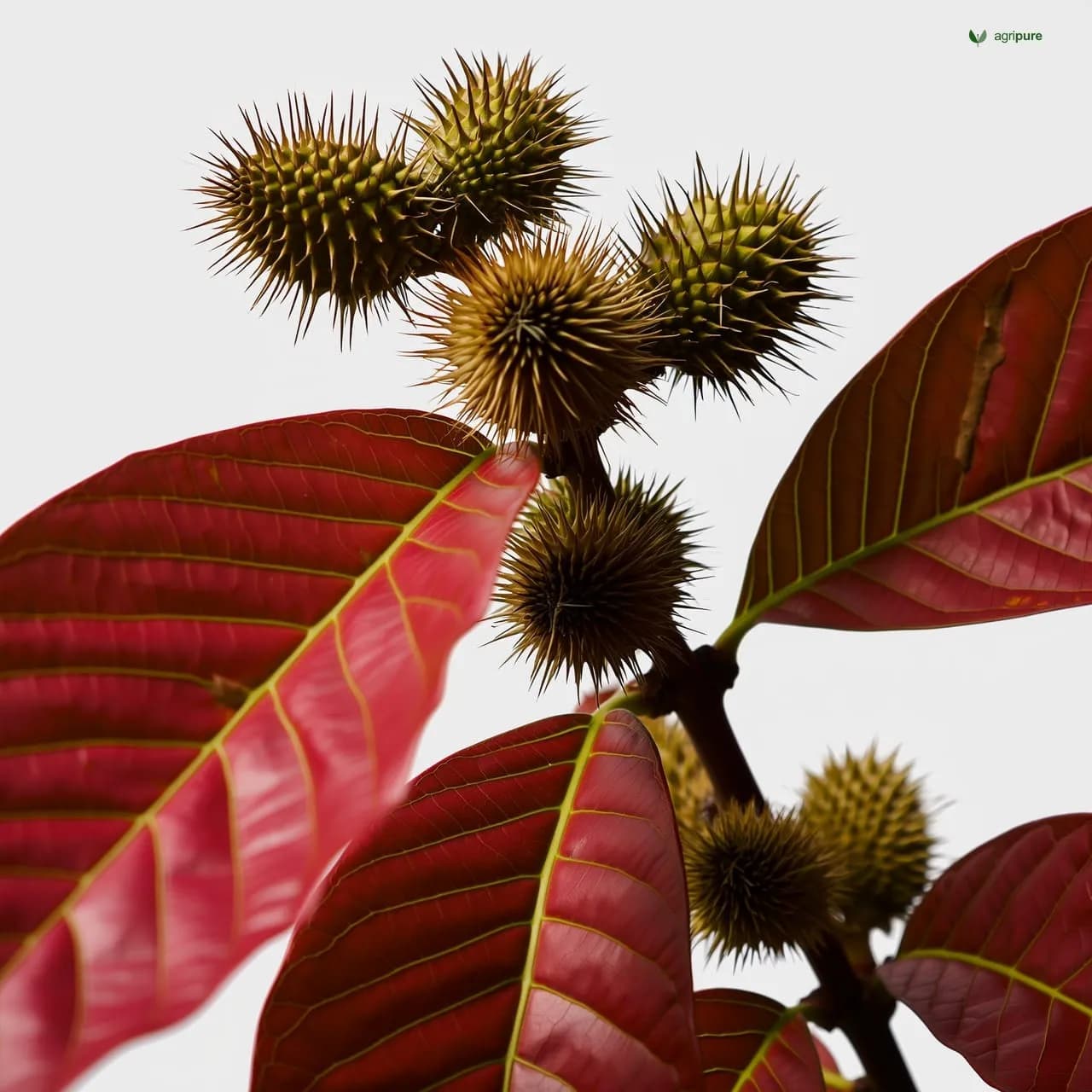
Two decisions decide both success and safety. First, containment: castor self-seeds aggressively and can become weedy, so cut the spiny seed capsules before they shatter unless you specifically want it to spread, and pull volunteers you do not want. Second, the seed hazard: every part is best treated as toxic and the seeds are lethal if eaten, so harvest, handle, and dispose of capsules with gloves, and keep them strictly away from children and livestock. Direct-sow at 1 to 1.5 metre spacing; it needs little care once up. Coppice for biomass before flowering to limit seeding.
What you get
What you get is fast soil cover and large volumes of green mulch on land that grew nothing. Castor is grown commercially for its non-edible seed oil, but the de-oiled cake is dangerous and must be detoxified before any feed or fertiliser use. For the small grower the realistic yield is biomass and shade, taken across the warm season. The economic angle is reclamation: near-zero-cost groundwork that prepares marginal ground for productive planting.
Sourcing notes
Propagate from seed, which is freely available and germinates fast; no nursery skill is needed. Companion it only as a temporary nurse over young pioneer and secondary plantings, never beside vegetable beds or animal runs. The defining sourcing rule is the seed: store, sow, and dispose of it where no child or animal can reach it, because the toxicity is the plant’s main risk, not a footnote.
Sources
- POWO (2024). “Ricinus communis L.” Plants of the World Online, Royal Botanic Gardens, Kew.
- Worbs, S., et al. (2011). “Ricinus communis Intoxications in Human and Veterinary Medicine – A Summary of Real Cases.” Toxins (Basel).
- Feedipedia (2020). “Castor bean (Ricinus communis) seeds, oil meal and by-products.” INRAE, CIRAD, AFZ and FAO.