secondary
Karonda
karonda (کرونڈا)
Carissa carandas
- punjab plains
- sindh coast
International hardiness
- USDA 9-11
- RHS H1c
- AU: Tropical, Subtropical, Warm temperate
Where it grows — regional guide
| Zones / rating | Regional notes |
|---|---|
USDA 9-11 | Defensive hedge in USDA zones 9 to 11 with edible ripe fruit; unripe berries are astringent, stems bear sharp thorns, and medicinal use needs care. |
| Zones / rating | Regional notes |
|---|---|
H1c (5 to 10C) | No region-specific data yet |
| Zones / rating | Regional notes |
|---|---|
Tropical, Subtropical, Warm temperate | Impenetrable spiny living fence with edible ripe fruit; unripe berries are astringent, stems are heavily armed, and medicinal use needs care. |
| Zones / rating | Regional notes |
|---|---|
USDA 9-11 (USDA scale) Canada uses its own zone system; Canadian zones run roughly one lower than USDA. | No region-specific data yet |
| Zones / rating | Regional notes |
|---|---|
Punjab plains, Sindh coast | Pakistan:Thorny evergreen barrier shrub; ripe fruit is edible but unripe is astringent, stems bear sharp thorns, and medicinal use needs care. India:Thorny shrub grown for living fences and ripe berries; unripe fruit is astringent, stems bear sharp thorns, and medicinal use needs care. |
Karonda (Carissa carandas) is a thorny, evergreen fruiting shrub in the dogbane family (Apocynaceae), native to the Indian subcontinent and now grown across arid to semi-arid tropical and subtropical regions for its tart, vitamin-rich fruit, its use as a living fence, and a long history of traditional medicinal use. Also sold as karaunda, Bengal currant, carandas plum, or Christ’s thorn, it does two jobs from one planting: the dense, spiny growth makes a stock-proof hedge while the same shrub crops a useful berry, turning a marginal-ground perimeter into a productive edge. The fruit is generally edible when ripe, but as with other dogbane-family plants, different parts contain bioactive compounds, so only the fruit is widely treated as food and any medicinal use calls for caution and professional guidance.
How to identify it
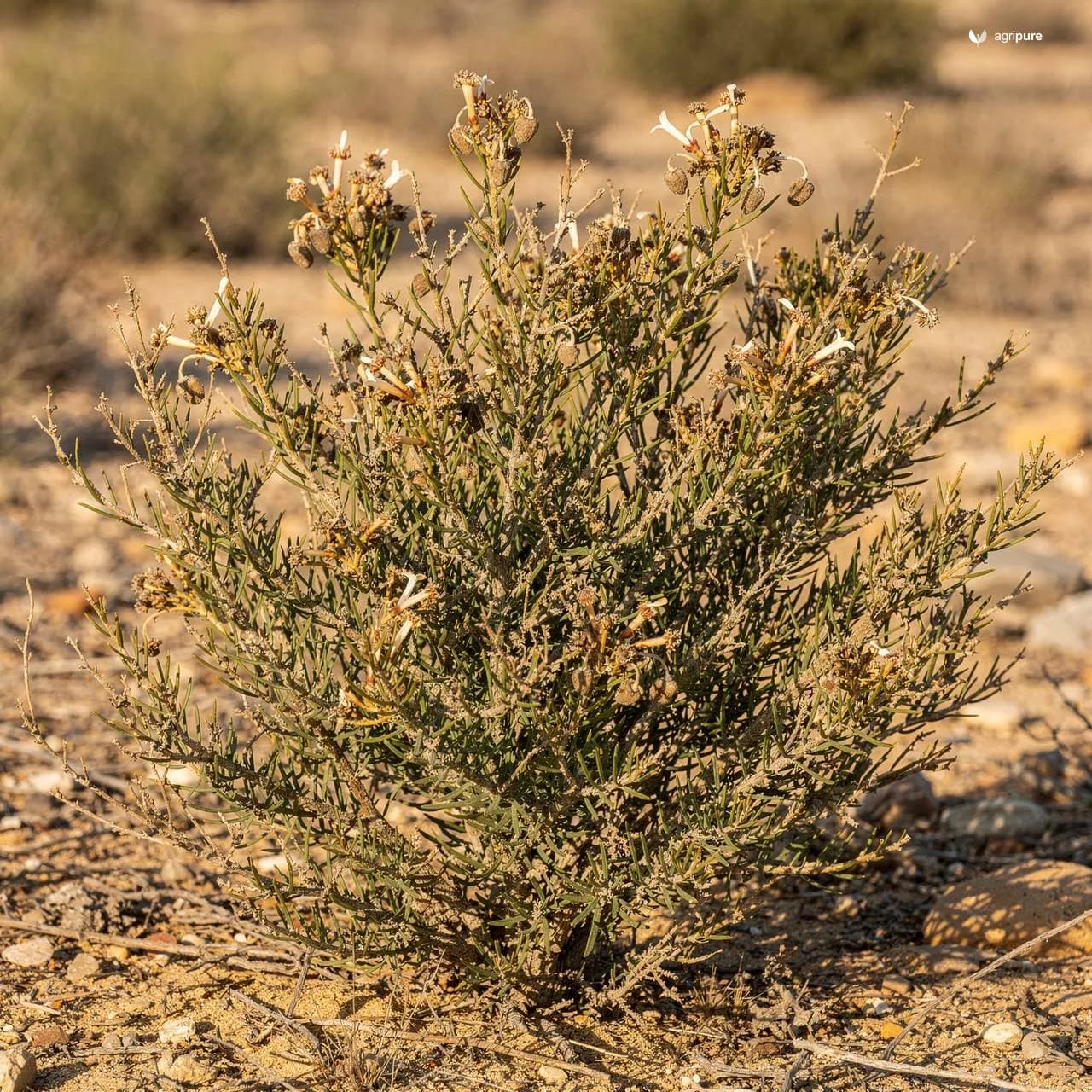
Karonda is a hardy, evergreen, strongly spiny shrub, the source of the “Christ’s thorn” name, used extensively as a thorny barrier and fence in India. In hedges it is commonly 2 to 4 m tall, with some sources reporting plants up to about 4 to 5 m and trainable into taller hedges; it has also been described as a medium-sized, vine-like shrub that will climb if supported. The leaves are opposite, simple, leathery, and evergreen, typical of the genus, forming the dense canopy that makes the plant useful for hedging. The flowers are fragrant and white to pale rose, usually borne in small clusters of two or three.
The fruit is a berry-like drupe, often compared to small grapes. Immature fruits are green, very sour and astringent, while ripe fruits turn reddish to dark purple or black, becoming sub-acid to sweet with a distinctive aroma. Cultivated forms are classified by fruit colour into green-, pink-, and white-fruited types, and each fruit holds several hard seeds, typically five to seven.
Growing karonda
Karonda is built for heat and hard country: a hardy dryland fruit for arid and semi-arid regions that thrives in tropical and subtropical climates and flourishes where temperatures run high. It is very hardy and notably drought-tolerant, able to crop on marginal and waste land where other commercial crops fail, and performs as a rainfed plant needing minimal care once established. Its natural range spans the high-rainfall Western Ghats and Konkan belt of Maharashtra, Goa, and Karnataka to the temperate Himalayan Siwalik Hills at roughly 30 to 1,800 m elevation. The primary literature does not assign it a USDA hardiness zone; horticultural sources report plants survive to about 25 degrees F (around minus 4 degrees C), an informed inference pointing to roughly USDA zones 9b to 10, with best growth in frost-free climates.
The most common way to start karonda is from seed, and it is widely propagated this way for homestead and hedge use. Seeds are taken from ripe fruit (five to seven per berry) and sown fresh; one grower report notes germination within about ten days and seedlings ready to transplant after roughly 45 days. Because seedlings vary genetically in fruit size and quality, seed-raising is useful for selecting good plants but inconsistent for uniform production, which is why selected types are increasingly multiplied vegetatively to fix fruit quality. The research here gives no consistent figures for spacing, time to first harvest, or watering, so those are omitted rather than stated with false precision. In practice, treat karonda like other warm-season dryland shrubs: full sun, free-draining ground, kept lean and dry once established, with a defensive hedge spaced closer than wider-set fruiting bushes.
Harvest and uses
Unripe green berries are sour and astringent and are traditionally used in pickles and preserves, while the ripe red-to-dark fruit turns sub-acid to sweet and can be eaten fresh or worked up into jams and other products. Valued as a tart, vitamin-rich food, the fruit means a single managed hedge returns both a stock barrier and a crop from the same row. The dense spiny growth is the plant’s other main use, grown extensively as an evergreen living fence. Karonda also carries a long record of traditional medicinal use, though that sits outside any food role and should not be improvised.
Safety and cautions
Karonda’s ripe fruit is the only part widely regarded as food. The sources are explicit that, like other plants in the dogbane family (Apocynaceae), various parts of the shrub contain bioactive compounds, so it should not be casually consumed beyond the ripe fruit; unripe green berries are markedly sour and astringent and are used cooked or pickled rather than eaten raw in quantity. Its long history of traditional medicinal use is not the same as a proven treatment, and this profile makes no claim that the plant treats or cures any condition; the sources describe medicinal use as requiring caution and professional guidance. As a general principle with any plant in this family, anyone pregnant or breastfeeding, or taking prescription medication, should seek qualified advice before using it medicinally. The shrub is also heavily armed with thorns, so handle and prune it with gloves and care.
Sources
- Carissa carandas – Wikipedia
- Karanda (Carissa carandas) – Trade Winds Fruit
- Karonda: A Semi-Wild Fruit – College of Horticulture and Forestry, Central Agricultural University
- Carissa carandas: nutritional and functional properties – ScienceDirect