pioneer
Indian Sweet Clover
senji
Melilotus indicus
Also known as Senji (Pakistan, India).
- punjab plains
- sindh coast
- pothohar
International hardiness
- USDA 5-9
- RHS H5
- AU: Warm temperate, Mediterranean, Arid / semi-arid, Subtropical, Cool temperate
Where it grows — regional guide
| Zones / rating | Regional notes |
|---|---|
USDA 5-9 | A cool-season annual legume volunteering in open ground; contains coumarins that present an anticoagulant bleeding hazard to livestock. |
| Zones / rating | Regional notes |
|---|---|
H5 (-15 to -10C) | No region-specific data yet |
| Zones / rating | Regional notes |
|---|---|
Warm temperate, Mediterranean, Arid / semi-arid, Subtropical, Cool temperate | Naturalized annual legume in pastures and waste ground across temperate and mediterranean zones; carries toxic coumarins causing bleeding hazards in livestock. |
| Zones / rating | Regional notes |
|---|---|
USDA 5-9 (USDA scale) Canada uses its own zone system; Canadian zones run roughly one lower than USDA. | No region-specific data yet |
| Zones / rating | Regional notes |
|---|---|
Punjab plains, Sindh coast, Pothohar | Pakistan:A rabi green fodder crop across the plains; coumarin content presents an anticoagulant bleeding risk to livestock. India:Sown as a rabi green fodder and cover crop; contains coumarins that carry toxic anticoagulant bleeding risks to livestock. |
Grows alongside
Species that appear with Indian Sweet Clover in 2 of our published guides — a starting list for a guild, not a planting plan.
Indian sweet clover (Melilotus indicus) is a small, yellow-flowered annual legume in the pea family, Fabaceae, sometimes listed under the synonyms Melilotus parviflorus or Trifolium indicum. It is one of the “sweet clovers” or melilots, native to a broad belt that runs from Macaronesia and northern Africa across Europe and into temperate and tropical Asia, with North American floras describing it more narrowly as a Mediterranean-area native. From that home range it has naturalised widely across temperate regions of the world and is now common in disturbed ground. For a homesteader it is most useful as a low-input cool-season cover and forage legume that volunteers readily on poor, open soil, though it carries real toxicity cautions that make it a plant to understand before you turn it into hay or fodder.
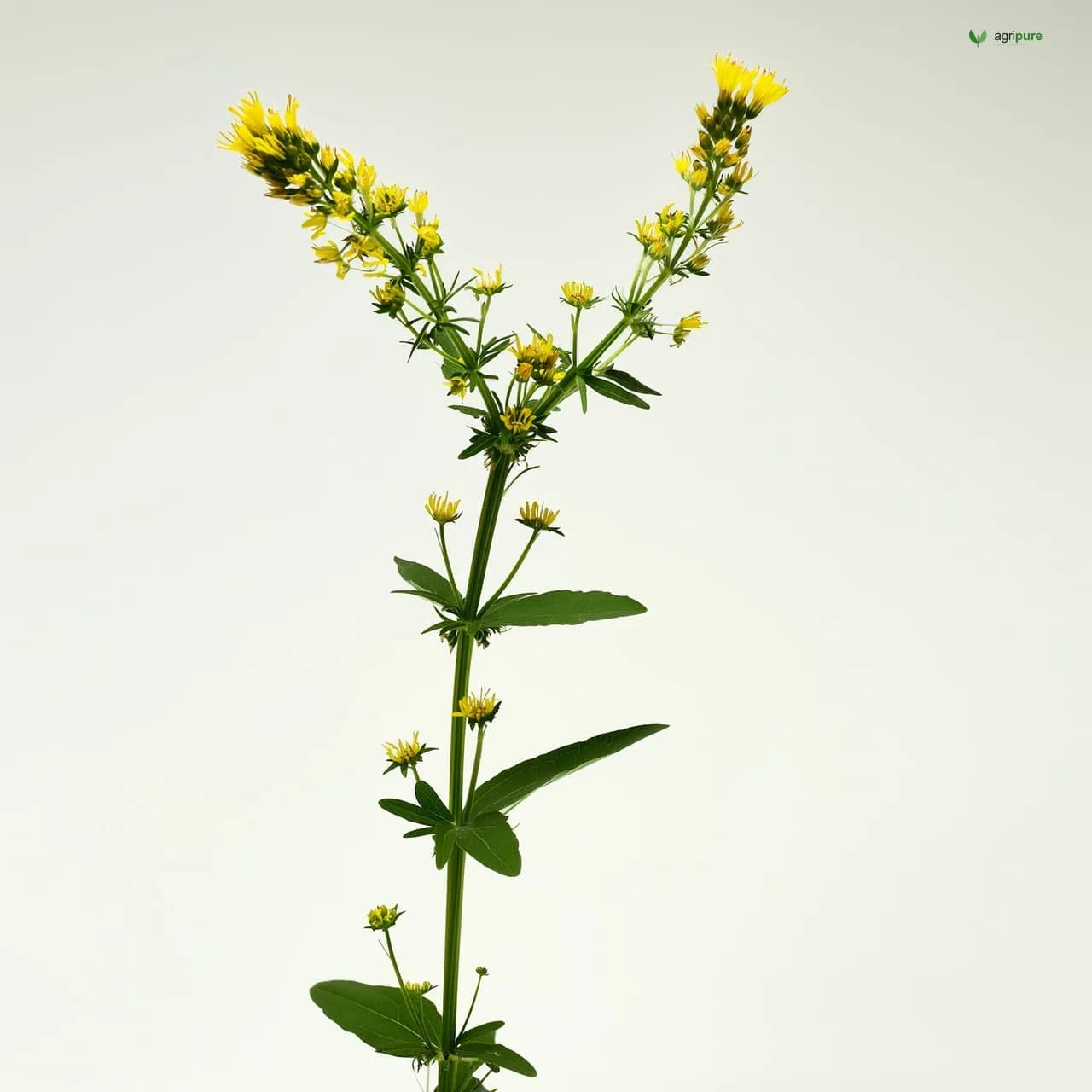
It is a herbaceous forb, usually 10 to 50 cm tall and occasionally reaching about a metre in some floras, with upright to spreading stems that branch in the upper part and are glabrous (hairless). The leaves are compound and trifoliolate (three leaflets per leaf, clover-fashion), borne alternately along the stem. Each leaflet is oblanceolate to obovate, roughly 10 to 25 mm long and 5 to 10 mm wide, and sharply toothed (serrulate) along the broader outer margin. The flowers are tiny, pea-shaped and yellow, only about 2 to 3 mm long, packed into slender spike-like racemes 2 to 8 cm long that arise from the leaf axils. Each flower gives way to a small one-seeded pod. Crushed leaves and flowers carry the characteristic sweet “melilot” fragrance of the genus, which comes from coumarin compounds in the tissue. Helpful negative field characters: there is no milky sap, and the stems are unarmed, with no thorns.
Growing Indian sweet clover
Indian sweet clover is grown from seed. It is an annual (occasionally reported as annual or biennial) that reproduces and persists from its own seed, and it is described as self-fertilised, largely self-pollinating, which helps it re-establish itself once it has set seed in a spot. The sources here do not record any special seed pre-treatment such as scarification or stratification for this species, so it is best treated like other small legume seeds rather than assumed to need extra handling.
It is very much a plant of open, disturbed, sunny ground. In the wild and as a weed it turns up on roadsides, in fields and waste places, in ditches, and on other open disturbed sites, and it is classed as a facultative upland (FACU) plant, meaning it usually grows in drier, non-wetland conditions rather than in soggy ground. That habitat profile is the practical guidance the literature supports: give it sun and free-draining, even rough or poor soil, and it will establish without much fuss. The cited sources do not give consistent figures for sowing rate, plant spacing, or days to maturity for this species, so those are left out rather than stated with false precision.
The plant flowers over a long window that shifts with climate. In parts of the United States, such as Louisiana and California, it blooms from April into October, while in the cooler Pacific Northwest it flowers mainly from May to July. Its documented distribution runs from the cool coastal climate of British Columbia and Washington south to California, and across the southern United States and eastern North America, which shows how broad a temperature range it tolerates as a self-seeding annual. Primary sources do not assign it a USDA hardiness zone, so no single figure is claimed here.
Harvest and uses
Indian sweet clover’s main documented value is as a forage and soil-improving legume. As a member of the pea family it is the kind of plant grown to feed grazing animals and to enrich the ground, and its quick, self-seeding establishment on poor, disturbed land makes it a natural choice for covering bare or marginal soil. The sources here do not provide reliable yield figures, harvest dates, or culinary uses for this species, so none are claimed; the recorded use is forage and improvement of the soil rather than a food crop.
Safety and cautions
Although it is grown as forage, Indian sweet clover is documented as carrying toxic and anticoagulant risks, and it should be handled with that in mind. Like other sweet clovers, its tissues contain coumarin, the compound class responsible for its sweet smell. In the broader Melilotus group these coumarins are the source of the well-known “sweet clover” bleeding hazard to livestock, and the research flags this species specifically for documented anticoagulant risk, so treat it as a plant that needs caution before it is fed to animals or used in any other way. This profile makes no medical claims and gives no dosages; the responsible approach is to identify the plant accurately and seek qualified guidance before relying on it as fodder or for any medicinal purpose.
Sources
- Melilotus indicus – Wikipedia
- Melilotus indicus (annual yellow sweetclover) – USDA PLANTS Database
- Melilotus indicus species details – U.S. Geological Survey
- Melilotus indicus – Burke Herbarium Image Collection, University of Washington
- Melilotus indicus, Annual Yellow Sweetclover – Southwest Desert Flora
- Melilotus indicus (annual yellow sweet-clover) – Go Botany, Native Plant Trust