Key takeaways

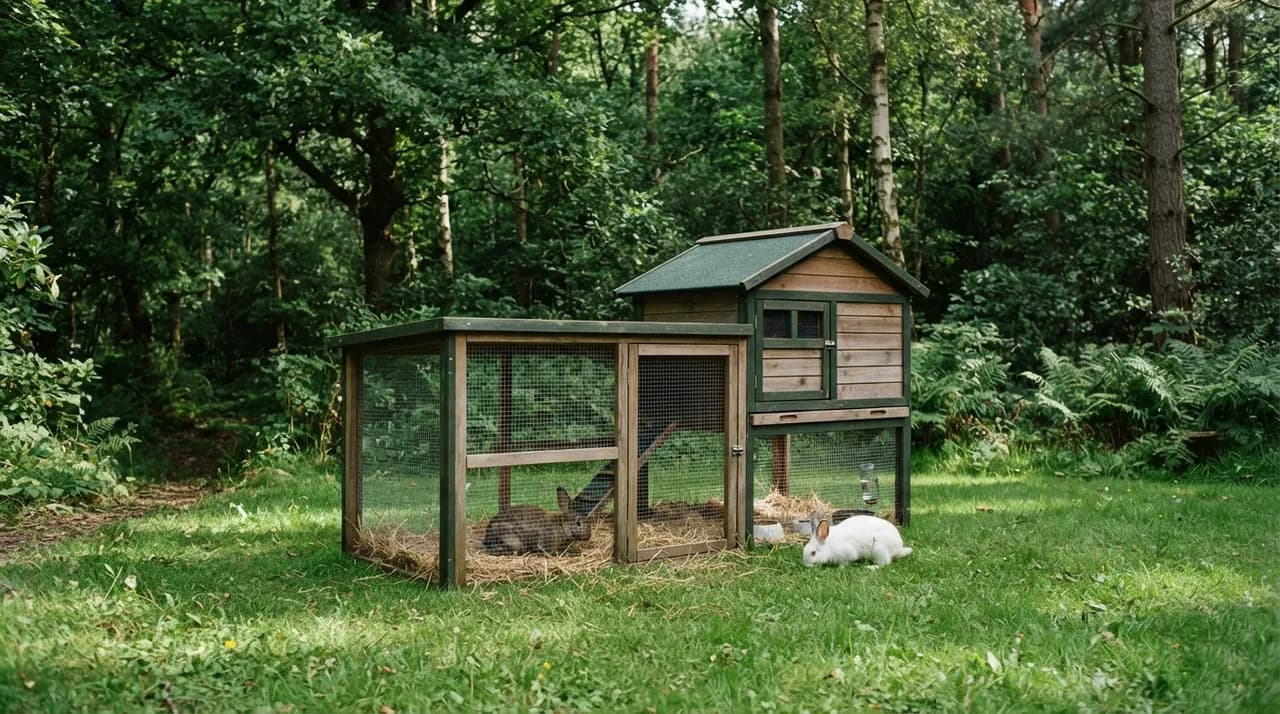
A typical outdoor rabbit hutch design providing proper ventilation, shade, and predator protection.
- Meat rabbits are the quietest, smallest-footprint livestock a homesteader can keep: a doe and her litters are legal inside most city limits, the cages take little room, and a medium breed reaches a 5-pound fryer in about 10 weeks on a high feed-conversion diet.
- The two workhorse meat rabbit breeds are the New Zealand White and the Californian, both medium-weight at 9 to 12 pounds; heritage options like the Silver Fox, American Chinchilla, and Rex add pelt value, and the Flemish Giant adds size but grows slowly.
- Housing is a welfare problem as much as a shelter problem. Wire floors keep cages clean but cause sore hocks, so every cage needs a solid resting board or mat, at least 30 by 30 by 20 inches of space, and real protection from heat and predators.
- Feed is unlimited grass hay plus a measured ration of 18%-fiber pellets and safe forage. A diet too low in fiber and too high in starch is the direct path to gastrointestinal stasis, the condition that kills more rabbits than any predator.
- One buck services about 10 does; gestation runs roughly 31 days, litters average 8 to 10 kits, and weaning lands around 4 to 6 weeks, so one doe can produce about five litters a year. Processing is straightforward, fast, and worth doing respectfully.
A single medium doe, bred five times a year and weaning 8 kits a litter, can put more meat in the freezer than most backyard flocks — and she does it in a hutch the size of a large dog crate, without a rooster’s crow to annoy the neighbors. That is the quiet case for meat rabbits, and it is why homesteaders on small lots keep coming back to them. This guide covers the whole arc: why rabbits earn their space, which breeds to start with, how to house them without hurting them, what to feed and what to never feed, how breeding and grow-out actually work, and how to handle processing factually and without flinching. Every number here (breed weights, gestation days, litter size, weaning age, butcher weight, cage dimensions) traces to a university extension program, the Merck Veterinary Manual, a heritage-breed registry, or peer-reviewed work. Where the real-world figures are messier than the homestead lore, this guide says so.
Why meat rabbits earn their space
Meat rabbits make a case against the louder alternatives. A pig is large, a goat needs fencing and a companion, and a rooster will get you a noise complaint. A meat rabbit does none of that, asking only a cage of about 6 square feet and almost no sound, which is why three advantages keep pulling small-lot homesteaders back to them: space, efficiency, and the meat itself.
Space, legality, and quiet
The first advantage is footprint. Oregon State University Extension puts it plainly: rabbits are allowed within city limits, and their cages often take little room. A doe lives comfortably in a cage about 30 inches square, makes almost no noise, and needs no pasture. For a homesteader on a quarter-acre lot, or inside a zoning code that bans poultry, that single fact is often the deciding one.
Feed efficiency and grow-out speed
The second advantage is efficiency. Rabbits convert feed to meat quickly because they are butchered young (most are processed as fryers by 10 weeks) and because they have, in Oregon State’s words, a high feed conversion rate, meaning they require less feed per pound of meat produced. Penn State Extension notes that a medium breed reaches the standard 5-pound slaughter weight at about 10 weeks of age, so feed and labor inputs to convert feed to meat stay low.
Be honest about that efficiency, though. The often-repeated “3 pounds of feed per pound of rabbit” is a best-case figure from optimized commercial barns. A 2021 study of a semi-intensive Argentine system, published in World Rabbit Science, measured a global feed conversion rate of 6.9 (close to 20 kg of feed per animal produced) once you count the breeding does, the bucks, and the inevitable losses. Your backyard number lands somewhere between those poles. Rabbits are genuinely efficient; they are not magic.
Lean, mild meat
The third advantage is the meat itself. Oregon State describes rabbit as high in protein and B vitamins, and low in fat, sodium, and cholesterol — a lean white meat that tastes mild, somewhere between chicken and pork. For a household raising more of its own protein on less than 100 square feet of cages, that is a strong nutritional return on a small daily chore. If you already keep a backyard flock, rabbits slot in beside pastured chickens as the second, quieter protein source.
The best meat rabbit breeds to start with
That lean meat comes fastest from the right breed, and of the 50-odd rabbit breeds recognized in North America only a handful are true meat rabbits. The trait that matters is growth rate (how fast a kit reaches a 5-pound butcher weight on a given amount of feed), followed by litter size, mothering, and, if you want it, pelt quality. Penn State is direct about the top pick: for meat production, medium-weight New Zealand Whites are best, followed by Californians. Oregon State agrees, calling Californians and New Zealand the leading commercial breeds because of their consistent color and growth rate.
Here is how the common meat rabbit breeds compare.
Breed | Mature weight | Type | Litter / traits | Best for |
|---|---|---|---|---|
New Zealand White | 9 to 12 lb | Medium, commercial | 8 to 10 kits, fast even growth | The default fryer |
Californian | 9 to 12 lb | Medium, commercial | Blocky meaty carcass | Crosses with New Zealand |
Silver Fox | 11 to 12 lb | Large, heritage | 6 to 8 kits, ~65% dress-out, fine pelt | Meat and fur |
American Chinchilla | 9 to 12 lb | Large, heritage | Hardy, gentle, rare | Meat and pelts |
Rex | ~7.5 to 10.5 lb | Medium | Plush pelt; prone to sore hocks | Pelt plus meat |
Flemish Giant | over 20 lb | Giant | “Gentle Giant,” slow grower | Crossing in for size |

The commercial standards
- New Zealand White. The default meat rabbit and the benchmark every other breed is measured against. A medium breed at 9 to 12 pounds mature weight, with the fast, even growth and the 8-to-10-kit litters that built the commercial industry. If you want one breed and no fuss, start here.
- Californian. The close second, a medium breed of similar weight, bred for the same fast growth and a blocky, meaty carcass. New Zealand–Californian crosses are the backbone of commercial rabbitries because the cross combines growth rate with hybrid vigor.
The heritage and dual-purpose breeds
- Silver Fox. One of only three rabbit breeds developed in the United States, created by Walter B. Garland of Ohio and raised for both meat and fur. Bucks reach 11 pounds and does 12; at its peak the breed was said to dress out at up to 65% of live weight with a good meat-to-bone ratio, and does raise calm litters of 6 to 8 kits. It graduated from The Livestock Conservancy’s priority list in 2026 — a heritage breed worth supporting.
- American Chinchilla. A large, hardy, gentle breed bred specifically to be better suited for meat and pelts, with bucks at 9 to 11 pounds and does at 10 to 12. It is the rarest of the Chinchilla breeds, its numbers thinned by the collapse of the rabbit fur trade in the late 1940s.
- Rex. Prized for a plush, velvety pelt as much as its meat. Be warned that the Rex’s short coat is also its weakness in a wire cage — more on that in the housing section.
- Flemish Giant. The giant of the group, often over 20 pounds, exported to America in the 1890s to improve the size of meat rabbits during the great rabbit boom. It earns its “Gentle Giant” nickname, but giant breeds grow slowly and eat heavily, so the Flemish Giant is usually crossed in for size rather than raised as a pure fryer line.
The practical move for most homesteaders is to buy 2 or 3 proven New Zealand or Californian does from a local rabbitry, learn the system on a forgiving breed, and only branch into heritage lines once you know what good growth looks like.
Housing: hutch, cage, or colony
Those breeds all need the same thing once you own them: housing that keeps them clean, safe, and off their own feet. Housing is where good intentions meet rabbit biology, and where most beginners get it wrong. There are three broad systems: individual cages, the traditional hutch, and group or colony pens, and each trades cleanliness against welfare differently.
Cages and hutches
The commercial standard is the individual wire cage, and Penn State gives the specifications: mature bucks and does should have individual cages at least 30 inches wide, 30 inches deep, and 20 inches high. The wire itself is specified too — 1-by-2-inch mesh for the sides and top, and a finer 0.5-by-1-inch mesh for the floor, small enough to support the feet while letting droppings fall through to a tray below. That wire floor is what keeps a rabbit cage hygienic without daily mucking, and it is the single biggest reason cages beat solid-floor hutches for disease control.
The wire floor is also the source of the most common housing injury. Sore hocks (properly, ulcerative pododermatitis) are caused, in the Merck Veterinary Manual’s words, by pressure on the skin from bearing the body weight on wire-floored cages, with secondary infection of the broken skin. The condition attacks the plantar surface of the 2 hind feet, and it is made worse by an accumulation of urine-soaked feces and by the type of wire used. The fix keeps the wire and simply breaks it up: every cage needs a solid resting board or mat covering part of the floor, so the rabbit can get its feet off the mesh. Merck is explicit that the treatment is to give the rabbit a solid floor (board or mat) on which to sit or rest. A scrap of plywood or a ceramic tile is enough.

Always put a resting board on a wire floor. Sore hocks come from a rabbit’s weight pressing its feet into bare mesh, and they are painful and slow to heal. A square of plywood or a ceramic tile covering part of the cage floor lets the rabbit rest off the wire. The Rex, with its short hock fur, and the heavy Flemish Giant need this most — for them the mat is not optional.
Colony raising
Colony or group housing (does and grow-outs together on a deep-litter or earth floor, often 10 or more square feet per group) is the welfare-forward alternative, letting rabbits hop, dig, and socialize in a way a cage cannot. It is more natural and, for many keepers, more pleasant to manage. The honest tradeoffs are real, though: ground colonies make parasite and disease control harder, mixing intact animals invites fighting and unplanned breeding, and you lose the clean individual records a cage system gives you. Peer-reviewed welfare studies comparing wire cages with group pens find better movement and behavior in groups but more foot and hygiene problems on solid floors: there is no free lunch. A reasonable middle path many homesteaders settle on is individual cages for breeding does and bucks, with a larger colony pen for weaned fryers during their short grow-out.
| Wire cage / hutch | Colony / group pen |
|---|---|---|
Cleanliness | High — droppings fall through wire | Lower — solid floor needs mucking |
Welfare / movement | Limited; needs resting board | Better — hop, dig, socialize |
Disease & parasites | Easier to control | Harder to control |
Breeding records | Clean, individual | Mixed; risk of unplanned litters |
Best use | Breeding does and bucks | Weaned fryers in grow-out |
Protection from heat and predators
Whatever the system, two threats will undo it. The first is heat. Rabbits are far more vulnerable to heat than to cold: a peer-reviewed review notes they have fewer sweat glands and a thicker coat of fur than other livestock, so they cannot shed heat well. Another review puts the comfort zone at 15 to 25 degrees C (roughly 59 to 77 degrees F); heat stress sets in above 30 degrees C, and above 35 degrees C (95 degrees F) a rabbit can no longer regulate its body temperature at all. In a hot-summer region, shade, airflow, and frozen water bottles tucked into the cage are not luxuries — they are what keeps your herd alive in July.
The second threat is predators. A hutch is a target for dogs, raccoons, hawks, and weasels, and the 1-by-2-inch mesh chosen for ventilation will not stop a determined raccoon reaching through. Site the cages off the ground, use hardware cloth instead of chicken wire on any opening, latch every door, and roof the run against birds of prey.
Feeding meat rabbits
A protected, well-housed rabbit still needs the right diet, and a rabbit’s gut is a fiber-fermenting machine that makes feeding mostly a matter of respect for that fact. The foundation is grass hay, available at all times, with a measured ration of pellets on top. The House Rabbit Society recommends pellets that are relatively high in fiber (18% minimum) and warns against gourmet pellets that contain nuts, seeds, or grains, which trade fiber for starch the gut cannot handle.
How much pellet depends on the rabbit’s job. Penn State’s rule for the hardest-working animals is simple: pregnant does and those with litters should receive all the feed they can eat across the day, alongside the same 18%-fiber pellet the rest of the herd gets. A growing fryer also eats freely to make weight. A mature buck or a resting doe, by contrast, will get fat and sub-fertile on unlimited pellets, so those animals get a measured cup instead of a full hopper. Water matters as much as feed: Penn State notes a doe and her litter need a full gallon of water a day in warm weather, and a rabbit that stops drinking quickly stops eating.

Safe forage, and what to never feed
Part of the appeal of meat rabbits is that they will eat garden surplus and forage, turning weeds and trimmings into meat. Safe greens (dandelion, plantain, clean grass, carrot tops, most leafy herbs) can supplement the hay, but introduce any single new green slowly over 7 to 10 days instead of all at once. But several common foods are genuinely dangerous, and the House Rabbit Society’s list is worth memorizing: do not feed iceberg lettuce, nuts, legumes such as beans, yogurt, bread, crackers, seeds, popcorn, onion, garlic, potatoes, chocolate, or rhubarb. Watery iceberg lettuce in particular can trigger diarrhea, and the starchy and sugary items feed the wrong gut bacteria. Introduce any new green in a small amount and watch the droppings before making it a staple.
A reliable, clean water supply is the one input you cannot skimp on, especially with does in milk drinking 1 gallon a day. An automatic watering system pays for itself in saved labor and steadier drinking across a hot day.
Breeding basics: doe, buck, and the 31-day clock
That daily feeding routine pays off fastest when a doe is producing 5 litters a year, and breeding rabbits for meat is the most reliable part of the whole enterprise — rabbit reproduction is fast and forgiving.
The doe and the buck
The breeding pair is a doe (the female) and a buck (the male). You do not need many bucks: Penn State notes that one buck can service about 10 does, though no more than two to three times a week, so a single good buck anchors a substantial herd. Maturity comes early. Penn State says medium-weight breeds can start breeding at 6 to 7 months of age, with males maturing about a month later than females; the Merck Veterinary Manual gives a similar window, with medium-to-large breeds sexually mature at 4 to 4.5 months and giant breeds not until 6 to 9 months. The standard mating practice is to take the doe to the buck’s cage, never the reverse — a doe defends her own territory and may attack a buck brought into it.
Gestation, kindling, and weaning
After a successful mating, the clock is short and predictable. Penn State and Merck both put gestation at about 31 to 33 days. A few days before kindling (the term for giving birth), the doe is given a nest box and will pull her own belly fur to line it. Litters are generous: Penn State cites an average commercial litter of 8 to 10 kits, and Merck notes that medium-to-large does, which carry 8 to 10 nipples, often give birth to 12 or more young. Kits are born blind and hairless and develop fast. Weaning closes the cycle: Penn State weans kits at about 30 days, Merck gives a slightly wider 4-to-6-week window, and because the turnaround is so quick the math works out to an average of five litters a year per doe. That cycle of breeding, kindling in about a month, and weaning in another makes a few does productive.
From weaning to butcher weight
That weaning step hands you a pen of growing kits, and the grow-out is the simplest phase of all. Weaned kits go onto free-choice pellets and hay and grow steadily toward market weight with little intervention beyond clean water and shade. For the standard meat breeds, the target is the fryer at about 5 pounds live weight at roughly 10 weeks of age. Oregon State notes that rabbits grown past that point, butchered at a higher weight before about 6 months, are sold as roasters.
Two things decide how cleanly you hit that 10-week target: genetics and feed. Proven New Zealand or Californian stock will make weight on schedule; a slow heritage or giant breed will take longer and eat more to get there, which is the real reason the commercial industry standardized on two medium breeds. Watch the grow-outs for the early signs of trouble — a fryer that goes off its feed or stops passing droppings is a digestive emergency, not a wait-and-see.
Sexing, processing, and common health issues
That same vigilance over droppings and feed runs through the last 3 skills, which separate people who keep rabbits from people who succeed at it: telling the sexes apart, processing the animals respectfully, and catching the handful of health problems that occur most often.
Sexing
Sexing young rabbits is notoriously error-prone, and a mistake means an unplanned litter. The Merck Veterinary Manual gives the method: sex is determined by depressing the external genitalia to reveal a slit-like vulva in females or the penis in males. In a buck the protrusion is rounded and the testicles descend at around 10 to 12 weeks; in a doe the opening is a slit that runs toward the tail. It is far easier at 8 weeks and older than at birth, so confirm sex again before you pair any breeders.
Processing
Processing is the part newcomers dread and experienced keepers treat as routine. The honest version is this: a rabbit is dispatched quickly and humanely, then skinned and dressed much like any small carcass, and the whole job takes an experienced hand only a few minutes. The pelt comes off cleanly (which is why dual-purpose breeds reward the extra step), and the dressed yield is high, up to about 65% of live weight in the Silver Fox. Learn the technique hands-on from an experienced keeper or a butchering workshop instead of from a description, do it calmly and cleanly, and treat the animal with the respect any food animal is owed. Done right, it is the least dramatic part of the operation.
The health issues that matter
Most rabbit illness traces to two preventable causes: a low-fiber diet and heat. The first produces gastrointestinal stasis, which the House Rabbit Society calls the silent killer (the slowdown or cessation of gut peristalsis). It is driven by a diet too rich in digestible carbohydrates and too low in crude fiber, and left untreated it can cause a painful death in a relatively short time. The Society’s threshold is worth committing to memory: if a rabbit stops eating or passing feces for 12 hours or more, treat it as an emergency. Prevention relies on steady dietary fiber from fresh grass hay each day.
The other 2 common problems are housing-driven. Heat stress, covered above, kills fast once temperatures pass 30 degrees C and is prevented with shade, air movement, and frozen bottles. Sore hocks come from bare wire and are prevented with a solid resting board and clean cages. Add routine attention to ventilation (drafts and ammonia from dirty trays drive respiratory disease), and you have covered the great majority of what goes wrong in a backyard rabbitry. Rabbits raised for meat are hardy animals; they mostly fail from the few mistakes above, all of which are within your control.
The takeaway
Meat rabbits reward the homesteader who manages the key basics well. Pick a proven medium breed (New Zealand White or Californian) and you will reach a 5-pound fryer in about 10 weeks. House the herd in cages at least 30 by 30 by 20 inches with a solid resting board on the wire, and you sidestep sore hocks. Feed unlimited grass hay plus 18%-fiber pellets, never the starchy treats on the do-not-feed list, and you sidestep the gut stasis that kills more rabbits than any predator. Keep them cool below 30 degrees C and safe from raccoons and hawks, and the rest is a fast, productive cycle: one buck to 10 does, a 31-day gestation, 8-to-10-kit litters, weaning at a month, five litters a year. Start with two does and a buck this season, get the housing and feed right before you scale, and learn processing from someone who has done it. Few animals put this much protein on so little land, so quietly. When you are ready to add the louder, sunnier half of the homestead protein supply, pastured chickens and dairy goats are the natural next steps.
Frequently asked questions
What are the best meat rabbit breeds for beginners?
The New Zealand White and the Californian are the two best meat rabbit breeds to start with. Both are medium-weight at 9 to 12 pounds, grow fast and evenly, and raise litters of 8 to 10 kits, which is why commercial rabbitries are built on them and New Zealand–Californian crosses. Heritage breeds like the Silver Fox and American Chinchilla add pelt value and reach similar 10-to-12-pound weights, while the Flemish Giant grows past 20 pounds but matures slowly. For a first herd, buy proven New Zealand or Californian stock from a local breeder.
How long does it take to raise a rabbit to butcher weight?
About 10 weeks for a standard meat breed. Penn State and Oregon State Extension both put the fryer target at roughly 5 pounds of live weight at around 10 weeks of age, after which rabbits are grown to a heavier roaster weight if butchered before about 6 months. Hitting the 10-week mark depends on genetics and feed: a proven New Zealand or Californian on free-choice pellets and hay will make weight on schedule, while a heritage or giant breed takes longer and eats more.
How much space does a meat rabbit need?
Penn State Extension recommends individual cages for mature bucks and does that are at least 30 inches wide, 30 inches deep, and 20 inches high — about the footprint of a large dog crate. The cage floor should be 0.5-by-1-inch wire mesh so droppings fall through, with 1-by-2-inch mesh on the sides and top, but every cage also needs a solid resting board or mat so the rabbit can get its feet off the wire and avoid sore hocks.
What should you not feed meat rabbits?
The foundation of a rabbit’s diet is unlimited grass hay plus 18%-fiber pellets, and several common foods should be avoided entirely. The House Rabbit Society’s do-not-feed list includes iceberg lettuce, nuts, legumes such as beans, yogurt, bread, crackers, seeds, popcorn, onion, garlic, potatoes, chocolate, and rhubarb. Starchy and sugary foods, and very watery greens like iceberg lettuce, upset the fiber-fermenting gut and can trigger diarrhea or gastrointestinal stasis. Introduce any new green slowly and watch the droppings.
How many babies do meat rabbits have, and how often?
A meat doe averages 8 to 10 kits per litter, and Merck notes medium-to-large does often have 12 or more. Gestation is short, about 31 days, and kits are weaned at roughly 4 to 6 weeks, so Penn State Extension estimates a doe can produce about five litters a year. One buck can service about 10 does, no more than two to three times a week, so a single buck and a handful of does make a productive herd.
References
- Penn State Extension. “Rabbit Production.” extension.psu.edu
- Oregon State University Extension. “Living on the Land: Raising Rabbits for Meat — Getting Started.” extension.oregonstate.edu
- Merck Veterinary Manual. “Breeding and Reproduction of Rabbits.” merckvetmanual.com
- Merck Veterinary Manual. “Noninfectious Diseases of Rabbits.” merckvetmanual.com
- Merck Veterinary Manual. “Management of Rabbits.” merckvetmanual.com
- House Rabbit Society. “GI Stasis: The Silent Killer.” rabbit.org
- House Rabbit Society. “Rabbit Diet & Nutrition: Safe Foods and Treats.” rabbit.org
- Liu, L., et al. “Impacts of Heat Stress on Rabbit Immune Function, Endocrine, Blood Biochemical Changes, Antioxidant Capacity and Production Performance.” Antioxidants, 11(6), 1064 (2022). ncbi.nlm.nih.gov
- Abdel-Wareth, A.A.A., et al. “Ramifications of Heat Stress on Rabbit Production and Role of Nutraceuticals in Alleviating Its Negative Impacts.” (2023). ncbi.nlm.nih.gov
- The Livestock Conservancy. “Silver Fox Rabbit.” livestockconservancy.org
- American Rabbit Breeders Association. “Flemish Giant.” arba.net
- The Livestock Conservancy. “American Chinchilla Rabbit.” livestockconservancy.org
- Cossu, M.E., et al. “Global feed conversion in a semi-intensive rabbit production system of Argentina.” World Rabbit Science (2021). pubmed.ncbi.nlm.nih.gov