secondary
Lotus
kanwal
Nelumbo nucifera
Also known as Sacred Lotus (United States, UK & Ireland, Canada, Australia), Kanwal (Pakistan).
- punjab plains
- sindh coast
International hardiness
- USDA 4-11
- RHS H5
- AU: Tropical, Subtropical, Warm temperate, Cool temperate
Where it grows — regional guide
| Zones / rating | Regional notes |
|---|---|
USDA 4-11 | Hardy perennial in USDA zones 4 to 11 when overwintered below ice; contain to prevent aggressive spread, check local weed rules, process seeds before eating, and harvest only from clean water. |
| Zones / rating | Regional notes |
|---|---|
H5 (-15 to -10C) | Hardy at RHS H5 if rhizomes remain below surface ice; contain tubs to avoid spread to natural waterways, check weed regulations, process seeds, and harvest from clean water. |
| Zones / rating | Regional notes |
|---|---|
Tropical, Subtropical, Warm temperate, Cool temperate | Grown in sunny ponds across tropical, subtropical, warm-temperate and cool-temperate areas; contain rhizomes to prevent spread, check weed rules, process seeds, and harvest from clean water. |
| Zones / rating | Regional notes |
|---|---|
USDA 4-11 (USDA scale) Canada uses its own zone system; Canadian zones run roughly one lower than USDA. | Hardy in deep ponds where rhizomes stay below winter ice; contain to prevent spread, check weed regulations, process seeds before eating, and harvest from clean water. |
| Zones / rating | Regional notes |
|---|---|
Punjab plains, Sindh coast | Pakistan:Grown in sunny ponds across Punjab and Sindh; keep contained to prevent choking waterways, check local weed regulations, process seeds before eating, and harvest only from clean water. India:Prized across warm wetlands for sacred blooms; grow in contained mud to stop aggressive spread, check weed regulations, process seeds before eating, and harvest from clean water. |
Grows alongside
Species that appear with Lotus in 2 of our published guides — a starting list for a guild, not a planting plan.
Sacred lotus (Nelumbo nucifera) is a hardy, rhizomatous aquatic perennial in the family Nelumbonaceae, grown in sun-warmed ponds and tubs for its starchy rhizomes, edible seeds, and young leaves, and prized for its large, showy flowers. Also called Indian, pink, or Oriental lotus, it is an obligate aquatic that roots in the mud and lifts its leaves and blooms above the water on long stalks. For a homesteader with a pond, a stock tank, or even a wide tub, it is the productive plant of the water layer: one planting turns open water into a harvest of vegetable “root,” nutty seeds, and cut flowers.
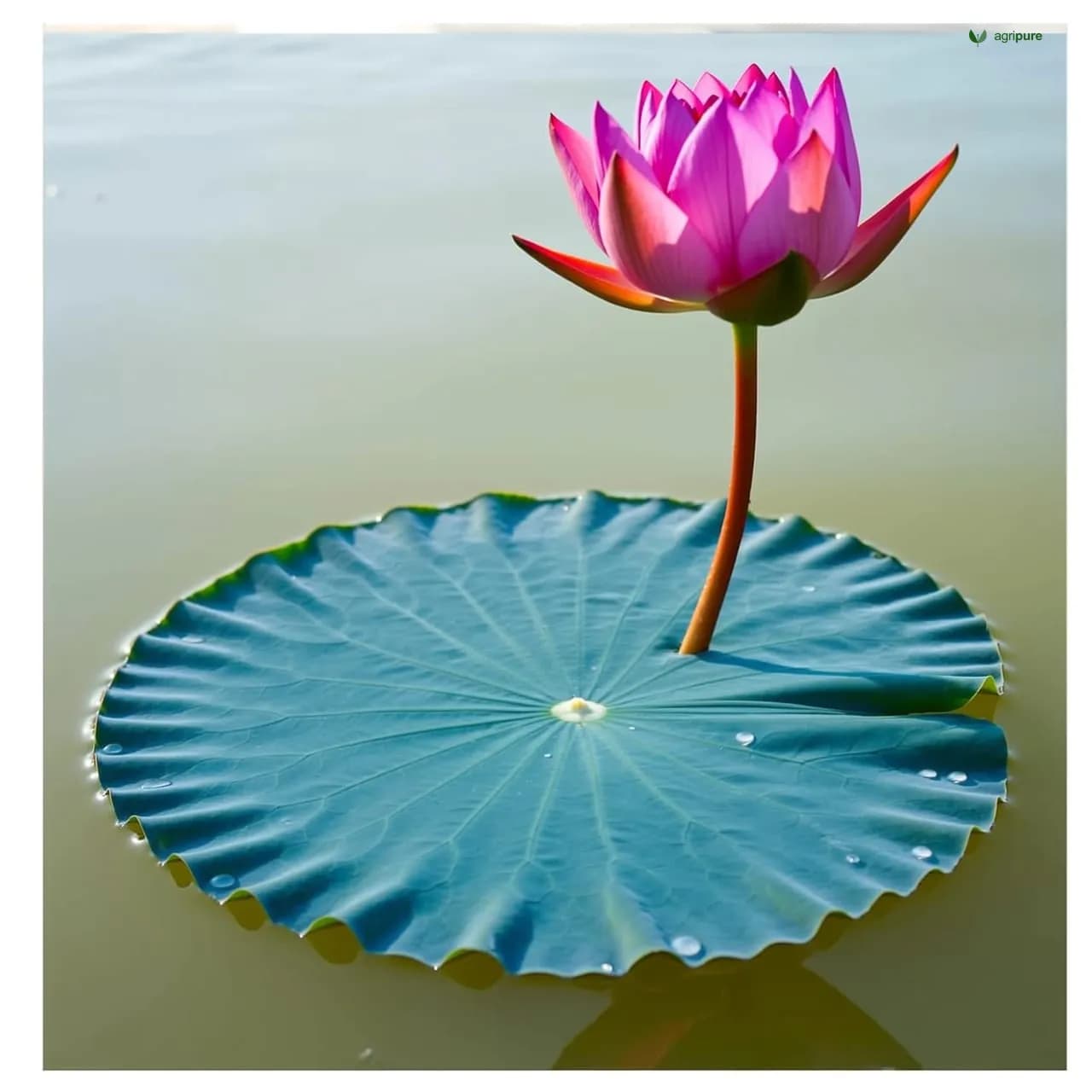
Lotus is unmistakable once you know its parts. The leaves are rounded, parasol-like, and cupped upward, with a waxy green surface, held clear of the water on long petioles; typical blades reach about 2 feet (roughly 60 cm) across, and University of Florida notes 18 to 36 inches (about 45 to 90 cm) in large forms. The flowers are large and showy, soft pink in the species (cultivars range to white and yellow) and up to about 8 inches (20 cm) across, each on a stiff stalk rising from below the water. At the centre of every bloom sits the distinctive “showerhead” receptacle, which enlarges into a large, woody seed head that dries brown and holds big, hard seeds in its face; those dried pods are a familiar item in floristry. Beneath the surface, thickened rhizomes (often called tubers in the kitchen) run horizontally through the mud and serve as both the storage organ and the main means of spread.
Growing sacred lotus
Lotus is a plant of warm-temperate to tropical shallow wetlands, occurring naturally in floodplains, lagoons, slow-moving rivers, deltas, marshes, and swamps. Botanical sources, including Kew, describe a broad native range across warm-temperate to tropical Asia and into northern Australia, with native or long-naturalised populations reaching the Russian Far East and parts of Eastern Europe. University of Florida IFAS lists the species as hardy in USDA zones 5 to 10, and in cold-winter zones within that range it overwinters as rhizomes in the pond mud and resprouts in spring. The practical limit is not summer heat but a rhizome frozen solid, so a pond meant to carry it through winter needs mud deep enough that it never freezes through.
The non-negotiable requirement is full sun, over an organically rich, mucky bottom in calm, shallow water. The standard way to start a plant is by rhizome division: lift and plant a section of rhizome carrying at least one growing tip. Seed propagation is possible and used in research and restoration, but mainstream gardening sources focus on rhizomes, so a homesteader is on firmer ground dividing rhizomes than fussing with the very hard, long-lived seeds. Lotus is vigorous enough that University of Florida calls it “extremely aggressive,” and it should be planted into containers rather than loose pond mud to keep it from escaping and rooting permanently into the bottom. Use a shallow, wide container rather than a tall, narrow one, filled with garden soil or potting mix; this also makes the autumn rhizome harvest far simpler.
Harvest and uses
A single lotus planting yields several distinct foods. The thick, jointed, starchy rhizomes are the lotus “root” of the kitchen, lifted from the mud and cooked as a vegetable, and they double as the propagation and storage organ. The large, hard seeds set into the woody receptacle are long-lived and edible once processed, and the young leaves and leaf stalks are eaten too; all have a long record in Asian cuisines. Above the waterline the plant earns its keep as an ornamental, the soft-pink blooms among the most recognisable of any aquatic and the dried brown seed heads a staple of cut and dried arrangements.
A note on spread and the law
The same vigour that makes lotus productive also makes it a plant to site with care. It is non-native in North America and considered potentially invasive, and U.S. Fish & Wildlife Service and USGS records show it introduced and established across many U.S. states. Some jurisdictions list it as prohibited or noxious; it is prohibited in Wisconsin and not approved in Illinois. The takeaway for a homestead is simple: check local regulations first, keep the planting contained, and never release rhizomes into natural waterways, where the dense rhizome mat can take over.
Safety and cautions
Lotus has a long, documented history in Asian food and in traditional medicine, and its rhizomes, seeds, and young leaves are eaten across that range. Sources note, however, that high-dose extracts can affect the heart and nervous system and should be used cautiously; this profile makes no claim that lotus treats or cures anything. Two grounded cautions apply. First, the seeds are described as edible “when processed,” so treat them as a food to be prepared, not nibbled raw. Second, as with any crop rooted in pond mud, plants take up whatever the water and sediment carry, so rhizomes for the table should come from clean water.
Sources
- Nelumbo nucifera (Sacred Lotus) – University of Florida IFAS Extension
- Nelumbo nucifera, Plant Finder – Missouri Botanical Garden
- Nelumbo nucifera – Wikipedia
- Sacred lotus (Nelumbo nucifera) – Royal Botanic Gardens, Kew
- An Eye on Plants: Sacred Lotus (Nelumbo nucifera) – National Tropical Botanical Garden
- Ecological Risk Screening Summary: Sacred Lotus – U.S. Fish & Wildlife Service
- Nelumbo nucifera, Nonindigenous Aquatic Species – U.S. Geological Survey
- Nelumbo nucifera – NatureServe Explorer