pioneer
Garden Pea
matar
Pisum sativum
Also known as Green Pea (Canada, Australia), Matar (Pakistan).
- punjab plains
- pothohar
- kpk hills
International hardiness
- USDA 7-10
- RHS H4
- AU: Cool temperate, Warm temperate, Mediterranean
Where it grows — regional guide
| Zones / rating | Regional notes |
|---|---|
USDA 7-10 | Sown in the cool season in warm regions across USDA zones 2 to 11; harvest sweet peas, but discard tough, fibrous pods from standard types. |
| Zones / rating | Regional notes |
|---|---|
H4 (-10 to -5C) | Hardy at RHS H4 and sown in spring for a cool-season crop; eat sweet shelled peas, but discard tough, fibrous shelling pods that are inedible. |
| Zones / rating | Regional notes |
|---|---|
Cool temperate, Warm temperate, Mediterranean | Grown as a cool-season annual across Mediterranean and temperate zones; enjoy sweet shelled seeds, but throw away fibrous, inedible pod walls. |
| Zones / rating | Regional notes |
|---|---|
USDA 7-10 (USDA scale) Canada uses its own zone system; Canadian zones run roughly one lower than USDA. | Sown as soon as soil can be worked in spring; harvest plump pods for shelling, but discard the fibrous inedible pod husks. |
| Zones / rating | Regional notes |
|---|---|
Punjab plains, Pothohar, KPK hills | Pakistan:A winter crop of the Punjab and Sindh plains; pick plump green pods for fresh peas, but discard tough fibrous shelling pods. |
Grows alongside
Species that appear with Garden Pea in 12 of our published guides — a starting list for a guild, not a planting plan.
The garden pea (Pisum sativum) is a cool-season annual legume in the pea family, Fabaceae, grown the world over for its edible seeds and pods. Its centres of origin span Ethiopia, the Mediterranean, and Central Asia, with a secondary centre of diversity in the Near East; the commonly cultivated garden form is often listed as native to southern Europe. Humans have grown it for a very long time, with evidence of cultivation reaching back roughly 9,000 years. For the homesteader it is one of the earliest things you can put in the ground each year: a fast, soil-building climber that takes the cool shoulders of the season when little else will set fruit, and feeds the bed for the crop that follows.
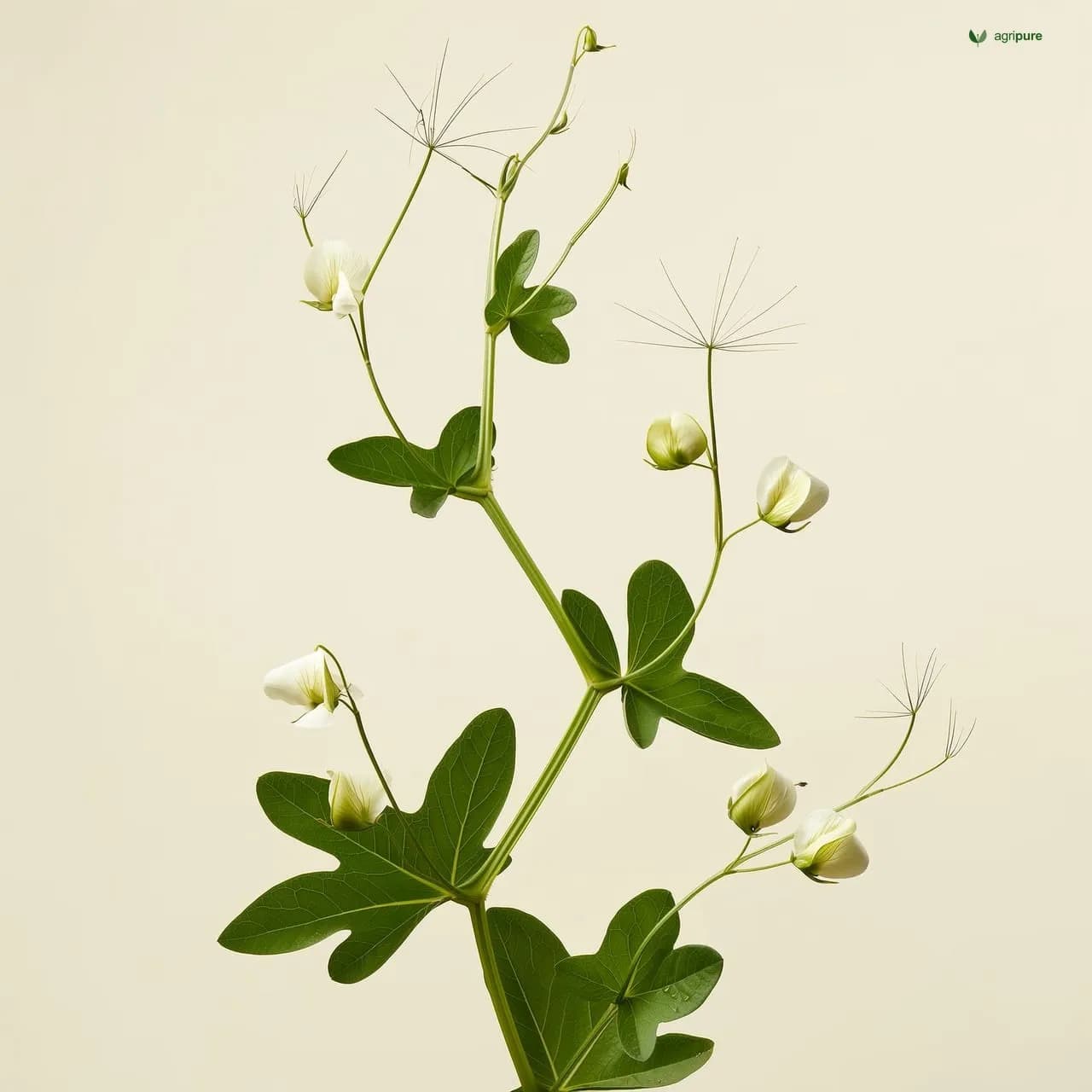
Pea is an herbaceous annual vine that finishes its whole life cycle in a single season. Many garden types stand about 30 to 45 cm (1 to 1.5 ft) tall with an 18 to 30 cm spread, though vining cultivars run taller and need support. The stems climb by tendrils that grip trellises, netting, or neighbouring plants, and the leaves are pinnate and compound, carrying one to four pairs of smooth, medium-green leaflets that end in a terminal tendril. Below ground it forms the typical legume taproot, which develops nitrogen-fixing nodules when partnered with the soil bacterium Rhizobium leguminosarum. The flowers are the classic papilionaceous pea bloom rather than anything showy. Seeds may be smooth or wrinkled, the wrinkled types generally being the sweeter. It is worth knowing which type you are growing: the common garden pea (var. sativum) has fibrous, inedible pods so only the seeds are eaten, while snow and sugar-snap types (var. macrocarpon) lack the fibrous inner lining, making the whole pod edible along with the immature seeds.
Growing garden pea
Pea is propagated by seed, which is the standard and reliable method. Sow it directly where it is to grow, as peas resent transplanting once the seedlings are past their youngest stage. In temperate climates the rule is to plant as soon as the soil can be worked in spring, since this is one of the first crops the season allows. Where the climate suits it, a fall crop is also possible: snow peas can be sown in late summer (an August sowing for an October harvest in a Kentucky-type climate). Resist sowing too early into cold, very wet ground, as the seed will simply rot. Some growers soak the seed for about 24 hours before sowing and then coat it with a Rhizobium inoculant to make sure the nitrogen-fixing nodules form, which is especially worth doing in a bed that has not grown peas before.
Peas adapt to many soil types but do best on fertile, light-textured, well-drained ground. Aim for a soil pH of about 6.0 to 7.5, moisture-retentive but never waterlogged; the Missouri Botanical Garden recommends a fertile, moisture-retentive, roughly neutral soil. Because it is a legume that fixes its own nitrogen, pea needs little nitrogen fertiliser, and well-rotted manure suits it. This is a cool-season crop through and through: the optimal growing range is about 13 to 18 degrees C (55 to 65 degrees F). Young plants take light frosts in their stride, but frost during flowering and pod set can damage the yield, and plants tend to stop growing and fail to flower or pod once temperatures climb above about 29 degrees C (85 degrees F). It is listed for outdoor cultivation as an annual vegetable across USDA zones 2 to 11, grown in the cool season in warm regions and as one of the earliest spring crops in cold ones.
Harvest and uses
Garden pea is grown for its edible seeds and pods, and it carries multiple culinary and ecological uses with a generally good safety profile when eaten as food. With the common garden pea, the fibrous pod is discarded and only the round seeds are shelled and eaten; with snow and sugar-snap types, the tender pod is eaten whole along with the immature seeds inside. Wrinkled-seeded cultivars are prized for their extra sweetness. Beyond the plate, the plant earns its keep in the system: as a legume it hosts Rhizobium leguminosarum in its root nodules and fixes atmospheric nitrogen, which is why it pairs so well with a heavier-feeding crop grown after it and why it needs so little added nitrogen of its own.
Safety and cautions
Eaten as a food, garden pea has a generally good safety profile, but not every part of the plant is edible. In the common garden pea the pod itself is fibrous and inedible, so only the seeds should be eaten from that type. The research also notes specific cautions around heavy or medicinal-style use in vulnerable groups, so the plant is best treated simply as the vegetable it is rather than as a remedy.
Sources
- Pisum sativum (Taxonomy) – PubChem, National Center for Biotechnology Information
- Pisum sativum – Missouri Botanical Garden Plant Finder
- Pea (Pisum sativum L.) Plant Guide – USDA NRCS
- Origin, Domestication, Taxonomy and Botanical Description of Pea – International Journal of Current Research
- Edible Garden Featured Plant: Pea – Bernheim Arboretum and Research Forest
- Pisum sativum (Garden Pea) Plant Profile – USDA PLANTS Database
- Pea – Wikipedia