climax
Guava
Psidium guajava
Also known as Amrood (Pakistan, India).
- punjab plains
- sindh coast
International hardiness
- USDA 9-11
- RHS H1c
- AU: Tropical, Subtropical, Warm temperate
Where it grows — regional guide
| Zones / rating | Regional notes |
|---|---|
USDA 9-11 | Productive small tree in frost-free southern states; it can spread aggressively in humid subtropical ground so check local rules. |
| Zones / rating | Regional notes |
|---|---|
H1c (5 to 10C) | No region-specific data yet |
| Zones / rating | Regional notes |
|---|---|
Tropical, Subtropical, Warm temperate | Productive garden fruit tree in warm districts; monitor seedlings closely in tropical zones to prevent feral weed spread. |
| Zones / rating | Regional notes |
|---|---|
USDA 9-11 (USDA scale) Canada uses its own zone system; Canadian zones run roughly one lower than USDA. | No region-specific data yet |
| Zones / rating | Regional notes |
|---|---|
Punjab plains, Sindh coast | Pakistan:A widespread and forgiving orchard tree of the irrigated plains on almost any well-drained soil; it tends to bear a flush of fruit in the rainy season and another in winter. India:A small, forgiving fruit tree for home gardens and orchards on almost any well-drained soil; it tends to bear a flush of fruit in the rains and another in winter, and grows readily from seed or cuttings. |
Grows alongside
Species that appear with Guava in 13 of our published guides — a starting list for a guild, not a planting plan.
Guava (Psidium guajava) is an evergreen shrub or small tree in the myrtle family, Myrtaceae, grown across the warm tropics and subtropics for its vitamin-rich, sweet, aromatic fruit. It is native to the American tropics: the University of Florida and other references place its origin in Mexico and Central and South America, while some botanical sources narrow this to Peru and others extend the native range to include the Caribbean. The tree has been carried far beyond that range and naturalized widely; it was established in Florida by 1765 and is now found throughout the tropics and subtropics worldwide. For a homesteader in a frost-free or near-frost-free climate, the appeal is simple: guava is a fast, soil-tolerant fruiter that carries fruit you can eat fresh off the tree.
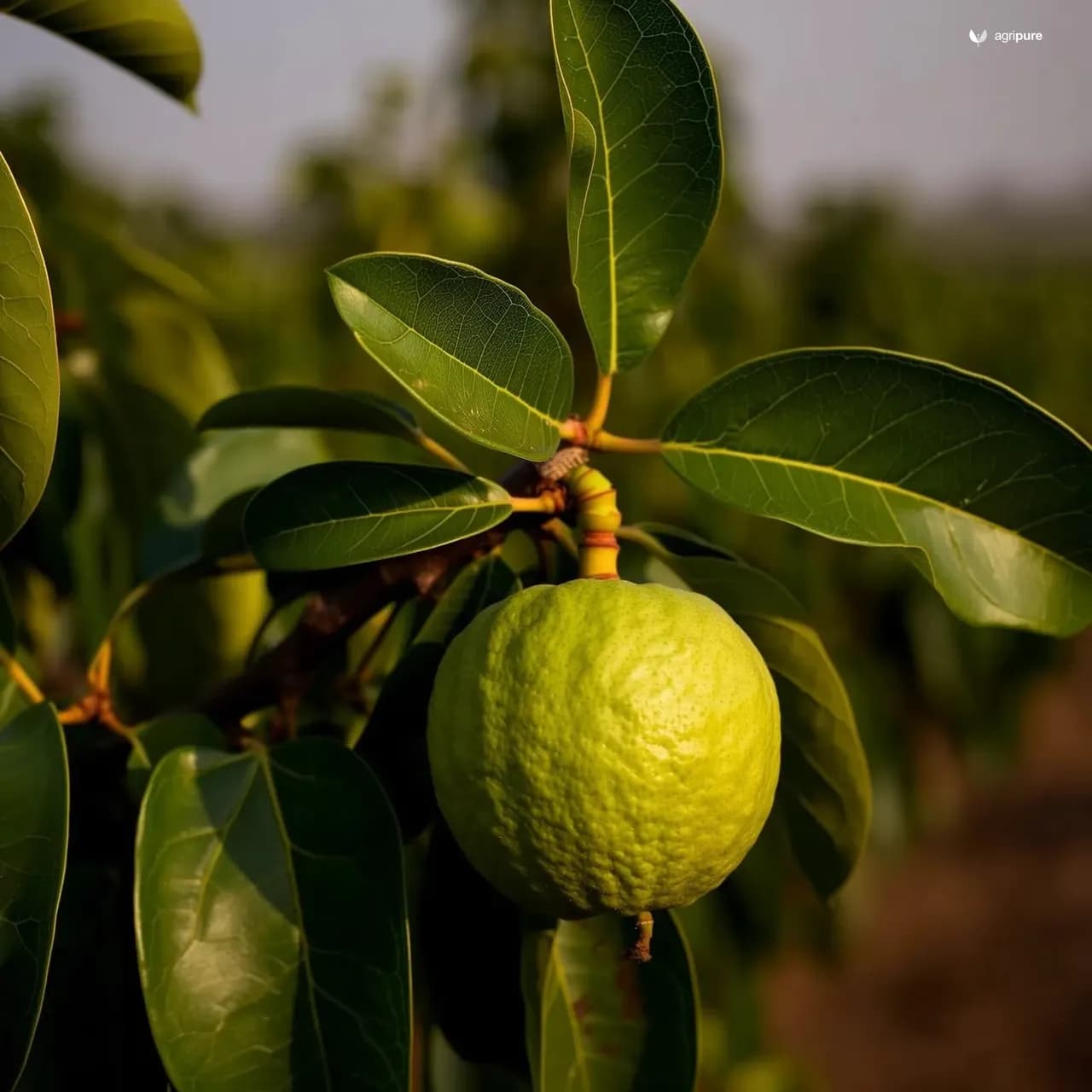
Guava is an evergreen plant that typically grows 3 to 9 m (10 to 30 ft) tall over a shallow root system. Its bark is scaly and greenish-brown, often peeling away in thin flakes, and the young branches are distinctively four-angled and hairy. The leaves are opposite, simple, and entire (untoothed), oval to oblong-elliptic and up to about 15 cm (6 in) long, carried on short stalks; they are softly hairy beneath, with veins that are impressed on the upper surface and raised conspicuously below. The flowers are white and fragrant, up to about 4 cm (1.6 in) across, with five petals and many stamens, borne singly or a few together in the leaf axils. The fruit is a true berry, oval to pear-shaped and 3 to 10 cm (1 to 4 in) long, with skin that turns from green to yellow at maturity; the flesh ranges from white to yellow or deep pink and is studded with numerous hard seeds. The flavour is sweet and aromatic, often described as a blend of pear, strawberry, and citrus. These traits help separate P. guajava from related Psidium species, which differ in fruit size and colour and in leaf and bark characters.
Growing Guava
Guava thrives in tropical and subtropical climates with warm temperatures and well-drained soils, and it is now well established across the tropics and subtropics generally. It is best treated as a frost-tender to low-frost species: reliable outdoor culture is generally limited to frost-free or very-light-frost climates corresponding to roughly **USDA zones 9 to 11**, with some cultivars reported to survive in protected sites in zone 8.124 In the continental United States the USDA PLANTS database records it as an introduced perennial shrub or tree in warm regions such as Hawaii, Florida, Puerto Rico, and the Virgin Islands.
On soil, guava is forgiving. It tolerates a wide range of soil types, including sandy, loamy, and clay soils, provided they are well drained. Paired with its warm-climate preference, that makes it a fruiter well suited to the open, sunny, free-draining ground of a homestead orchard row.
There are two practical routes to new plants:
- From seed: Guava grows readily from seed. The trade-off is that seedlings can take several years to begin fruiting and show genetic variation, so seed-grown trees are unpredictable in fruit quality.
- From cuttings or air-layering: Guava is also propagated vegetatively, by cuttings or air-layering. These clonal methods preserve a chosen cultivar’s traits and can shorten the time to bearing, which makes them the better choice when you want fruit true to a known parent.
Detailed spacing, irrigation schedules, and exact time-to-harvest figures vary by cultivar and region and are not specified in the sources used here, so they are left out rather than stated with false precision. In practice, treat guava like other warm-climate small fruit trees: give it open sun, well-drained ground, and clonal stock if predictable fruit matters to you.
Harvest and uses
The harvest cue is the fruit itself: the skin shifts from green to yellow at maturity. Inside, the flesh may be white, yellow, or deep pink depending on the plant, sweet and aromatic and full of hard seeds. Guava is grown first and foremost for that fruit, which is prized for being rich in vitamins and eaten fresh. Major agronomic references treat the plant as a food crop with no parts classified as poisonous, so the fruit is straightforward, edible homestead produce.
Safety and cautions
Guava is generally considered safe to eat. No plant parts are classified as poisonous in the major agronomic references consulted here, and the fruit is a conventional food. The one caveat the sources raise concerns concentrated medicinal use of guava leaves and extracts, a different matter from eating the fruit. Such preparations warrant the standard cautions for any potent botanical: care during pregnancy, awareness of possible drug interactions, and caution in chronic disease management. This profile makes no medical claims and gives no dosages; anyone considering guava-leaf preparations rather than simply eating the fruit should seek qualified guidance first.
Sources
- Psidium guajava plant directory – University of Florida IFAS
- Psidium guajava – Wikipedia
- Psidium guajava (guava) plant profile – USDA PLANTS Database
- Guava (Psidium guajava) – Feedipedia (INRAE/CIRAD/AFZ/FAO)
- Psidium – ScienceDirect Topics
- Psidium guajava (guava) – Center for Invasive Species and Ecosystem Health
- Psidium guajava review – PMC (National Library of Medicine)