secondary
Wild Himalayan Pear
batangi / tangi
Pyrus pashia
Also known as Batangi (Pakistan).
- kpk hills
- pothohar
International hardiness
- USDA 5-9
- RHS H6
- AU: Cool temperate, Warm temperate
Where it grows — regional guide
| Zones / rating | Regional notes |
|---|---|
USDA 5-9 | No region-specific data yet |
| Zones / rating | Regional notes |
|---|---|
H6 (-20 to -15C) | No region-specific data yet |
| Zones / rating | Regional notes |
|---|---|
Cool temperate, Warm temperate | No region-specific data yet |
| Zones / rating | Regional notes |
|---|---|
USDA 5-9 (USDA scale) Canada uses its own zone system; Canadian zones run roughly one lower than USDA. | No region-specific data yet |
| Zones / rating | Regional notes |
|---|---|
KPK hills, Pothohar | Pakistan:A hardy native small tree of the KPK hills and Pothohar; yields gritty fruit that turns sweet when bletted, and is the standard rootstock for orchard pears. India:Native across the mid-elevation western and central Himalayan hill tracts; a resilient hillside tree used as tough pear rootstock and for bletted sweet wild fruit. |
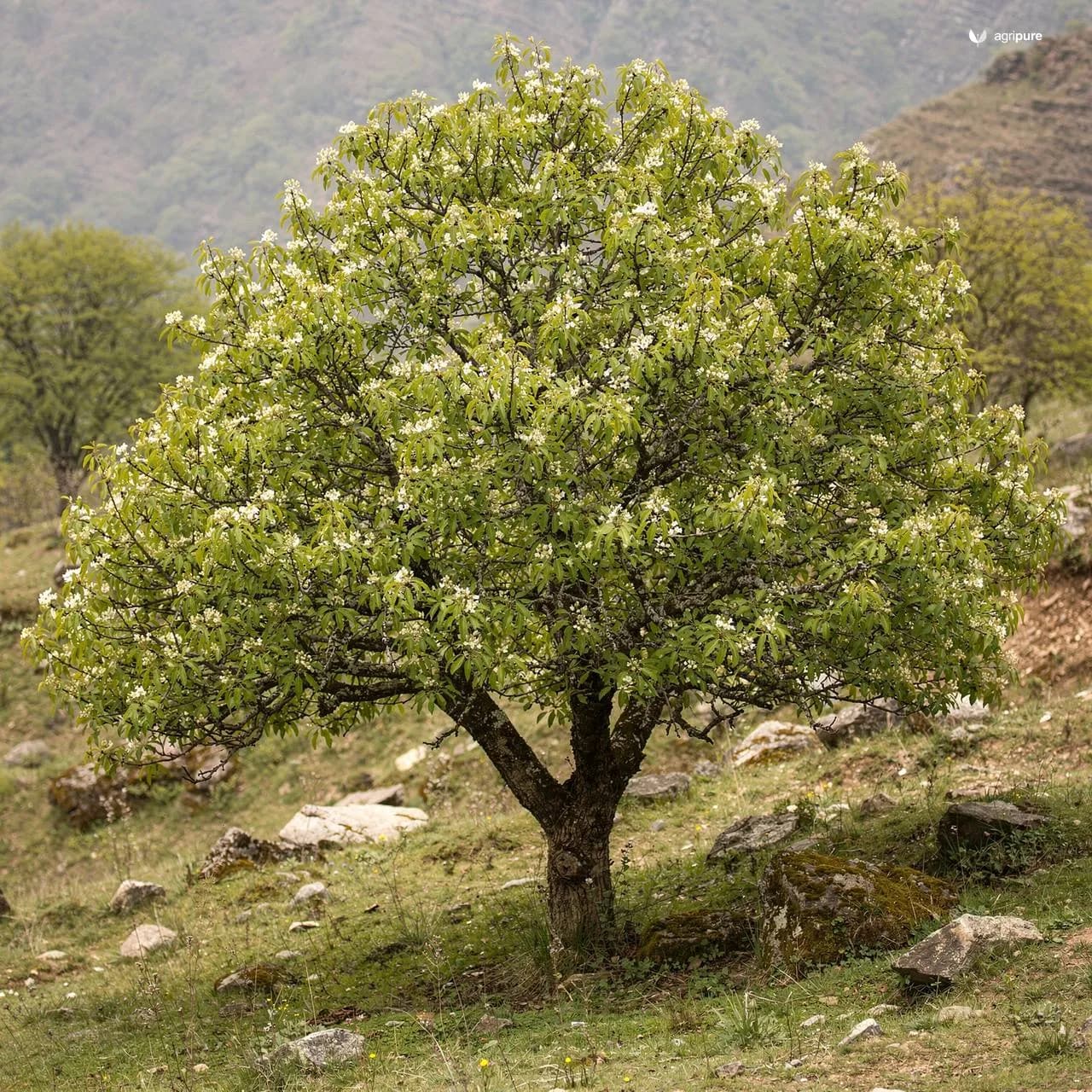
Wild Himalayan pear (Pyrus pashia, locally batangi or tangi) is the small, white-flowered wild pear of the sub-Himalayan slopes of the KPK hills and the Pothohar plateau. Its fruit is eaten once bletted, soft and sweet after a spell off the tree, and it is the standard rootstock for grafting orchard pears. On a syntropic site it is a secondary tree: a quicker-returning fruit tree that fills the mid-canopy while slower climax trees establish around it.
Where it thrives
Wild pear is a tree of the mid-hill belt. It commonly occurs from the Caucasus to the Himalaya between roughly 750 and 2,600 m above sea level, on rainfall of about 750 to 1,500 mm a year or more, and through a temperature range from around -10 to 35 °C. Its distribution runs across the Himalaya from Pakistan eastwards, taking in Kashmir, Afghanistan, and Iran. In Pakistan that places it through the KPK hills and onto the higher Pothohar ground, where it is a common small tree of slopes and field edges.
Role in the system
Treat wild pear as a secondary-stratum fruit tree that returns sooner than the climax oaks and pistachios it grows among. Its small, open crown casts light shade rather than dense cover, so understorey layers can carry on beneath it, and its spring blossom draws pollinators into the system. The deeper value for a grower is as a rootstock: because it grafts readily and is hardy on dry hill ground, it carries cultivated pear varieties on sites where they would not stand on their own roots. Its white flowers carry red anthers and open before the leaves are fully out, an early nectar source on the slope, and it tolerates a wide temperature swing, from about -10 to 35 °C, so it is unfussy about where it sits in the system. It is a useful bridge between the wild hill flora and an orchard layer.
Uses
The fruit is the everyday return. It is gritty and sharp straight off the tree, but once bletted it is sweet and pleasant to eat, and a mature tree yields about 45 kg of fruit a year. Young shoots are eaten as a vegetable, the wood is used for fuel and small tools, and the tree is widely employed as a rootstock for grafting cultivated pears. Over its life the same tree gives fruit, blossom for pollinators, firewood, and a hardy base for an orchard pear.
Establishment
Raise it from seed for rootstock, then graft your chosen pear variety onto the seedling once it is established. The fruit must be bletted, left to soften after picking, before it is good to eat, so harvest a little firm and let it ripen off the tree. It is hardy and undemanding on dry hill sites, which is exactly why it makes such a dependable rootstock and a low-input fruit tree. Set it where its early blossom and bird-sown fruit can do double duty, drawing pollinators in spring and seed-dispersing birds in autumn, and it will largely look after itself once away.
Sources
- Wikipedia contributors. “Pyrus pashia.” Wikipedia.
Sourcing notes
Raise rootstock from seed collected off ripe wild fruit, then graft cultivated pear scions onto the seedlings. Wild pear is common on hill slopes and field margins, so local seed is easy to come by; it is the standard pear rootstock in the region.