pioneer
Radish
mooli
Raphanus sativus
Also known as Mooli (Pakistan).
- punjab plains
- pothohar
- kpk hills
International hardiness
- USDA 6-11
- RHS H5
- AU: Cool temperate, Warm temperate, Subtropical, Mediterranean, Arid / semi-arid
Where it grows — regional guide
| Zones / rating | Regional notes |
|---|---|
USDA 6-11 | A fast-growing annual root crop across USDA zones 2 to 11; harvest taproots while crisp, and ensure wild or weedy volunteers are monitored and managed. |
| Zones / rating | Regional notes |
|---|---|
H5 (-15 to -10C) | Hardy at RHS H5, it is direct-sown in succession from early spring for quick salad roots; harvest crisp roots before summer heat and watch for weedy volunteers. |
| Zones / rating | Regional notes |
|---|---|
Cool temperate, Warm temperate, Subtropical, Mediterranean, Arid / semi-arid | A cool-season annual grown across Mediterranean and temperate zones; harvest crisp roots before they bolt in heat, and monitor weedy volunteers. |
| Zones / rating | Regional notes |
|---|---|
USDA 6-11 (USDA scale) Canada uses its own zone system; Canadian zones run roughly one lower than USDA. | A cool-season annual vegetable grown in short-season climates; harvest crisp taproots before heat pushes it to bolt, and manage weedy volunteers. |
| Zones / rating | Regional notes |
|---|---|
Punjab plains, Pothohar, KPK hills | Pakistan:A cool-season annual vegetable of the Punjab and Sindh plains; pull taproots before summer heat pushes it to bolt, and control weedy volunteers. |
Grows alongside
Species that appear with Radish in 55 of our published guides — a starting list for a guild, not a planting plan.
Radish (Raphanus sativus) is a fast-growing, cool-season root crop in the mustard family, Brassicaceae, grown around the world for its pungent edible taproot and greens. It is usually treated as an annual, though it can behave as a biennial in wild or weedy situations. The species has no single confirmed wild ancestor: it is generally considered a domesticate of Mediterranean and Western Asian stock, and the Missouri Botanical Garden simply lists its native range as “garden origin,” a reflection of how long it has been cultivated. For the home grower it is one of the quickest and most forgiving things you can sow, slotting easily into the cool shoulders of the season and into gaps between slower crops.
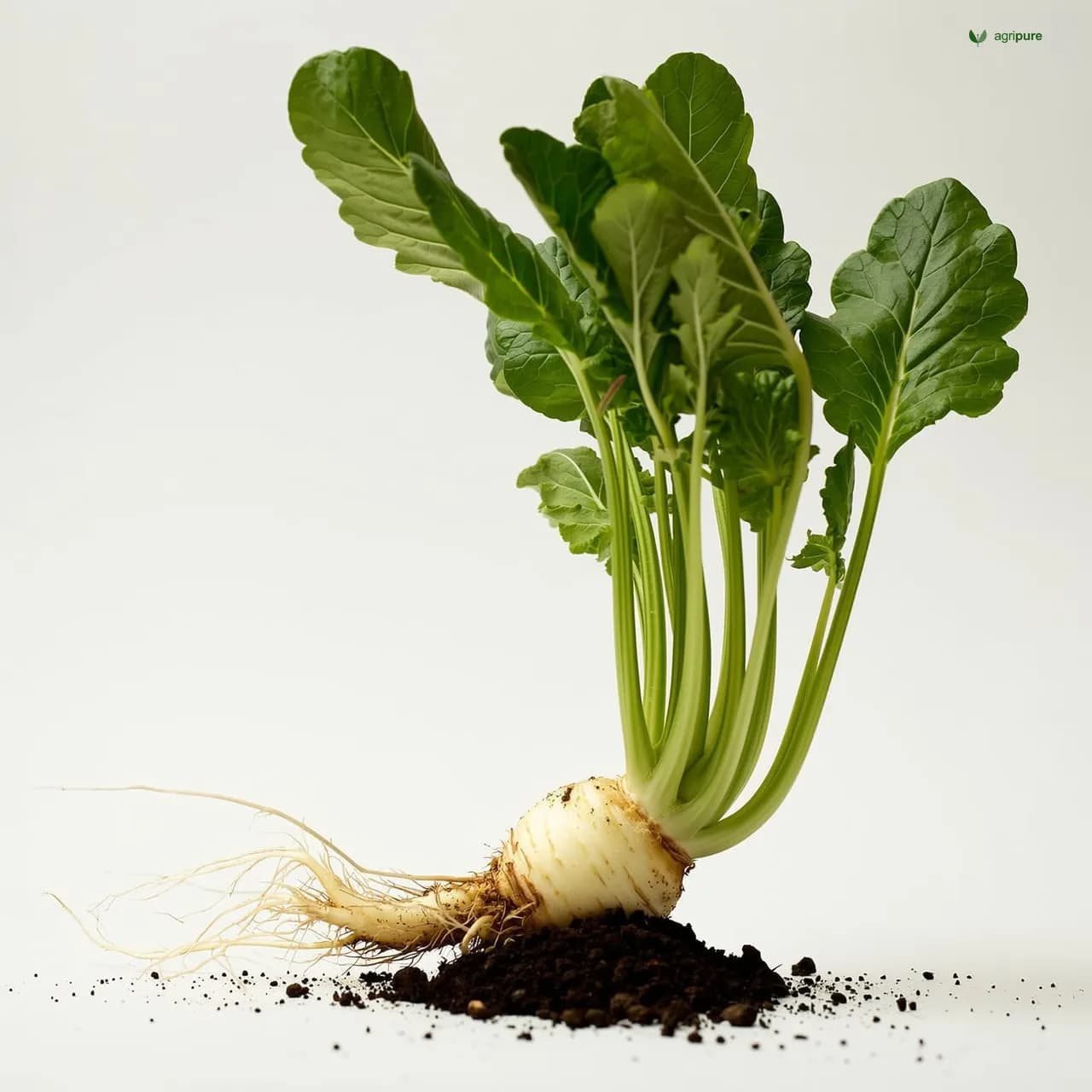
Garden radish is described by the Missouri Botanical Garden as an annual reaching about 2 to 3 feet (0.6 to 0.9 m) tall with a spread of 1 to 2 feet, grown chiefly for its fleshy taproot eaten raw, cooked, or pickled. The leaves are dark green with a velvety, slightly fuzzy texture, typically forming a basal rosette that elongates onto an erect flowering stem as the plant bolts. The edible swollen taproot in most cultivars commonly runs about 1.6 to 3.1 inches (4 to 8 cm) in diameter and comes in a range of colours including white, pink, red, and purple. When the plant flowers, it carries the four-petalled blooms typical of the mustard family, white to pale violet in garden forms, followed by narrow seed pods called siliques; in R. sativus these pods are less constricted than the distinctly beaded pods of wild radish, R. raphanistrum. Cultivars differ widely in root size, shape, colour, and days to maturity.
Growing radish
Radish is propagated by seed and is not routinely grown from cuttings or other vegetative means. The Missouri Botanical Garden advises sowing seed directly where it is to grow, at roughly two-week intervals between mid-April and the start of May for a spring crop, and again in August for a fall crop in a temperate climate. Those staggered sowings are worth repeating: because the plant matures so quickly, a fresh batch every couple of weeks keeps a steady supply rather than a single glut.
For soil and exposure, the garden recommends growing radish in full sun in loamy or sandy soils. Well-drained ground is preferred; under stress the roots tend to turn tough and hot, though this is a matter of eating quality rather than the plant’s survival. Full sun combined with moderate temperatures gives the best root formation, which is why radish is grown as a cool-season crop the world over: excessive heat pushes it to bolt and spoils root quality. The Missouri Botanical Garden gives a broad hardiness range of USDA zones 2 to 11 for cultivated radish grown as a cool-season annual, so the limiting factor is usually summer heat rather than winter cold.
Harvest and uses
The part most cultivars are grown for is the swollen taproot, harvested while it is still crisp and before heat or age makes it pithy. Roots are eaten raw, cooked, or pickled, and the whole plant is valued for its sharp, pungent flavour. That bite is not incidental: radishes owe their flavour to glucosinolates and the enzyme myrosinase, which on cell damage produce the isothiocyanates, or mustard-oil compounds, characteristic of the family. Beyond the kitchen, the same glucosinolate chemistry is the focus of nutraceutical interest in the species.
How to identify it
A radish in the ground or in flower is recognisable by a handful of consistent traits. Look for the dark green, velvety rosette leaves; a swollen taproot a few centimetres across in white, pink, red, or purple; four-petalled white-to-violet flowers on an erect stem; and slender seed pods that are smooth rather than beaded. In North America, plants in weedy stands are noted as actively growing or flowering in spring (April to June) and again in fall and winter (October to January), bracketing the heat of midsummer. The smooth, only-slightly-constricted pods are the most reliable feature separating cultivated radish from the wild radish it can otherwise resemble.
Safety and cautions
Radish root and greens are ordinary food crops eaten raw, cooked, and pickled, and the research here records no toxicity for the cultivated plant. The plant’s pungency comes from mustard-oil compounds (isothiocyanates) released from glucosinolates when the tissue is cut or chewed, the same family of compounds found in other brassicas. Note that the same name covers weedy and wild radish forms that are treated as invasive or agricultural weeds in some regions, so seed and volunteers are not always the cultivated kitchen type. This page describes culinary and horticultural use only and is not medical guidance.
Sources
- Raphanus sativus (Radish) – Missouri Botanical Garden Plant Finder
- Raphanus sativus species profile – EDDMapS
- Raphanus sativus L. – GBIF
- Raphanus sativus seed fact sheet – Seed ID Guide
- Wild Radish – UC ANR Integrated Pest Management
- Deciphering the Nutraceutical Potential of Raphanus sativus – NCBI PMC
- Radish (Raphanus sativus) review – ScienceDirect
- Raphanus sativus plant profile – California Invasive Plant Council