secondary
Webb’s Rose
chal
Rosa webbiana
Also known as Chal (Pakistan).
- kpk hills
- balochistan highlands
International hardiness
- USDA 5-9
- RHS H6
- AU: Cool temperate, Warm temperate
Where it grows — regional guide
| Zones / rating | Regional notes |
|---|---|
USDA 5-9 | No region-specific data yet |
| Zones / rating | Regional notes |
|---|---|
H6 (-20 to -15C) | No region-specific data yet |
| Zones / rating | Regional notes |
|---|---|
Cool temperate, Warm temperate | No region-specific data yet |
| Zones / rating | Regional notes |
|---|---|
USDA 5-9 (USDA scale) Canada uses its own zone system; Canadian zones run roughly one lower than USDA. | No region-specific data yet |
| Zones / rating | Regional notes |
|---|---|
KPK hills, Balochistan highlands | Pakistan:A cold-hardy, suckering thorny native wild rose of Gilgit, Chitral, and Quetta highlands; makes dense boundary thickets, but parts are unconfirmed for food use. India:Native across high-altitude cold mountain valleys from northern India to western Nepal; forms resilient, thorny thickets on dry slopes, though parts should not be eaten. |
Webb’s rose (Rosa webbiana) is a thorny, temperate-zone wild rose native to a broad arc of high Asia, running from Afghanistan eastward through western China and into Nepal. It is one of the many wild species roses that grow as open, suckering shrubs rather than the bred garden hybrids most people picture, and like its relatives it sets small red hips after flowering. For a homesteader, the honest appeal of a wild species rose is its toughness and self-sufficiency: it is a thicket-forming shrub adapted to a temperate mountain climate, not a pampered border plant.
This profile sticks deliberately to what reliable botanical and floristic sources actually document for Rosa webbiana. Detailed homestead cultivation figures, yields, and traditional uses were not available in the sources consulted, so they are left out rather than invented. What follows is a grounded identification and botanical picture of the plant.
Identifying Webb’s rose
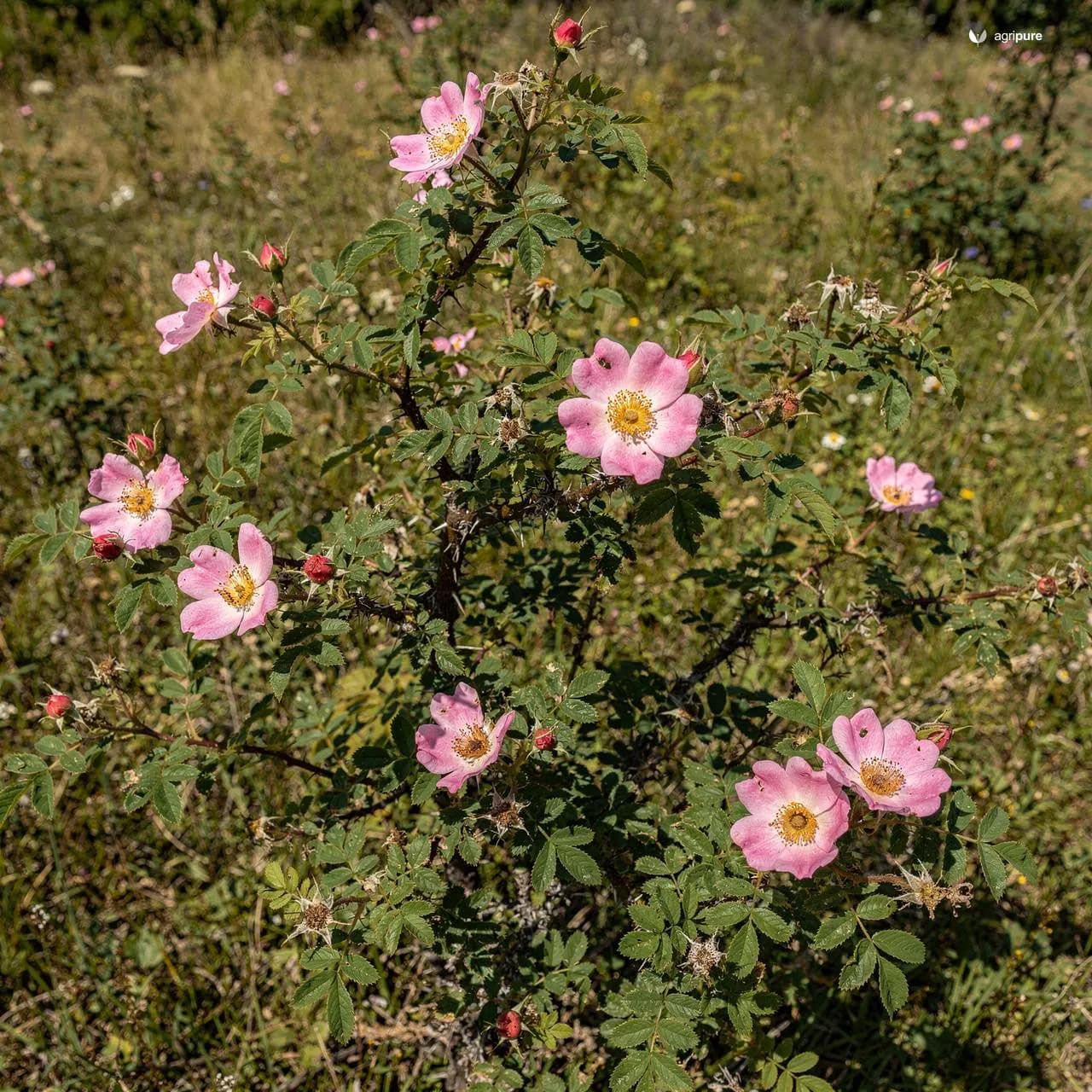
Webb’s rose is a shrub with thin, flexible, yellowish-brown twigs. Its prickles are uniform or mixed with bristles, usually borne in pairs, straight or ascending, and notably absent on the flowering stems. The leaves are compound, carrying 5 to 9 leaflets, each roughly 1 to 2 cm long, elliptic to obovate in shape, with simply or doubly serrulate (finely toothed) margins.
The flowers are borne solitary or in clusters of three to five, measuring about 3 to 5 cm across, and range from red and pink to white. The sepals are entire and persistent, hanging on rather than dropping away. After flowering, the plant produces small oblong-ovoid to globose hips that are glabrous (hairless) and turn red at maturity, measuring roughly 1 to 2 cm across.
A useful field distinction separates it from the similar Rosa macrophylla: compared with that species, R. webbiana has smaller leaflets, shorter calyx tips, and shorter, ovoid hips without glands. The combination of paired prickles, small leaflets, pink-to-white five-petalled flowers, and small red glandless hips is the most reliable way to recognise it.
Where it grows
Kew’s Plants of the World Online gives the native range of Webb’s rose as Afghanistan to western China and Nepal, and characterises it as a temperate biome species. A regional flora source records it more widely still, listing occurrences across Tibet, Kazakhstan, Tajikistan, Kyrgyzstan, Turkmenistan, Uzbekistan, Afghanistan, Pakistan and Pakistani Kashmir, northern India, Myanmar, Jammu and Kashmir, and western Nepal. This is, in short, a plant of the cooler mountain country of Central and South Asia rather than the lowland tropics.
The sources consulted support a temperate climate placement but do not assign a specific USDA hardiness zone to R. webbiana. Rather than guess at a number, this profile omits a zone rating. If you are siting it on a homestead, the practical takeaway from its native distribution is that it is a cold-temperate mountain shrub, suited to climates with real winters rather than to humid lowland heat.
Taxonomy and naming
The accepted botanical name is Rosa webbiana Wall. ex Royle, in the rose family (Rosaceae). The International Plant Names Index records the name under Rosaceae and cites the type specimen as coming from Nepal. The accepted name matters when sourcing seed or plants, because wild species roses are easily confused with one another and with ornamental hybrids.
Growing and using it: what the sources do and do not say
It is worth being explicit about the gaps. Reliable, species-specific cultivation guidance for Rosa webbiana — propagation method, soil preference, sun and water needs, spacing, and time to maturity — was not found in the sources consulted, so no such figures are stated here. The same applies to yield: no dependable harvest or yield data for this species was available, so none is claimed.
Likewise, the sources did not provide species-specific culinary, material, or medicinal uses that can be responsibly cited. Wild roses as a group are grown for hedging, wildlife value, and their hips, but those are statements about roses in general, not documented facts about this species, so this profile does not extend them into specific claims about R. webbiana.
Safety and cautions
An important caution applies because the record is thin. The sources consulted did not document toxicity for Rosa webbiana, but they also did not confirm that it is edible. For that reason, this page makes no claim that the plant or its hips are safe to eat. Do not treat the hips, petals, or any other part as food on the strength of this profile alone. Before eating any wild plant, confirm both the identification and the edibility against authoritative, species-specific sources or a qualified expert. No medicinal use or dosage is described here, because none was supported by the sources.
Sources
- Rosa webbiana Wall. ex Royle – Plants of the World Online, Royal Botanic Gardens, Kew
- Rosa webbiana – eFlora of India
- Rosa webbiana – International Plant Names Index (IPNI)
- Rosa webbiana – U.S. Fish & Wildlife Service
Sourcing notes
Collect ripe hips or take hardwood cuttings from healthy wild stands in Gilgit, Chitral, or the Quetta highlands; it suckers freely, so one plant supplies a hedge over a few seasons.