secondary
Himalayan Musk Rose
kujai / chal
Rosa brunonii
Also known as Kujai (Pakistan).
- kpk hills
- pothohar
International hardiness
- USDA 6-9
- RHS H4
- AU: Cool temperate, Warm temperate, Mediterranean
Where it grows — regional guide
| Zones / rating | Regional notes |
|---|---|
USDA 6-9 | No region-specific data yet |
| Zones / rating | Regional notes |
|---|---|
H4 (-10 to -5C) | Hardy at RHS H4; a vigorous scrambling climber that requires a sturdy tree or fence line to support its fragrant early-summer clusters of white blooms. |
| Zones / rating | Regional notes |
|---|---|
Cool temperate, Warm temperate, Mediterranean | No region-specific data yet |
| Zones / rating | Regional notes |
|---|---|
USDA 6-9 (USDA scale) Canada uses its own zone system; Canadian zones run roughly one lower than USDA. | No region-specific data yet |
| Zones / rating | Regional notes |
|---|---|
KPK hills, Pothohar | Pakistan:A vigorous, prickly native scrambling wild rose of the KPK hills and Murree; forms stockproof thorny hedges and yields fragrant white petals and edible hips. India:Native across the temperate western Himalayan slopes; scrambles vigorously over trees and fences, yielding vitamin-C-rich hips and petals. |
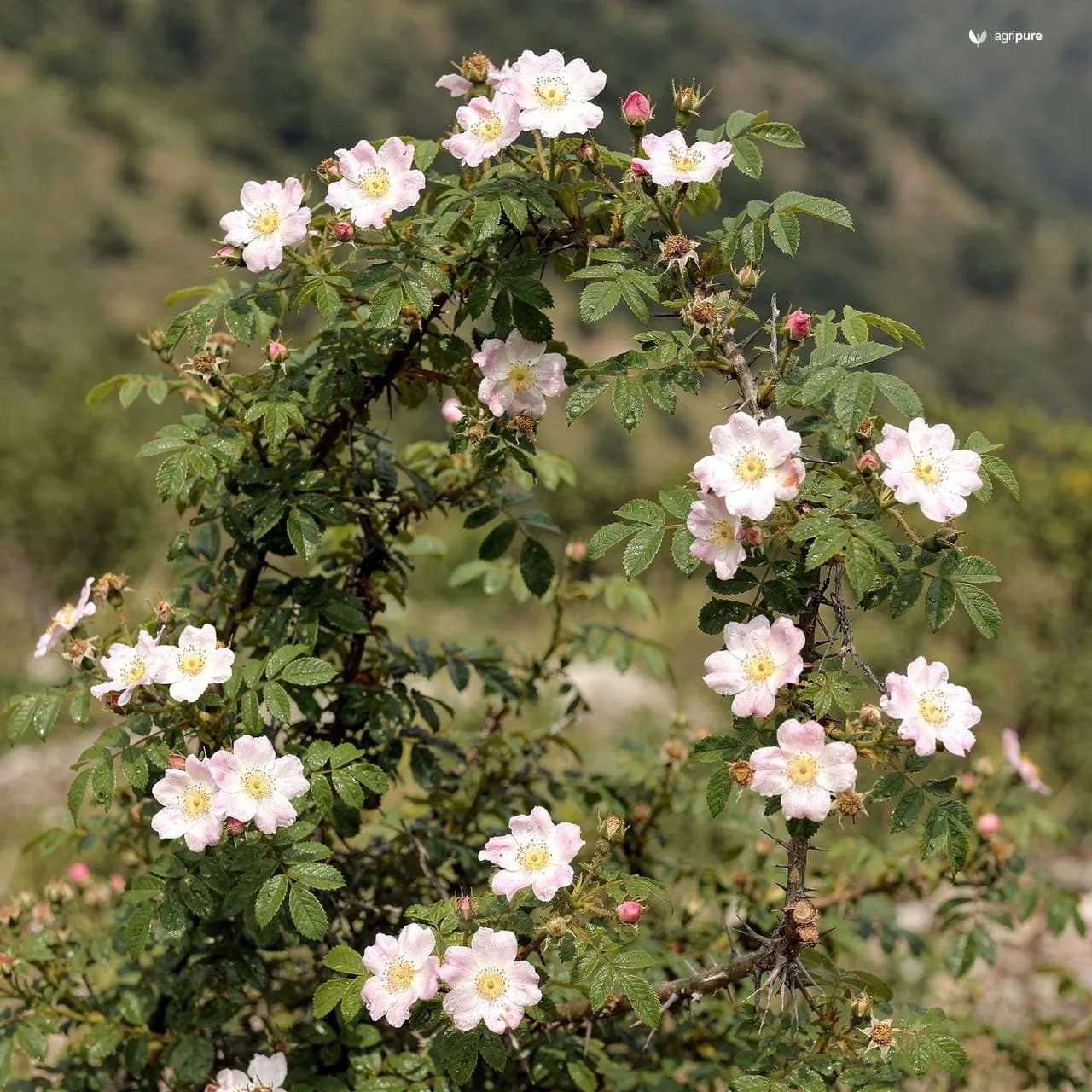
The Himalayan musk rose (Rosa brunonii, locally kujai or chal) is a vigorous, scrambling wild rose of the KPK hills and the moister Pothohar slopes, where it climbs through hedgerows and into trees on arching, prickly stems up to 10 m long. On a hill farm it doubles as a living, thorny boundary and a source of food and medicine — a hedge that bites back and pays you in hips.
Where it thrives
In Pakistan it grows wild through Chitral, Kurram, Hazara, Swat, Murree, Poonch, Kashmir, and Gilgit, ascending into trees at roughly 1,200 to 2,400 m. It is a deciduous to semi-evergreen climber of the temperate Himalayan foothills, with compound leaves and large corymbose clusters of white, musk-scented, five-petalled flowers full of yellow stamens, opening in early summer. It takes hill-country cold the lowland species cannot, wants sun to part shade, and does best with something to scramble over — a fence line, a bank, or a sturdy tree it can climb into. Loose, well-drained hill soil suits it; it is undemanding once established.
Role in the system
Treat it as a secondary-stratum shrub and a hedge plant rather than a standalone tree or a core producer. Its dense, thorny, scrambling growth makes a stockproof living boundary, and trained along a fence line or field edge it shelters the plants behind it from wind and grazing while providing nectar for pollinators and cover for birds and beneficial insects. It is not a nitrogen fixer, so its place is at the margins of a system: defining boundaries, filling the scrubby edge that would otherwise grow nothing useful, and yielding hips and petals, rather than in the productive heart of a planting. On a steep hill plot it also helps hold soil on banks and terrace edges with its spreading, anchoring growth.
What you get
The plant is genuinely multi-use in the western Himalaya, where local communities eat young leaves, tender spring shoots, petals, fruit, and seed, raw or cooked. Petals go into rose water and a local sherbet, the vitamin-C-rich hips are eaten fresh or cooked down into jam, and the seed is dried and ground into a flour. Leaf, flower, bark, and root all carry traditional medicinal use, the root in particular being valued for eye complaints. Prunings off a vigorous plant give a little firewood as well. None of these is a bulk commodity, but together they make a boundary shrub that feeds the household, the bees, and the soil.
Establishment
Propagate it from semi-hardwood cuttings or from seed collected off local hill stands, taking the hips when they are fully ripe and coloured. Give each plant a fence, a bank, or a tree to scramble over before it gets going, because a vigorous musk rose left without support becomes an awkward sprawling thicket. Once it has a frame and its roots are down, it largely looks after itself and needs only occasional cutting back to keep it in bounds.
Sources
- Flora of Pakistan. “Rosa brunonii Lindl.” eFloras.org, Missouri Botanical Garden & Harvard University Herbaria.
- Wikipedia contributors. “Rosa brunonii.” Wikipedia.
- Himalayan Wild Food Plants. “Rosa brunonii Lindl. — Kujja.” Himalayan Wild Food Plants.
Sourcing notes
Propagate from semi-hardwood cuttings or seed off local hill stands; collect hips when fully ripe. A vigorous scrambler, so give it a fence line or a sturdy tree to climb.