pioneer
Munj Sweetcane
munj
Saccharum bengalense
Also known as Sarkanda (Pakistan, India).
- punjab plains
- sindh coast
- pothohar
International hardiness
- USDA 8-11
- RHS H3
- AU: Subtropical, Warm temperate
Where it grows — regional guide
| Zones / rating | Regional notes |
|---|---|
USDA 8-11 | No region-specific data yet |
| Zones / rating | Regional notes |
|---|---|
H3 (-5 to 1C) | No region-specific data yet |
| Zones / rating | Regional notes |
|---|---|
Subtropical, Warm temperate | No region-specific data yet |
| Zones / rating | Regional notes |
|---|---|
USDA 8-11 (USDA scale) Canada uses its own zone system; Canadian zones run roughly one lower than USDA. | No region-specific data yet |
| Zones / rating | Regional notes |
|---|---|
Punjab plains, Sindh coast, Pothohar | Pakistan:A robust native clumping cane grass along Punjab and Sindh waterways and sandy banks; deep roots bind shifting soil and stems yield durable weaving fibre. India:Native across riverbanks, arid tracts, and sandy floodplains of northern India; extensively harvested for durable thatch, basketry fibre, and erosion control. |
Munj sweetcane (Saccharum bengalense, accepted today as Tripidium bengalense and also known by the older synonym Saccharum munja) is a tall, perennial member of the sugarcane group in the grass family, Poaceae. It goes by a string of regional names, among them munj grass, sarkanda, baruwa grass, Kana, and Bhadramunja. It is native across a band of Asia running from Iran and Afghanistan through Pakistan, northern India, Nepal, Bangladesh, and into Myanmar. For a homesteader, its appeal is not as a food plant (there is no good evidence it is eaten as a regular crop) but as a tough, fibre-rich grass that holds difficult ground, supplies craft material, and asks almost nothing of the soil.
How to identify Munj sweetcane
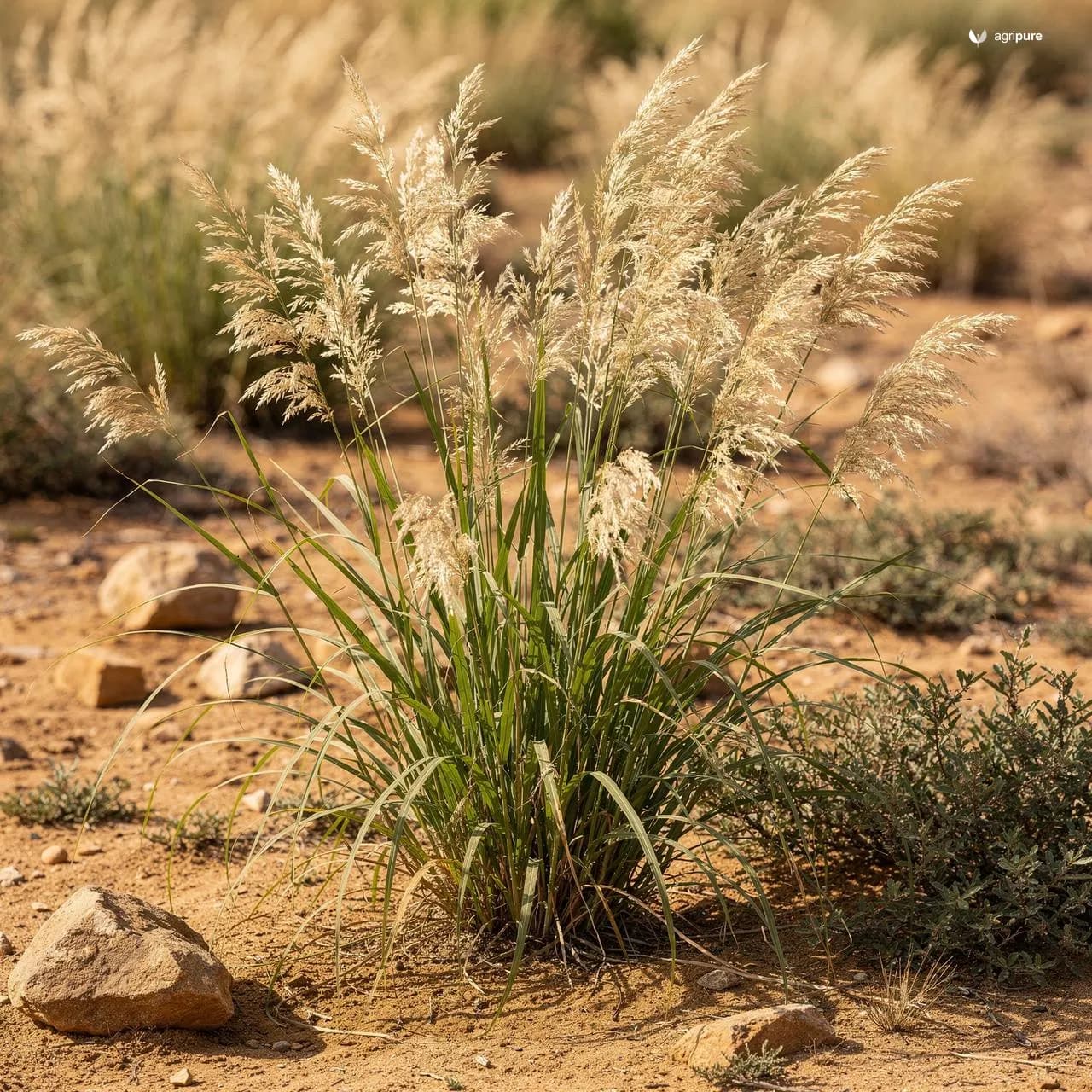
This is a tufted, cane-like perennial grass with rigid, strongly fibrous culms. Reported heights vary with site and moisture: one account describes a comparatively small sugarcane-like grass of only 2 to 3 feet (about 0.6 to 0.9 m) with a pinkish-green cast, while an Ayurvedic monograph describes a robust, tall-growing perennial reaching up to roughly seven feet, with strong fibrous stems and silky panicles. The spread of figures most likely reflects different ecotypes and growing conditions rather than two different plants.
A useful field cue is the inflorescence. In S. bengalense the flower head is pinkish, turning white as it matures, which separates it from the closely related S. spontaneum, whose plumes are silvery-white from the start. Combined with its tall, dense, cane-like clumps and silky panicles, this colour shift is one of the more reliable ways to tell it apart from other wild sugarcane relatives in the field.
Growing Munj sweetcane
Detailed agronomy for this grass is sparse in the published record; most grower-relevant information has to be read out of ecological and ethnobotanical notes rather than a formal cultivation guide.
Munj sweetcane is a plant of desert regions, arid country, and riverbanks across the Indian subcontinent. It is also recorded as one of the ecologically successful native colonisers of abandoned mine land, forming pure patches on rocky habitats with thin, skeletal soils. A primary slice of its native range lies in the Terai-Duar grasslands of the Himalayan foothills, notably in northeastern India. Taken together, that points to a plant built for high heat, seasonal drought, and poor, well-drained ground — exactly the marginal corners where more demanding crops fail.
No source assigns it a USDA hardiness zone, so none is stated here rather than extrapolated. It is most accurately treated as a warm-season, subtropical-to-tropical grass that tolerates aridity and skeletal soils.
On propagation, the published sources stop short of a precise method. What can be said is grounded: it is a perennial tufted grass that builds strong clumps and extensive root systems, and it is used so widely and abundantly in local craft and medicine that it is clearly either naturally plentiful or readily propagated by vegetative means, as is typical of grasses in the Saccharum / Tripidium group. Specific sowing dates, spacing, and time-to-maturity figures are not reliably documented in these sources and are deliberately left out rather than invented.
Harvest and uses
Munj sweetcane is grown and gathered mainly for fibre, thatching, and erosion control, with a secondary role in traditional Ayurvedic practice. Its strong, fibrous stems are the prize for craft: the rigid culms and tough fibre have long been worked into ropes, mats, and woven goods, and the plant’s reputation rests on this durable material rather than on any edible part.
Its ecological “yield” is just as practical. The grass throws up tall, thick clumps with high biomass and develops extensive root networks that bind soil and pebbles together, which is what makes it effective at stabilising loose, eroding ground along riverbanks, on sandy flats, and on disturbed rocky sites. On a homestead, that combination, a permanent, deep-rooted tussock that anchors poor soil while also producing usable fibre, is its real return: a pioneer soil-binder and a craft crop in the same plant.
Safety and cautions
The sources report no specific toxicity for Munj sweetcane, but they are equally clear that it is not established as a regular food crop — there is no strong evidence it is eaten as everyday food. Its medicinal use is traditional, drawn from Ayurvedic literature where it appears under the synonym Saccharum munja, and the sources advise that such use should be approached cautiously.
This profile therefore makes no medical claim: it does not state that the plant treats, prevents, or cures any condition, and it lists no dosages. Treat Munj sweetcane on a homestead as what the evidence supports: a fibre, thatch, and soil-binding grass, and seek qualified guidance before any medicinal use.
Sources
- Tripidium bengalense (Saccharum bengalense / S. munja) — Wikipedia
- Saccharum bengalense — Observation.org
- Saccharum munja: phytochemistry and traditional uses — Global Journal of Pharmacy & Pharmaceutical Sciences (Juniper Publishers)
- Saccharum bengalense — eFlora of India
- Saccharum munja / Saccharum bengalense (Bhadramunja) — Planet Ayurveda
- Saccharum bengalense — eFlora of Gandhinagar
Sourcing notes
Propagated by splitting and planting rooted clumps or rhizome pieces, which establish quickly on sandy banks; seed is less reliable. Wild stands along Punjab and Sindh waterways are the usual source of planting material.