pioneer
Wild Sugarcane
kans
Saccharum spontaneum
Also known as Kans (Pakistan).
- punjab plains
- sindh coast
International hardiness
- USDA 7-11
- RHS H4
- AU: Tropical, Subtropical, Warm temperate
Where it grows — regional guide
| Zones / rating | Regional notes |
|---|---|
USDA 7-11 | Classified as a federal noxious weed in the United States; check local legal restrictions, as deliberate planting or transport is prohibited in many states. |
| Zones / rating | Regional notes |
|---|---|
H4 (-10 to -5C) | No region-specific data yet |
| Zones / rating | Regional notes |
|---|---|
Tropical, Subtropical, Warm temperate | Suited to tropical and subtropical wetlands, but check local weed restrictions before planting, as wind-blown seeds and running rhizomes become aggressively invasive. |
| Zones / rating | Regional notes |
|---|---|
USDA 7-11 (USDA scale) Canada uses its own zone system; Canadian zones run roughly one lower than USDA. | No region-specific data yet |
| Zones / rating | Regional notes |
|---|---|
Punjab plains, Sindh coast | Pakistan:A native pioneer rhizomatous grass of the Punjab and Sindh riverbanks; stabilizes shifting sands, but check local weed restrictions and contain its aggressive spread. India:Native across Indian floodplains and Terai grasslands; binds sandy banks and provides thatch, but check local weed restrictions as rampant rhizomes invade farmland. |
Wild sugarcane (Saccharum spontaneum) is a tall, rhizomatous perennial grass native to tropical and subtropical Asia, thought to have originated in the Indian subcontinent and Southeast Asia. Despite its name and kinship to cultivated sugarcane, it is not a food plant: there is no well-documented traditional human food use for it. For a homesteader its appeal is functional rather than edible, as rough fodder, thatching and fiber, and erosion control. The flip side, which should anchor any decision to plant it, is that across much of the world it behaves as an aggressive, invasive weed.
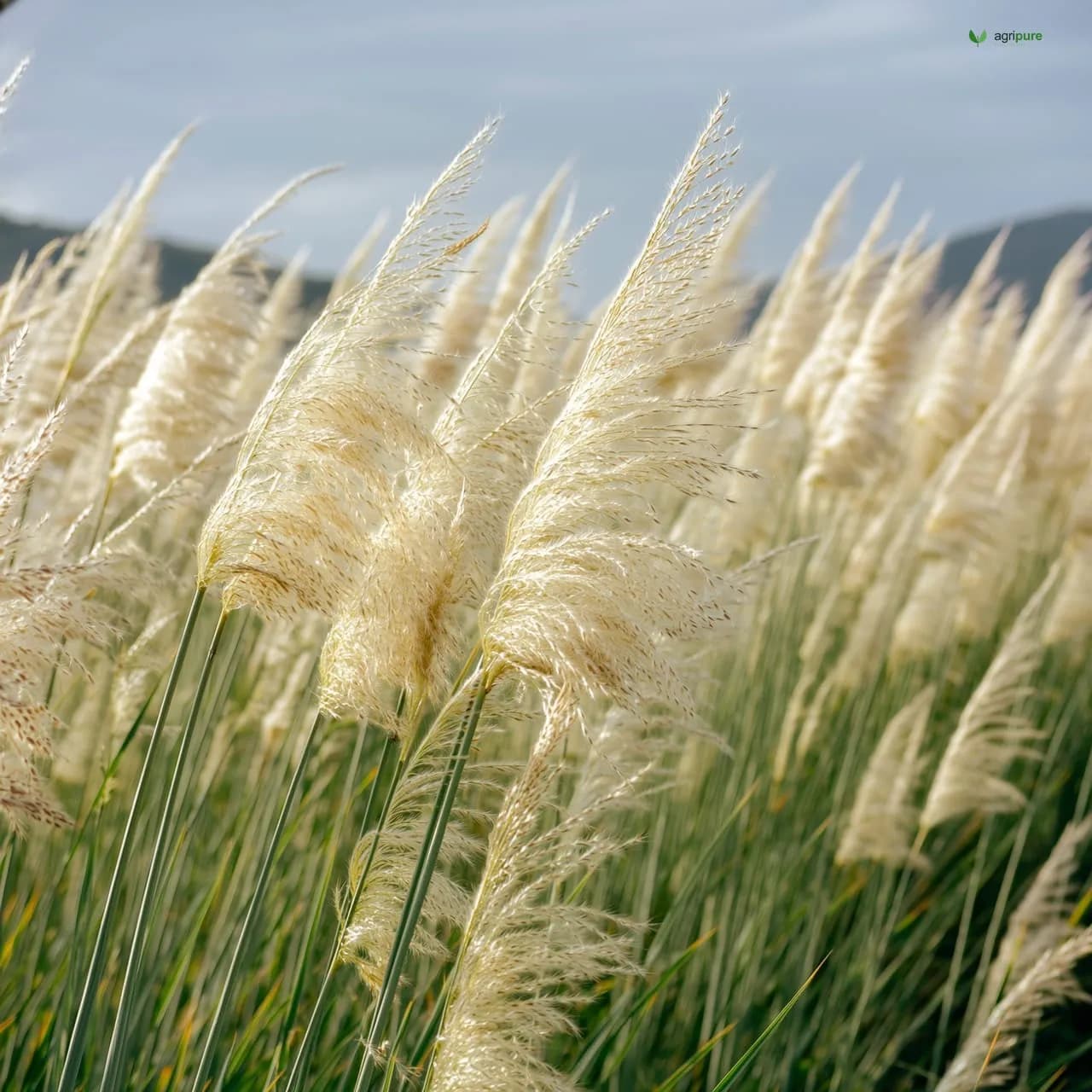
It is a robust, tufted grass built on an extensive system of underground stems (rhizomes), with erect culms rising from a deep root system that spreads outward to form dense, often monocultural stands. Plants are typically 2 to 4 m tall, and in favorable conditions can reach 6 to 8 m. The leaves are linear, narrowing toward the base, with margins often rough to the touch (scabrous); the small ligule is triangular in the typical subspecies. The most distinctive feature is the flower head: a large, plume-like, silvery-white panicle made up of many tiny spikelets surrounded by long silky hairs. The spikelets are roughly 3.3 to 4.5 mm long and awnless, and the seeds are wind-dispersed in large numbers. In the field, look for its tall, upright, clumping-yet-spreading habit with dense rhizome mats, topped in late season by silvery plumes coarser than many ornamental Miscanthus, often forming solid patches along rivers and canals.
Where wild sugarcane grows
Its native and long-established range runs across tropical and subtropical Asia, from the Himalayan foothills of northern India to equatorial Southeast Asia, with native or long-naturalized populations also in parts of East and North Africa, the Middle East, southern Europe, and Australasia. In its native range it grows from the lowlands up to about 1,500 m in elevation. It occupies riverbanks, marshes, sand dunes, roadsides, waste places, fields, and disturbed land, tolerating a wide range of soil types and moisture levels from relatively dry to waterlogged. Surviving both seasonal flooding and extended dry periods, it shows the same toughness that makes it useful for erosion control and dangerous as an invader.
Primary sources describe its climate rather than assigning hardiness zones. Given that it thrives in tropical and warm-temperate regions, it likely corresponds roughly to USDA zones 8 to 11; this is an inference from the climate descriptions, not a direct zone trial.
Growing wild sugarcane (and why caution comes first)
Before anything else: Saccharum spontaneum is listed as a federal noxious weed in the United States and is regulated in states such as Florida, so planting, moving, or propagating it is restricted or prohibited in many places. Check local regulations first; deliberate cultivation belongs to controlled research or carefully bounded agroforestry, not casual planting.
The plant establishes from its spreading rhizomes, which form the dense mats and stands that define it, and it produces large quantities of wind-dispersed seed. That dual spread, by creeping rhizome and airborne seed, is what makes containment so difficult and underlies its weed status. It asks little of the soil, tolerating a broad range of textures and moisture levels and shrugging off both flood and drought once established. Region-specific figures for spacing, sowing windows, and time to maturity are not reliably documented in the general botanical sources here, so they are left out rather than invented. The practical point: it needs no encouragement to grow, and any planting must be physically contained and cut before it can set seed.
Harvest and uses
Wild sugarcane is valued for what its biomass does, not for any harvest you eat. Documented uses are as fodder, as a source of thatching material and fiber, and as a soil-binding plant for erosion control, its deep roots and dense stands stabilizing riverbanks, dunes, and disturbed ground. Beyond the homestead, it is agriculturally important as a breeding parent crossed into cultivated sugarcane, and it is studied as a bioenergy crop for its abundant biomass. What it does not offer is human food: the sources are explicit that there is no well-documented traditional food use, so treat it as a fiber, fodder, and land-stabilizing grass.
Safety and cautions
The principal hazard with wild sugarcane is not toxicity but invasiveness, and it is a serious one. Multiple authorities document it as an aggressive invasive weed across tropical and subtropical regions, and in the United States it carries federal noxious weed status with additional state-level regulation. Its dense monocultural stands crowd out other vegetation and dominate disturbed land. It should never be introduced near intact vegetation, waterways, or a neighbor’s land, and in many jurisdictions it cannot legally be planted at all. Anyone weighing it for erosion control or research should confirm its legal status locally and have a firm containment and removal plan in place first.
Sources
- Saccharum spontaneum (wild sugarcane) – CABI Compendium
- Saccharum spontaneum – Federal Noxious Weed Disseminules (IDtools)
- Saccharum spontaneum – ScienceDirect Topics
- Federal Noxious Weed list reference – USDA APHIS
- Saccharum spontaneum invasive plant assessment – University of Florida IFAS