secondary
Toothbrush Tree (Mustard Tree)
jaal / pilu
Salvadora persica
Also known as Pilu (Pakistan).
- sindh coast
- punjab plains
International hardiness
- USDA 9-12
- RHS H1c
- AU: Arid / semi-arid, Tropical, Subtropical
Where it grows — regional guide
| Zones / rating | Regional notes |
|---|---|
USDA 9-12 | No region-specific data yet |
| Zones / rating | Regional notes |
|---|---|
H1c (5 to 10C) | No region-specific data yet |
| Zones / rating | Regional notes |
|---|---|
Arid / semi-arid, Tropical, Subtropical | No region-specific data yet |
| Zones / rating | Regional notes |
|---|---|
USDA 9-12 (USDA scale) Canada uses its own zone system; Canadian zones run roughly one lower than USDA. | No region-specific data yet |
| Zones / rating | Regional notes |
|---|---|
Sindh coast, Punjab plains | Pakistan:A native evergreen halophyte of saline coastal Sindh and dry southern Punjab; withstands severe salt and drought, providing pungent berries and miswak chew-sticks. India:Native to salt-affected coastal and desert tracts in India; survives extreme salinity and arid heat while supplying traditional miswak chew-sticks. |
Grows alongside
Species that appear with Toothbrush Tree (Mustard Tree) in 1 of our published guides — a starting list for a guild, not a planting plan.
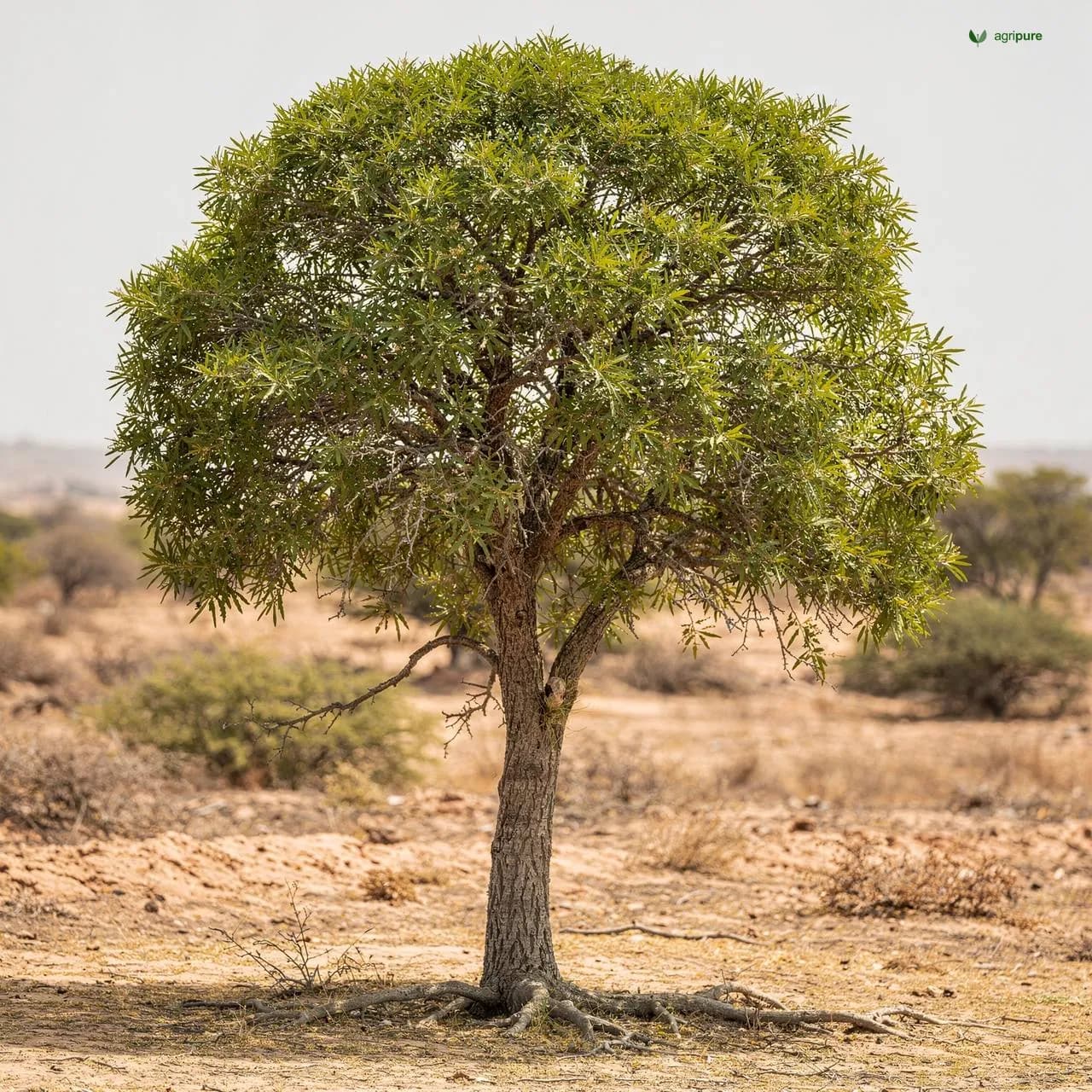
Toothbrush tree (Salvadora persica, jaal or pilu) is the salt-tolerant evergreen of saline Sindh and the drier Punjab flats, a small crooked-trunked tree that holds ground most species cannot. It carries peppery edible berries, and its twigs are the miswak chew-stick used as a toothbrush across the region. On a syntropic site it is a secondary-stage tree for the hardest, saltiest land: a windbreak and soil cover that still returns food and a daily-use product where almost nothing else will grow.
Where it thrives
Pilu is a perennial evergreen halophyte that grows under extremes, from very dry ground to highly saline soil. It is common in Sindh and through the dry belt of West Asia and North Africa, and it gets by on roughly 200 mm of rain a year or less, which is what makes it a tree for saline flats and arid waste ground rather than for irrigated cropland. It forms a small tree or shrub, usually 6 to 7 m tall, with a crooked trunk and cracked whitish bark, and that salt tolerance is the trait that puts it on coastal Sindh where soil salinity defeats most planting.
Role in the system
On saline ground pilu does the work a pioneer or secondary tree usually does on better soil: it stabilises the site, breaks wind, and shades the surface, opening the way for a wider planting. Its strength is simply that it survives the salt and drought that rule out most species, so it becomes the frame of a guild on land that would otherwise stay bare. Alongside that service it carries a genuine yield, edible fruit and the miswak twig, so it is never only a placeholder. Read it as the tree that makes saline coastal and inland flats workable at all, then build the system out from the shelter it provides.
Uses
The tree produces small red edible fruits in clusters, juicy but pungent, eaten as a minor fruit of arid horticulture. Its better-known product is the miswak: the roots and twigs are chewed as a traditional toothbrush, a use the World Health Organization formally recommended for oral hygiene in 1986 and again in 2000.1 That gives the tree a real medicinal and household value on top of its fruit, all from a species that asks almost nothing of the soil. As a hardy evergreen it also is a windbreak and shelter on exposed saline land.
Cautions
Match the species to the species. This is Salvadora persica, the smaller, more salt-adapted pilu of coastal and saline ground, not its inland relative *Salvadora oleoides*, so plant it where salinity and drought are the limiting factors and its tolerance actually pays. Because the berries are pungent and the twigs are the product, treat fruit as a minor secondary yield rather than a main crop, and harvest twigs for miswak without stripping the plant bare so it keeps its shelter value.
Sources
- Farag, M. A., et al. (2021). “Salvadora persica L.: Toothbrush tree with health benefits and industrial applications — An updated evidence-based review.” Journal of King Saud University — Science.
Sourcing notes
Pilu is raised from seed and is suited to saline and arid sites where most nursery stock fails. Collect seed from healthy local trees on comparable salt-affected ground, and site it specifically where salinity and drought rule out other species.