pioneer
Jaal
pilu
Salvadora oleoides
Also known as Pilu (Pakistan).
- sindh coast
- punjab plains
- balochistan highlands
International hardiness
- USDA 9-11
- RHS H2
- AU: Arid / semi-arid, Subtropical
Where it grows — regional guide
| Zones / rating | Regional notes |
|---|---|
USDA 9-11 | No region-specific data yet |
| Zones / rating | Regional notes |
|---|---|
H2 (1 to 5C) | No region-specific data yet |
| Zones / rating | Regional notes |
|---|---|
Arid / semi-arid, Subtropical | No region-specific data yet |
| Zones / rating | Regional notes |
|---|---|
USDA 9-11 (USDA scale) Canada uses its own zone system; Canadian zones run roughly one lower than USDA. | No region-specific data yet |
| Zones / rating | Regional notes |
|---|---|
Sindh coast, Punjab plains, Balochistan highlands | Pakistan:A slow, dense native evergreen tree of arid, saline plains across Punjab and Sindh; withstands high summer heat and salt, yielding sweet edible desert berries. India:Native across the arid and saline plains of India; exceptionally tolerant of salinity and drought, producing sweet edible berries. |
Jaal (Salvadora oleoides) is a small evergreen tree of hot, dry, and often salty ground in northwestern South Asia and the adjoining drylands of West Asia. It is one of those trees prized less for a tidy harvest than for sheer toughness: it holds its own in arid, saline country where most fruiting plants simply will not establish, and it still offers a sweet edible berry into the bargain. For a homesteader working a marginal, sun-baked, or salt-affected corner of a property, jaal is worth knowing as a slow but durable anchor rather than a quick cropping tree. Reliable modern cultivation data for the species are thin, so this profile sticks to what the botanical record actually documents and leaves the gaps as gaps.
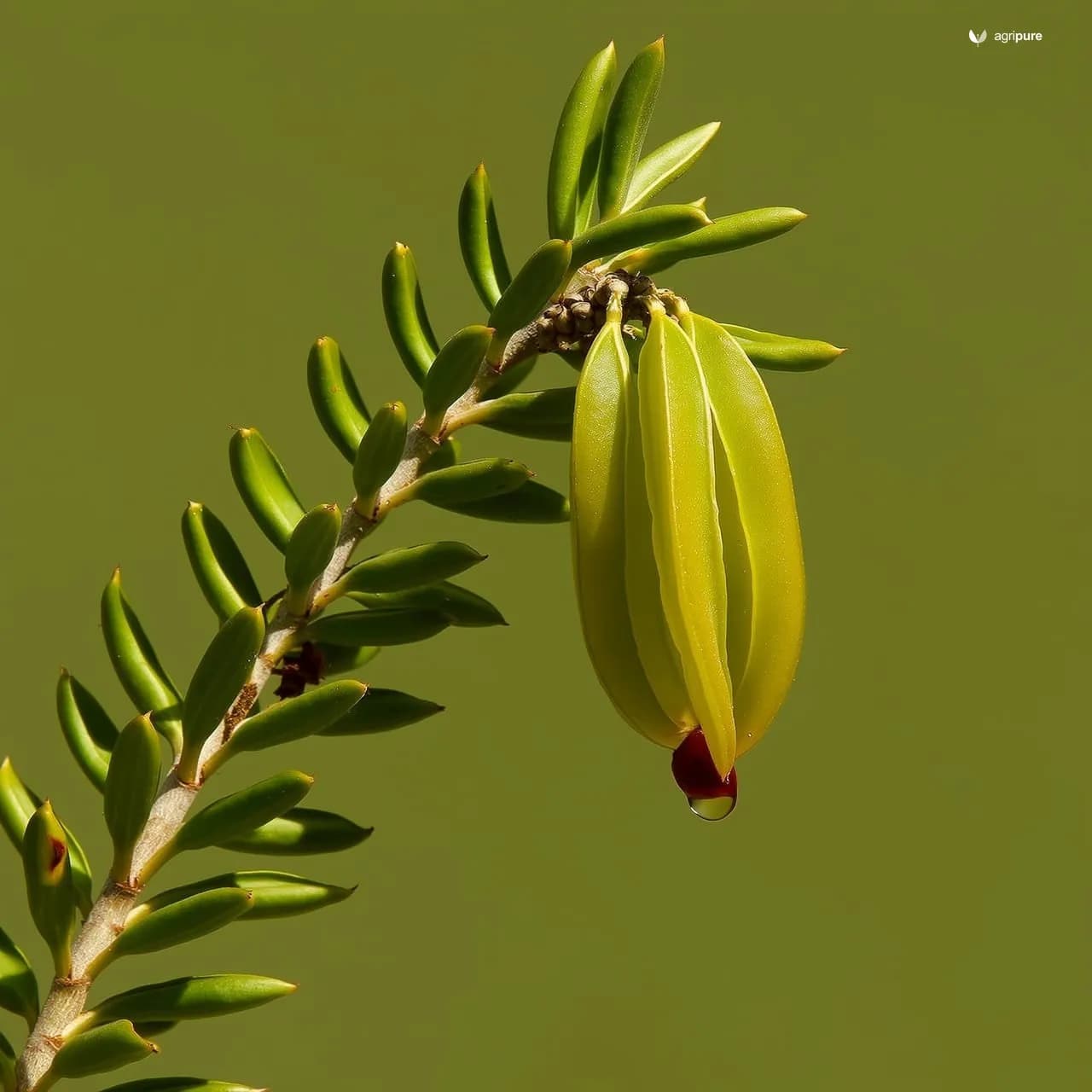
The tree is evergreen, with a dense crown and numerous drooping, often contorted branches that can give established plants a slightly weeping look. Reports of its size vary with conditions: horticultural sources describe it as a shrub or tree of roughly 6 to 9 m tall with a dense crown, while field observations compiled by CABI note it is often a slow-growing shrub or small tree seldom much over about 3.6 m on harsher sites. In suitable habitat it can form dense thickets, groves, or local woodland patches. The leaves are simple and evergreen; the plant produces small flowers followed by fleshy berries. It is closely related to and easily confused with the toothbrush tree (*Salvadora persica), which shares much of its range — the more strongly drooping branches and denser foliage of *S. oleoides are noted as a useful field cue for telling the two apart.
Growing jaal
Jaal is, above all, a plant of arid and semi-arid climates — country with hot summers, low rainfall, and high evaporation, which together imply strong heat and drought tolerance once a tree is established. Its native and naturalized range runs across western Yemen, southern Iran, Pakistan, and India, and it is described as common in the arid regions of India and Pakistan. No authoritative source assigns it a USDA hardiness zone; given that it grows in very hot, low-frost regions, it is reasonable to treat it as not frost-hardy in cold temperate climates, but that is an inference from its climate rather than a published rating, so no zone number is stated here.
Where jaal genuinely stands apart is soil tolerance. It favours arid, slightly to strongly saline soils and is reported to thrive even on medium-to-heavy saline soils of alluvial plains, with CABI describing it as adapted to saline and alkaline soils in arid regions. This salt and alkalinity tolerance is the practical reason to plant it: it puts useful tree cover and a food source on ground that would defeat most orchard or vegetable crops. As a documented slow-growing evergreen, it is not a fast-rotation timber or fuelwood species, and reliable species-specific figures for spacing, time to maturity, and propagation method are not consistently published in the open sources, so they are deliberately omitted rather than guessed.
Harvest and uses
The harvest from jaal is its fruit. The tree bears small fleshy berries that are edible and notably sweet — well enough regarded that the species earns the nickname “grape of the desert.” The fruits are documented as a traditional food, including as a famine food in dry regions, eaten where they grow. Beyond the fruit, jaal’s main value is as a hardy, evergreen presence on difficult land: a slow-growing, salt-tolerant tree that provides standing cover and a dependable food source on saline, arid ground. Detailed yield figures are not reported in the sources here, and none are invented; treat jaal as land-stabilising and food-bearing rather than a high-output cash crop.
How to identify it
In the field, jaal can be recognised by this combination of features drawn from the botanical descriptions:415
- Habit: Evergreen shrub or small tree, slow-growing, ranging from low scrubby specimens around 3.6 m up to 6–9 m where conditions allow, often forming dense thickets or groves.
- Crown and branches: Dense crown with numerous drooping, sometimes contorted branches, giving a weeping habit that is more pronounced than in the related S. persica.
- Foliage: Simple, evergreen leaves; the foliage is noticeably denser than that of S. persica, which is a helpful clue where the two species overlap.
- Fruit: Small fleshy berries that ripen to a sweet edible fruit.
- Setting: Found on arid, often saline or alkaline ground — dry plains and alluvial flats rather than moist, fertile sites.
Because vernacular names overlap with Salvadora persica and the two trees share much of their range, herbarium keys or local expert verification are worth seeking when exact species identity matters.
Sources
- Salvadora oleoides — eFlora of India
- Salvadora oleoides — Famine Foods, Purdue University
- Salvadora oleoides Decne. — International Plant Names Index (IPNI)
- Salvadora oleoides — Useful Tropical Plants
- Salvadora oleoides — CABI Digital Library