secondary
Yellow Bells
piili ghanti
Tecoma stans
Also known as Piili Ghanti (Pakistan).
- punjab plains
- sindh coast
International hardiness
- USDA 9-11
- RHS H1c
- AU: Tropical, Subtropical, Warm temperate
Where it grows — regional guide
| Zones / rating | Regional notes |
|---|---|
USDA 9-11 | An ornamental evergreen shrub in USDA zones 9 to 11; control pods to stop wind-blown seeds escaping into wild spaces, and treat strictly as a non-edible ornamental. |
| Zones / rating | Regional notes |
|---|---|
H1c (5 to 10C) | No region-specific data yet |
| Zones / rating | Regional notes |
|---|---|
Tropical, Subtropical, Warm temperate | Grown as a warm-climate ornamental, but a serious environmental weed whose windblown seeds invade native bushland; check local weed restrictions and do not forage. |
| Zones / rating | Regional notes |
|---|---|
USDA 9-11 (USDA scale) Canada uses its own zone system; Canadian zones run roughly one lower than USDA. | No region-specific data yet |
| Zones / rating | Regional notes |
|---|---|
Punjab plains, Sindh coast | Pakistan:A fast-growing ornamental shrub of the plains and coast; prune spent flowers to prevent wind-borne seeds escaping, and treat strictly as an ornamental rather than forage. India:Planted in tropical gardens for profuse yellow flowers; deadhead seed pods to curb invasive windborne spread, and treat strictly as an ornamental, not a food plant. |
Yellow bells (Tecoma stans) is a fast-growing, long-blooming ornamental shrub or small tree in the trumpet-creeper family (Bignoniaceae), native to the Americas and now widely planted across warm climates. Also known as yellow trumpetbush, yellow elder, yellow trumpet flower, and ginger Thomas, it is grown chiefly for its showy clusters of golden, bell-shaped flowers rather than for food. For a homesteader, the appeal is simple and honest: it is a tough, drought-hardy plant that puts out a long season of bee-friendly bloom and quick cover on hot, open ground. The catch, covered below, is that it seeds prolifically and has become an invasive weed in several countries, so it is best treated as a managed perimeter shrub rather than something left to its own devices.
It is the official floral emblem of both the U.S. Virgin Islands and The Bahamas, a sign of how cheerfully it flowers in the tropics.
How to identify yellow bells
Yellow bells is a spreading, fast-growing evergreen shrub or small tree, typically about 10 to 30 ft (3 to 9 m) tall. It can be trained as a multi-stemmed shrub or grown as a single-stemmed tree; the bark on older stems becomes light brown and furrowed with age. The leaves are once-compound and borne in opposite pairs along the stems, each carrying several elongated leaflets, and the leaflet margins are sharply toothed (serrated) — a useful first field cue.
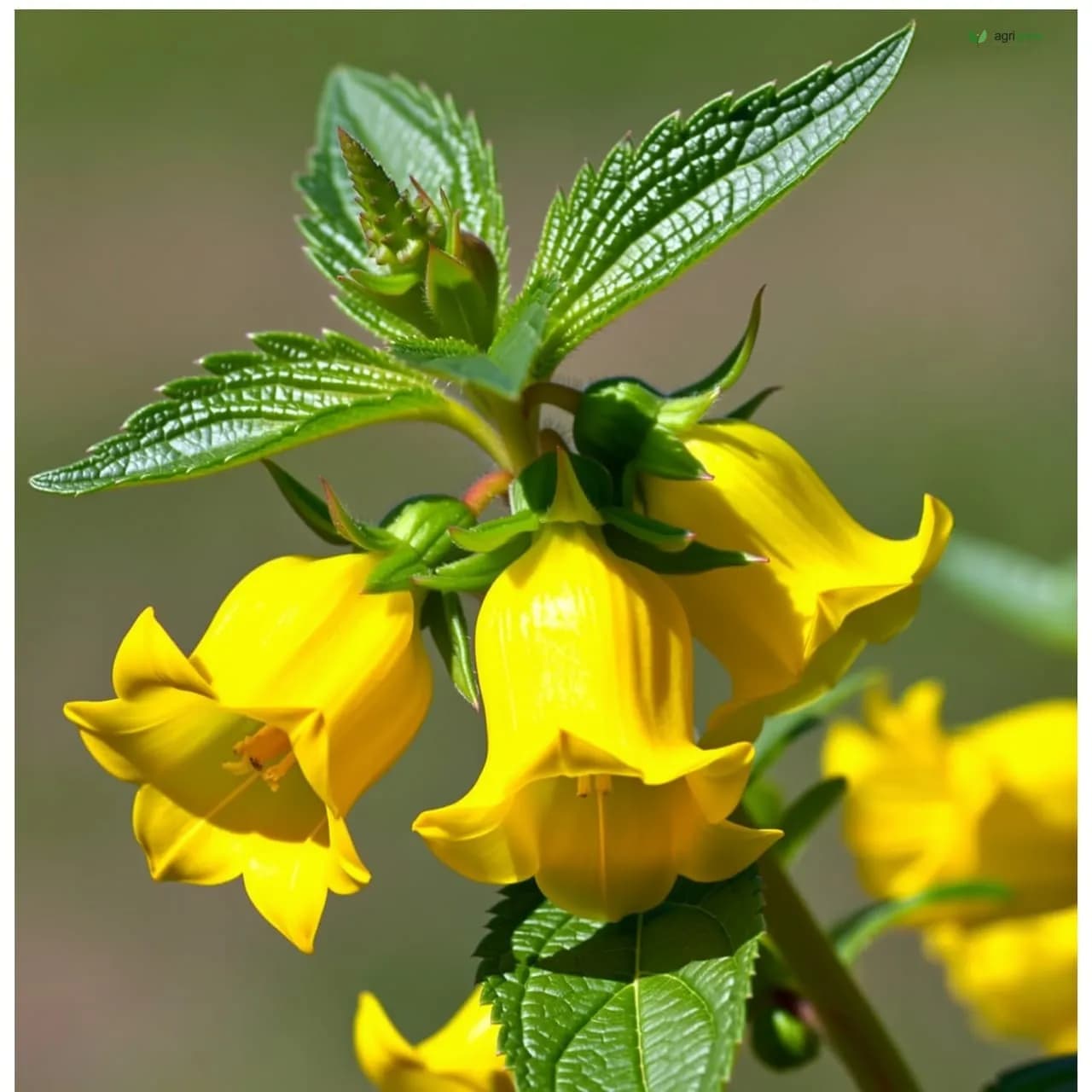
The flowers are the signature feature: showy, trumpet- or bell-shaped, bright yellow, and carried in terminal clusters. Each tubular flower is roughly 30 to 50 mm long, with five rounded lobes and faint reddish lines marking the throat. They are fragrant, and in warm climates plants may flower through much of the year, with peak bloom in autumn. After flowering, the plant forms long, narrow, legume-like capsules 10 to 30 cm long and 5 to 20 mm wide that dry and split open. Inside are numerous flat seeds about 7 to 8 mm long and around 4 mm wide, each carrying a transparent wing at either end that lets the wind carry them widely. Those winged, wind-borne seeds are both the easy way to find new plants and the reason it spreads so readily. This combination of compound, toothed leaves and long pods separates T. stans from other yellow-flowering homestead shrubs such as Cassia or Senna, which have different leaf structure and pod shape.
Where it grows
Yellow bells is native to the Americas, ranging from the southern United States through Mexico, Central America, and the Antilles to northern Venezuela, and down the Andes to northern Argentina. In the wild within the U.S. it grows on rocky slopes near San Antonio (Texas) and across the Trans-Pecos, north into New Mexico and Arizona, and south to Florida, Puerto Rico, and the Virgin Islands, and it is recognised as a native plant of Texas. It has since been introduced and naturalized in many tropical and subtropical regions, including Hawaii, southern Africa, India, and parts of Australia.
On climate, UF/IFAS lists yellow elder as suited to USDA hardiness zones 10B to 11 in Florida. San Marcos Growers notes that it is evergreen in mild climates but can be damaged or defoliated by frost, performing best in frost-free to light-frost conditions typical of warm subtropical and tropical regions. For a homestead, then, this is a plant for frost-free, warm-winter climates (roughly USDA 9b/10 to 11); in colder zones it may die back or fail.
Growing yellow bells
Yellow bells is easy to propagate, which is part of both its charm and its problem.
- From seed: UF/IFAS notes the plant grows easily from seed. The capsules split to release many winged, wind-dispersed seeds; for deliberate propagation, collect the pods when they are brown and dry and sow the seed in a well-drained medium under warm conditions.
- From cuttings: UF/IFAS also reports that propagation from cuttings is successful. Semi-hardwood cuttings are the type commonly used in horticulture, though the available sources do not give specific rooting-hormone protocols, so none are invented here.
- Light: Give it full sun, which it requires for best flowering.
The available research describes this plant’s identification, range, climate, and propagation in detail but does not provide reliable, consistent figures for soil type, plant spacing, watering schedules, or time to maturity. Rather than state those with false precision, they are left out here. In practice, treat yellow bells as the warm-climate, drought-hardy shrub the sources describe: plant it in full sun, water it through establishment, and then expect a tough, low-demand plant — while keeping a close eye on its seeding habit, below.
Uses and ecological role
Yellow bells is not a food crop. Across the sources, its documented value is ornamental, ecological, and traditional medicinal rather than culinary. Its long season of fragrant yellow trumpet flowers makes it a strong ornamental and a draw for pollinators, and its fast, dense growth gives quick cover and screening on exposed ground. Treat the plant as a managed boundary or screen shrub valued for bloom and pollinator forage, not for any harvested yield — the sources here do not document a food or fodder return.
Invasiveness and cautions
The single most important thing to know about yellow bells is that the same traits that make it easy make it weedy. It is widely regarded as an environmental weed in parts of Australia, including Queensland, New South Wales, the Northern Territory, and Western Australia, where its prolific seed production, fast growth, and ability to recolonize after fire let it outcompete native shrubs. The winged seeds travel on the wind, so a single unmanaged plant can spread well beyond where it was planted.
For a homesteader, the practical rules follow directly from that: site it on a defined boundary where you can patrol for seedlings, deadhead and prune before the capsules ripen and split, and pull volunteer seedlings promptly. Keep it well away from waterways, drains, and field edges where wind-blown seed could escape onto neighbouring land. Where you cannot commit to that management — and especially where it is a declared or recognised weed — choose a less aggressive windbreak or screen instead.
Safety and cautions
Yellow bells is not a food crop, and it should not be treated as one. The sources note that its documented value is ornamental, ecological, and traditional medicinal rather than culinary, and that the plant carries toxicity and safety cautions. This profile makes no medical claims and gives no dosage, and the various parts of the plant should not be casually consumed. If you grow it where children, livestock, or pets are present, treat it as an ornamental to look at rather than a plant to eat or forage.
Sources
- Tecoma stans — San Marcos Growers
- Tecoma stans: Yellow Elder — UF/IFAS Extension
- Tecoma stans — Wikipedia
- Yellow bells (Tecoma stans) — Brisbane City Council Weed Identification
- Tecoma stans — Native Plant Society of Texas