secondary
Water Chestnut
singhara
Trapa natans
Also known as Singhara (Pakistan, India), Water Caltrop (United States).
- punjab plains
- sindh coast
International hardiness
- USDA 6-11
- RHS H5
- AU: Warm temperate, Cool temperate, Subtropical
Where it grows — regional guide
| Zones / rating | Regional notes |
|---|---|
USDA 6-11 | Classed as a prohibited invasive aquatic weed in many waterways; check local restrictions before planting, boil nuts to kill parasites, and beware of barbed spines. |
| Zones / rating | Regional notes |
|---|---|
H5 (-15 to -10C) | No region-specific data yet |
| Zones / rating | Regional notes |
|---|---|
Warm temperate, Cool temperate, Subtropical | A declared noxious aquatic weed that chokes waterways; check biosecurity restrictions before introducing, cook nuts to destroy parasites, and handle spiny burs with care. |
| Zones / rating | Regional notes |
|---|---|
USDA 6-11 (USDA scale) Canada uses its own zone system; Canadian zones run roughly one lower than USDA. | No region-specific data yet |
| Zones / rating | Regional notes |
|---|---|
Punjab plains, Sindh coast | Pakistan:Cultivated in wetlands across Punjab and Sindh for edible nuts; keep contained to prevent invasive spread, boil nuts to eliminate parasites, and watch for spiny fruits. India:Grown in village ponds for starchy nuts; keep contained to prevent invasive spread, boil nuts to prevent waterborne parasite transmission, and beware of spiny fruits. |
Grows alongside
Species that appear with Water Chestnut in 3 of our published guides — a starting list for a guild, not a planting plan.
Water chestnut (Trapa natans) is a floating-leaved annual aquatic plant native to temperate and tropical Eurasia and Africa, where it roots in the sediment of still and slow-moving fresh water and spreads a raft of leaves across the surface. It is grown across parts of Asia for its starchy nut, but the same plant is a serious, often legally prohibited invasive weed elsewhere — so this is a profile to read carefully before you ever consider putting a nut in water.
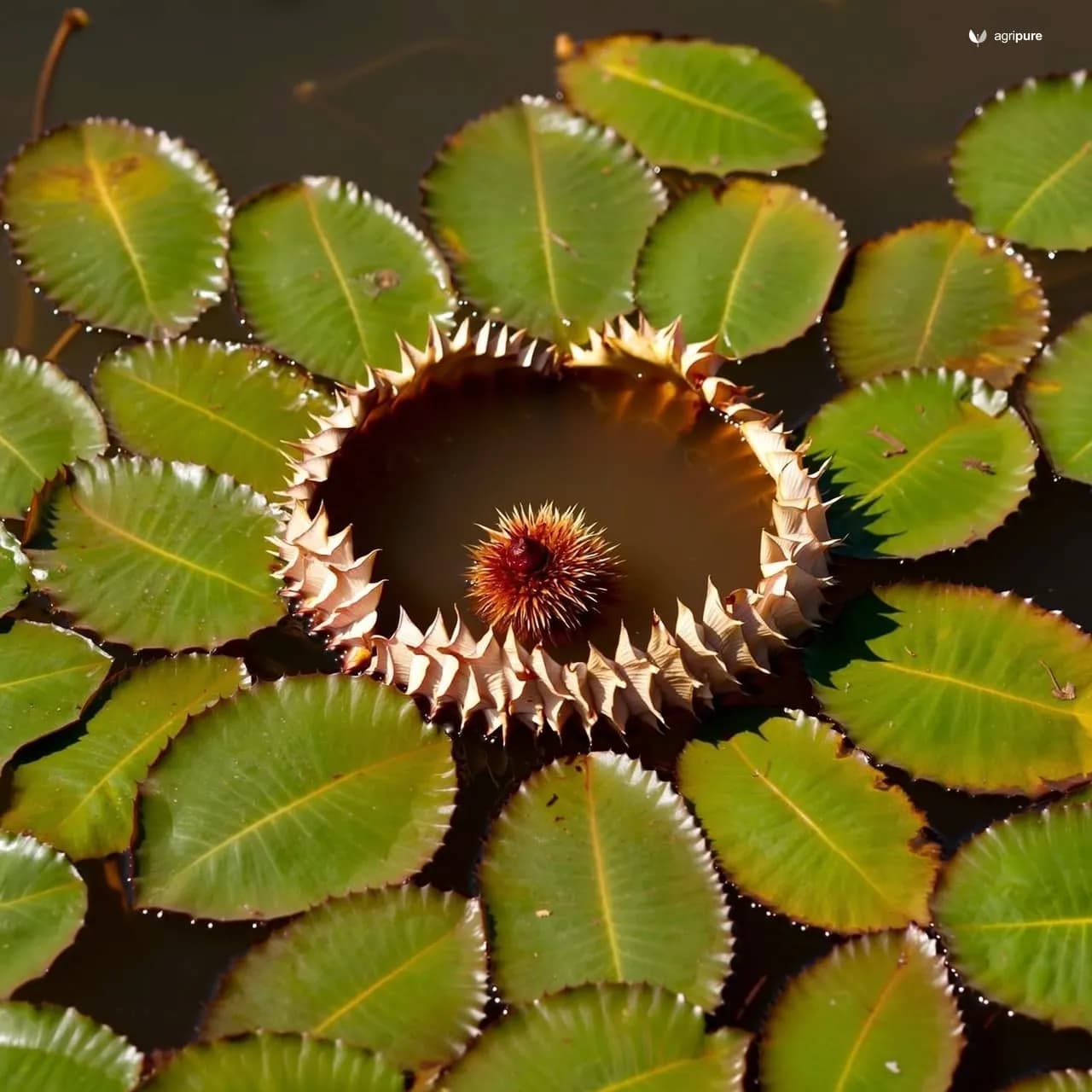
The plant is unmistakable once you know it. A single slender, thread-like stem rises from the mud (typically 50 to 200 cm, and reportedly up to 500 cm in deep water) to a rosette of floating leaves at the surface. Those floating leaves are triangular to rhombic with saw-toothed margins, shiny above and dull and finely hairy beneath, and each leaf stalk carries a swollen, spongy “air bladder” that keeps the rosette afloat. The rosette can reach about 30 cm across. Below the surface the stem also bears feather-like, finely divided submerged leaves in whorls. Small white four-petaled flowers appear singly among the surface leaves, each from a leaf axil.
The fruit is the famous part: a woody, bony nut about 2.5 cm long, armed with usually four (sometimes two) sharp barbed spines and containing a single fleshy seed. One rosette can set 10 to 15 fruits, and dense colonies carpet large areas of open water with overlapping rosettes.
Growing water chestnut
Almost all published literature on Trapa natans concerns how to control or eradicate it rather than how to cultivate it, because it is classified as an invasive or noxious aquatic weed in many U.S. states and other countries. Before anything else, confirm whether growing it is even legal where you live; in many jurisdictions it is prohibited and cannot be planted, moved, or possessed. Where it is legal, the safest setting is fully contained, such as an indoor tank, never an open pond linked to natural waterways.
Within those limits, the biology is straightforward. It is an annual: the plants die back over winter and the population regenerates from seed each spring. Propagation is therefore from the nuts, which carry the single seed and germinate in the following season. The plant needs still or slow-moving fresh water and roots into the bottom sediment; it commonly grows in water around 60 cm deep but can establish deeper. It occurs in freshwater wetlands, rivers, lakes, ponds, and slow or slightly brackish estuaries across tropical, subtropical, and temperate climates.
Authoritative hardiness-zone data for water chestnut as a crop are sparse. What the sources show is that it persists outdoors in cold-temperate climates where surface water freezes in winter, surviving by reseeding rather than through a perennial crown — its invasive populations in New York, Vermont, Massachusetts, and Quebec demonstrate that cold tolerance. The detailed sowing dates, water temperatures, and spacing figures a grower would want are not reliably documented in the general literature here, so they are left out rather than invented.
Harvest and uses
The harvested part is the nut, and its single fleshy seed is the edible portion eaten in parts of Asia. Each rosette produces only about 10 to 15 spiny fruits, and the sources here give no validated per-area yields, so no yield figure is stated. Handling demands respect: the barbed spines are sharp enough to puncture the feet of swimmers and waders and to injure livestock, so gloves and sturdy footwear are essential.
Ecologically, water chestnut is better known for its impact than its benefits. It forms dense surface mats that blanket open water, and in introduced ranges this is exactly why it is treated as a damaging invasive that crowds out other aquatic life and chokes waterways. Weighing it as a “pond crop,” understand that this mat-forming habit is a liability, not a selling point, in any system connected to wild water.
Safety and cautions
This plant carries two distinct, well-documented hazards, and both should temper any enthusiasm for growing it.
- Parasite risk from raw nuts: Although the nut is widely eaten in parts of Asia, raw nuts grown in contaminated water can transmit parasitic infections. This is a genuine food-safety concern tied to where and how the plant is grown, not a hypothetical one.
- Physical injury from the spines: The woody fruits bear sharp, barbed spines that cause puncture wounds to people wading or swimming and can injure livestock. Discarded nuts persist on shorelines and beaches and remain a hazard underfoot well after the plants have died back.
On top of the personal hazards is the legal one: Trapa natans is listed as a prohibited, invasive, or noxious species in many U.S. states and countries, so cultivating, moving, or releasing it can be both ecologically harmful and against the law. Check your local regulations before any cultivation, and never introduce it to a natural or connected waterway. This profile describes its traditional food use factually and makes no medical or dietary claims.
Sources
- Trapa natans species summary – Columbia University CERC
- Ecological Risk Screening Summary: Water Chestnut – U.S. Fish and Wildlife Service
- Trapa natans review – Journal of Pharmacognosy and Phytochemistry
- Water Chestnut profile – USDA National Invasive Species Information Center
- Trapa natans species profile – USGS Nonindigenous Aquatic Species Database
- Water Chestnut – New York Invasive Species Information (Cornell)
- Trapa natans biological flora account – Journal of Ecology (British Ecological Society)