pioneer
Snake Gourd
chichinda
Trichosanthes cucumerina
Also known as Chichinda (Pakistan, India).
- punjab plains
- sindh coast
International hardiness
- USDA 10-12
- RHS H1c
- AU: Tropical, Subtropical
Where it grows — regional guide
| Zones / rating | Regional notes |
|---|---|
USDA 10-12 | Grown as a frost-sensitive warm-season annual vine in USDA zones 10 to 12; train on trellises, harvest young green fruit, and avoid eating any fruit that tastes bitter. |
| Zones / rating | Regional notes |
|---|---|
H1c (5 to 10C) | No region-specific data yet |
| Zones / rating | Regional notes |
|---|---|
Tropical, Subtropical | Suited to tropical and subtropical northern gardens as a fast summer climber; pick slender green fruits young, and never consume bitter fruit with toxic cucurbitacins. |
| Zones / rating | Regional notes |
|---|---|
USDA 10-12 (USDA scale) Canada uses its own zone system; Canadian zones run roughly one lower than USDA. | No region-specific data yet |
| Zones / rating | Regional notes |
|---|---|
Punjab plains, Sindh coast | Pakistan:A vigorous summer climbing vine grown on trellises across the plains; harvest immature fruit for cooking, but discard any bitter gourds due to toxic cucurbitacins. India:A traditional monsoon trellis vegetable grown across the subcontinent; harvest young tender gourds for curries, and always discard bitter fruit containing cucurbitacins. |
Snake gourd (Trichosanthes cucumerina) is a climbing vine in the gourd family, Cucurbitaceae, grown across the warm tropics and subtropics chiefly for its long, slender, edible immature fruits and the tomato-like pulp of its fully ripe ones. The species is believed to have been domesticated in Asia, with the Indo-Malayan region, and India in particular, regarded as its centre of origin and diversity. For a homesteader in a hot-summer climate, it is a fast, heat-loving annual that turns a trellis into a productive vertical layer, and its dangling, snake-like fruit is one of the most striking things you can grow on a fence.
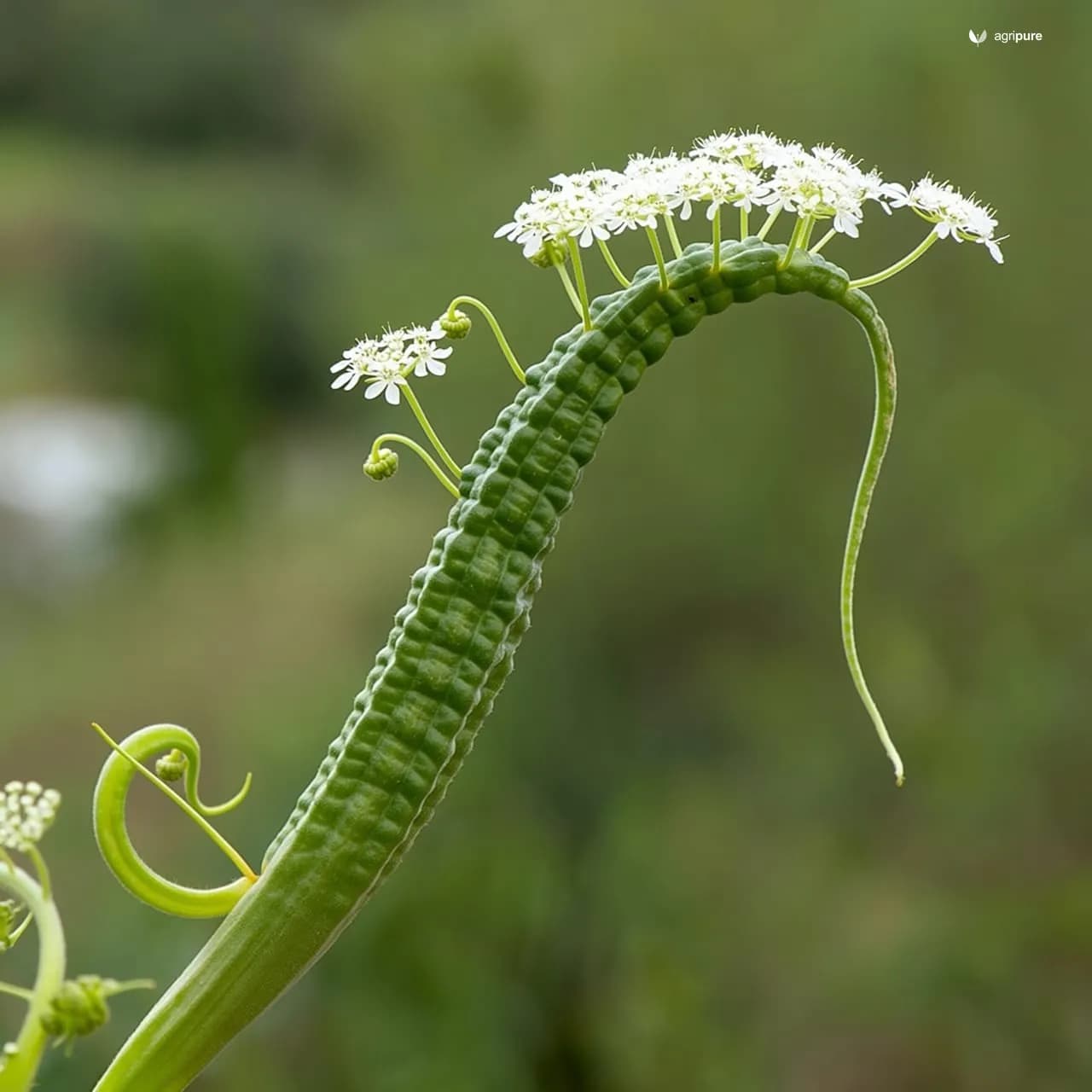
The plant is an annual to short-lived perennial climbing vine that scrambles upward by tendrils; it is almost always grown as an annual vegetable. Its stems are angular and slender, and both stems and leaves are usually pubescent (finely hairy). The leaves are palmately five-lobed and often roughly heart-shaped at the base, with a generally hairy surface. The flowers are showy and white, unisexual with separate male and female blooms, and carry deeply fringed, filigreed petals that are a hallmark of the genus Trichosanthes. The cultivated vegetable type is T. cucumerina var. anguina, whose fruits are very long, slender, and usually curved into a snake-like shape, often one to one and a half metres long, with records reaching about 1.88 m. Fruits start green and smooth to lightly ridged; as they mature the rind hardens and turns orange to red and becomes tough, while the inner pulp softens to a red, tomato-like flesh. The wild form, T. cucumerina var. cucumerina, has shorter, more gourd-like fruits and is used mainly in traditional medicine rather than as a vegetable. The seeds are flattened with jagged, wavy margins typical of the genus.
Growing Snake Gourd
Snake gourd is propagated by seed. The crop is usually direct-sown in the field, or started in nursery beds and transplanted, as described in agronomic studies of tropical production. It is a strictly warm-climate plant: sources describe it as a tropical and subtropical vine that grows well in a tropical climate, preferring warm regions with seasonal rainfall, and it is not frost-tolerant. Because it tolerates no frost, in cooler regions it has to be treated as a warm-season annual and given the hottest part of the year.
For soil, the wild plants grow on sandy soils along rivers and on disturbed ground, which points to a tolerance of light, well-drained soils. As a cucurbit vegetable, agronomic reviews recommend fertile, well-drained soils for good yields, and the crop is grown successfully on a range of tropical soils provided they are not waterlogged. The plant climbs by tendrils, so it does best given vertical support; in habitat and in cultivation it is a scrambling vine rather than a ground-cover crop.
Precise figures for sowing temperatures, plant spacing, and exact days to maturity are not consistently documented in the general sources gathered here, so they are left out rather than stated with false precision. In practice, treat snake gourd like other warm-season cucurbit vines: sow into warm, well-drained, fertile ground once frost has passed, give the vine a tall trellis to climb so the long fruit hangs straight, and keep the soil moist but never waterlogged.
Harvest and uses
The main harvest is the long, slender immature fruit, picked young and cooked as a vegetable; this is the principal reason the plant is cultivated across its range. Fully ripe fruits develop a soft red pulp that resembles tomato in both colour and texture and can be used in that way, though the rind hardens and toughens as the fruit matures, so the tender immature stage is preferred for eating. Snake gourd is grown as a vegetable across southern and Southeast Asia, parts of Africa, China, and Australasia, almost always as the long-fruited anguina type. The wild, shorter-fruited variety is valued instead for its traditional medicinal use rather than as food.
Pollination
Snake gourd carries separate male and female flowers, so both must be present for fruit to set. The flowers are reported to open in the evening or at night and to be moth-pollinated, a pattern noted for the genus in horticultural overviews; the night-opening, fringed white blooms fit this nocturnal pollination habit.
Safety and cautions
Snake gourd is described as not being one of the more dangerous cucurbits, but it carries the standard caution that applies to all gourds: very bitter fruits should be avoided because intense bitterness signals high levels of cucurbitacins, which are toxic. The practical rule is to taste before cooking and discard any markedly bitter fruit. The wild variety is documented as a traditional medicinal plant, but that is a historical record rather than a proven treatment, and this profile makes no medical claims and offers no dosages.
Sources
- NC State University, Cucurbit Breeding. “Snake Gourd and Pointed Gourd: Botany and Horticulture.”
- Idowu, D. O. et al. (2019). Study on snake gourd (Trichosanthes cucumerina). International Journal of Current Microbiology and Applied Sciences.
- Seed ID Guide. “Trichosanthes cucumerina L.” Fact Sheet.
- Royal Botanic Gardens, Kew. “Observations of a strange vegetable: snake gourd.”
- ScienceDirect. “Trichosanthes cucumerina” (Agricultural and Biological Sciences topic overview).
- CABI Digital Library. “Trichosanthes cucumerina” (CABI Compendium datasheet).