pioneer
White-Bark Acacia
safed kikar
Vachellia leucophloea
Also known as Safed Kikar (Pakistan).
- punjab plains
- sindh coast
International hardiness
- USDA 10-11
- RHS H1c
- AU: Tropical, Subtropical, Arid / semi-arid
Where it grows — regional guide
| Zones / rating | Regional notes |
|---|---|
USDA 10-11 | No region-specific data yet |
| Zones / rating | Regional notes |
|---|---|
H1c (5 to 10C) | No region-specific data yet |
| Zones / rating | Regional notes |
|---|---|
Tropical, Subtropical, Arid / semi-arid | No region-specific data yet |
| Zones / rating | Regional notes |
|---|---|
USDA 10-11 (USDA scale) Canada uses its own zone system; Canadian zones run roughly one lower than USDA. | No region-specific data yet |
| Zones / rating | Regional notes |
|---|---|
Punjab plains, Sindh coast | Pakistan:A thorny, drought-hardy arid tree of the Punjab plains and Sindh coast; handle spiny branches with care and monitor livestock browse to avoid hydrocyanic acid poisoning. India:A native dryland acacia of South Asian savanna tracts used for timber and fodder; wear thick gloves against sharp thorns, and regulate cattle grazing due to toxic hydrocyanic acid. |
White-bark acacia (Vachellia leucophloea, formerly Acacia leucophloea) is a thorny, deciduous nitrogen-fixing tree of the dry tropics, named for the pale, chalky bark that makes it easy to spot at a distance. Native to the dry parts of South and Southeast Asia, it grows where most trees give up, anchoring degraded ground and feeding livestock through long dry seasons. For a homesteader working hot, marginal land its appeal is a tough pioneer that fixes nitrogen, casts shade, and supplies fodder and fuel from sites that would otherwise carry nothing.
Description and identification
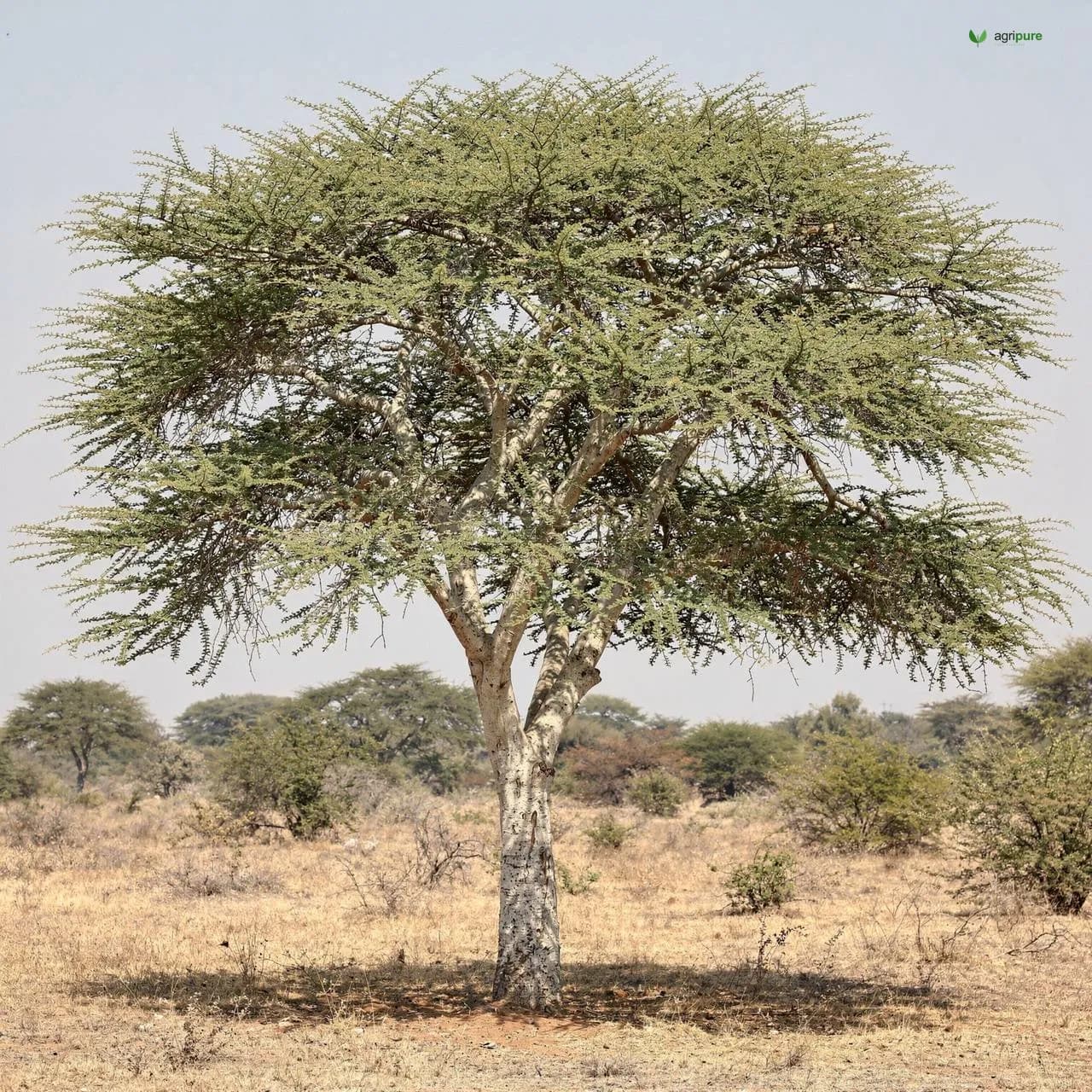
This is a thorny, spreading tree that can reach roughly 35 m tall with a trunk 35 to 100 cm in diameter, though many references describe it more modestly as a moderate-sized tree. The most reliable field cue is the combination of white to yellowish-white bark and large, wide-spreading limbs. It carries straight stipular spines (thorns) at the nodes that vary in length and are sometimes absent altogether. The foliage is bipinnate, with up to about 15 pairs of pinnae and small glands between certain pinnae pairs; new leaves flush around April in part of its range. Yellowish-white flowers are borne in panicles, hence the alternate name panicled acacia, typically from August to October in some regions, followed by legume pods. As a member of the pea family (Fabaceae, subfamily Mimosoideae) it nodulates and fixes nitrogen, which is part of why it is used in desert greening.
White-bark acacia is a component of dry forests, savannas, bush woodlands, and desert ecosystems, found from sea level up to about 800 m and concentrated in genuinely arid and semi-arid country. Its wild range runs across the dry zones of South Asia (India, Pakistan, Nepal, Sri Lanka, Bangladesh) and mainland Southeast Asia (Myanmar, Thailand, Vietnam), into Indonesia and East Timor, with native or naturalized populations also reported in Malaysia and Mauritius. The sources here do not assign a USDA hardiness zone; given its low-elevation dry-tropics range and the frost-sensitivity typical of tropical acacias, treat it as a frost-sensitive species suited to hot, dry climates with pronounced dry seasons rather than to a stated zone number.
Growing white-bark acacia
The tree is grown from seed. The seed has a hard coat and needs scarification to germinate well, and silviculture trials point to two tested pre-treatments for breaking dormancy:35
- Hot-water treatment: submerge the seed in recently boiled water and leave it until the water cools, about 24 hours.
- Acid scarification: soak the seed in sulfuric acid for 10 to 30 minutes, then rinse and soak it in cool water for 24 hours.
Both methods significantly improve germination in operational forestry settings; the acid method needs careful handling. On soil, it grows well on alluvial or infertile ground and occurs naturally on dry, poor soils at savanna and desert margins, which is why it is recommended for reforesting degraded sites. As a legume it forms nitrogen-fixing root nodules, putting fertility into ground that has little to give. It is a tree of open, arid habitat that demands full sun and is built for dry conditions, so it has no place under a closing canopy. Spacing, sowing dates, and time-to-maturity figures are not consistently documented in these general sources and are left out rather than stated with false precision; treat it like other dryland pioneer trees and give each room for its wide crown.
Harvest and uses
White-bark acacia is a multipurpose tree rather than a single-harvest crop, used for fodder, fuel, timber, dyes, liquor distillation, and as a famine food. The pods are eaten as a vegetable and the seeds can be ground and mixed with flour, which is the basis of its role as an emergency food. Across its range it is valued as shade and dry-season browse for livestock, supplying fodder when pasture has dried off, while the wood is also fuel and the tree yields timber and dye materials. The same standing tree returns shade, browse, fuelwood, and nitrogen on land that would otherwise be bare. The general sources here do not give reliable per-tree yield figures, so none are stated.
Safety and cautions
This tree carries real cautions for both people and animals, and they should be taken seriously.
- Livestock toxicity: the plant contains hydrocyanic acid and toxicity in livestock is documented; browse should be managed accordingly rather than relied on blindly.
- Edible uses are qualified: the pods and seeds are recorded as food and famine food, but human and animal use requires caution given the documented toxicity, so casual consumption is not advised.
- Traditional medicine: the bark and other parts are widely used in traditional medicine across the tree’s range. That is a record of traditional use, not evidence of safety; this profile makes no medical claims and offers no dosages.
- Thorns: the tree is spiny, which makes it useful as a livestock barrier or boundary but means it should be sited away from work lines and paths.
Sources
- Acacia leucophloea – eFlora of India
- Vachellia leucophloea – Wikipedia
- Acacia leucophloea: shade and fodder for livestock in arid environments – Winrock International FACT Net
- Vachellia leucophloea – iNaturalist
- Vachellia leucophloea – Useful Tropical Plants
Sourcing notes
Grow from seed collected off vigorous local trees on dry sites; the hard seed coat benefits from scarification or a hot-water soak before sowing. Seedlings are slow at first but become very drought-hardy once the taproot is down.