climax
Himalayan Viburnum
guch
Viburnum grandiflorum
Also known as Guch (Pakistan).
- kpk hills
International hardiness
- USDA 6-8
- RHS H6
- AU: Cool temperate
Where it grows — regional guide
| Zones / rating | Regional notes |
|---|---|
USDA 6-8 | No region-specific data yet |
| Zones / rating | Regional notes |
|---|---|
H6 (-20 to -15C) | Hardy to RHS H6 as a winter-flowering ornamental shrub for moist, shaded borders; enjoy the fragrant pink-white blooms, but never ingest berries flagged as potentially harmful. |
| Zones / rating | Regional notes |
|---|---|
Cool temperate | No region-specific data yet |
| Zones / rating | Regional notes |
|---|---|
USDA 6-8 (USDA scale) Canada uses its own zone system; Canadian zones run roughly one lower than USDA. | No region-specific data yet |
| Zones / rating | Regional notes |
|---|---|
KPK hills | Pakistan:A deciduous mountain shrub of the KPK hills valued for fragrant winter-to-spring flowers; do not casually eat the berries, as horticultural sources flag them as harmful. India:Native to western Himalayan temperate forests and planted for fragrant early blooms; treat the berry crop purely as ornamental, as authorities report it as potentially harmful. |
Himalayan viburnum (Viburnum grandiflorum) is a deciduous shrub or small tree native to the temperate Western Himalaya, where it grows along forest margins, shrubberies, hill slopes and clearings. It is best known for its fragrant white-to-pink flowers, which open on bare branches in winter and early spring — a season when very few other Himalayan woody plants are in bloom. For a homesteader in a cold, temperate climate, that makes it a striking ornamental that earns its keep when the rest of the garden sits dormant.
This is a hardy, mountain-forest plant. Wild stands are reported from Kashmir eastward to south-east Tibet, and it is widely distributed through India, Nepal, Bhutan, China and Pakistan, often covering whole Kashmir hillsides at high elevation. Trees and Shrubs Online describes its range as extending from Chamba eastward, possibly into parts of western China. It is genuinely cold-tolerant: one Himalayan wild-food source calls it “very hardy,” able to tolerate winter temperatures down to about -20 C, and the RHS rates the cultivated f. foetens at hardiness H6 (hardy through most of the UK, again to roughly -20 C). In homesteading terms that minimum maps roughly to USDA Zone 5 and the milder edge of Zone 4 — an informed mapping from those published temperatures rather than a direct USDA listing.
How to identify Himalayan viburnum
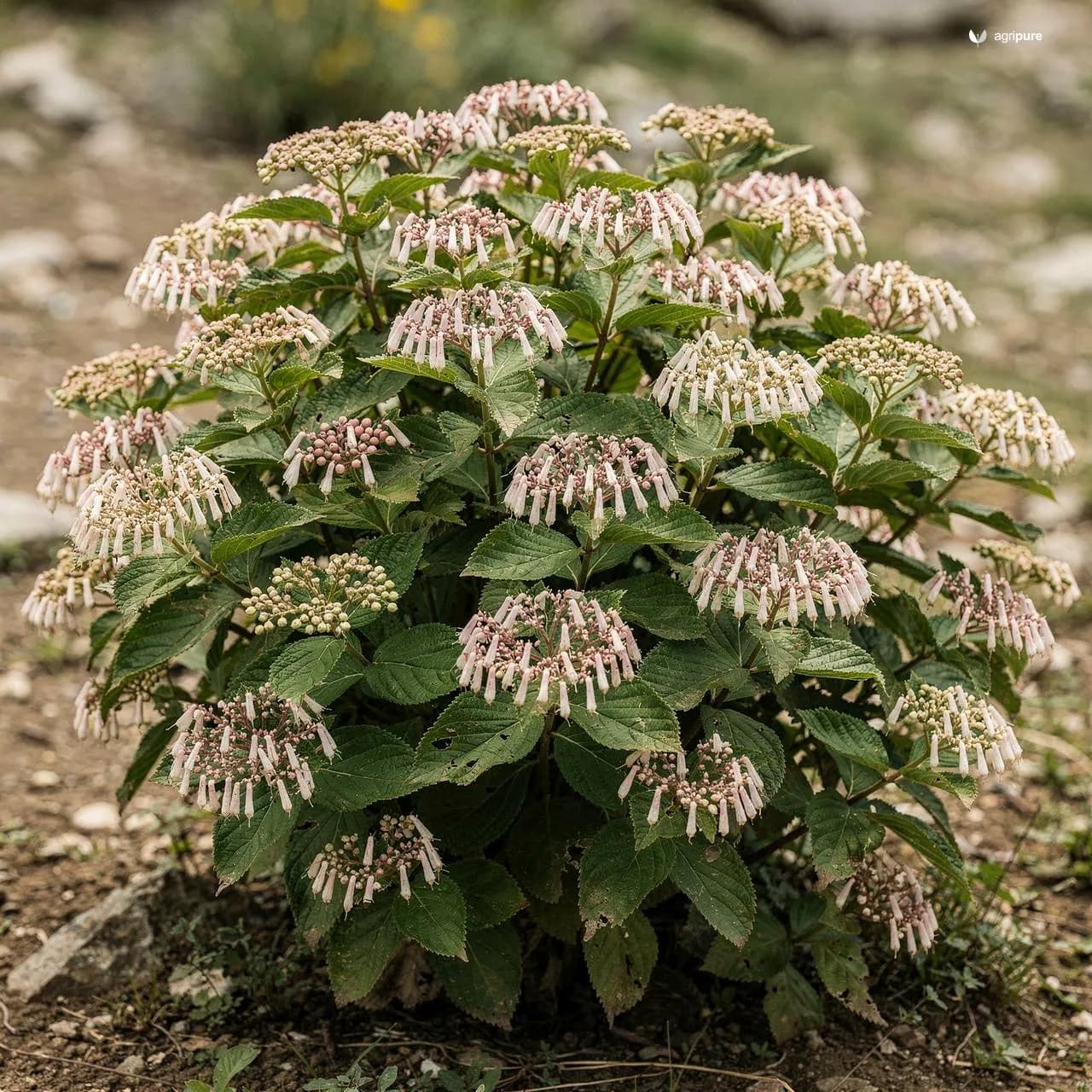
Himalayan viburnum is a perennial deciduous shrub or small tree, usually 2 to 5 m tall in the wild and up to about 3 m in gardens, with a dense, rounded to spreading habit. Young shoots are softly downy at first and darken to brown by winter. The leaves are ovate to elliptic, dark green and prominently veined, with toothed, hairy margins; they drop in autumn, so the flowers often appear on bare wood. The flowers come in dense clusters (cymes) of fragrant white to whitish-pink blooms (pale pink in bud in the cultivated f. foetens) through winter and early spring. The fruit is an ellipsoid berry, red ripening to black and roughly 2 cm long, usually with a single seed. A useful field cue: eFlora of India notes the plant is “easily recognised by its characteristic unpleasant smell.”
Growing Himalayan viburnum
The species has a reputation as an easy plant, in keeping with how commonly it turns up in wild shrubberies and forest margins. The Royal Horticultural Society recommends propagating it by seed, by softwood cuttings taken in summer, or by layering. For a homesteader, cuttings and layering are usually the most practical routes, as they reproduce the traits of a plant you already know.
On soil, it is described as succeeding in most soils but “ill-adapted for poor soils and for dry situations,” preferring moist, well-drained ground. That fits its home in cool, humid mountain forest rather than open, parched sites, so site it where the soil stays reliably moist and give it a position where the early blooms can be seen.
Specific sowing dates, germination temperatures, plant spacing and time-to-maturity figures are not consistently documented in the sources here, so they are left out rather than stated with false precision. Treat it as a slow, long-lived temperate shrub and let it settle over several seasons.
Harvest and uses
The headline use is ornamental. Himalayan viburnum is grown chiefly for its fragrant winter-to-spring flowers, valued for scent and for being one of the very few woody plants in bloom at that season. The berries ripen from red to black and are reported as edible by several Himalayan ethnobotanical and field-observation sources, where ripe fruit is eaten. Beyond that, the plant is used locally as a traditional wild fruit and folk medicine within its native range. No yield figures appear in the sources, so none are claimed here.
Safety and cautions
Guidance on eating the fruit is genuinely contradictory, and a homesteader should know that before tasting anything. Some horticultural authorities class the fruit as ornamental and “not to be eaten,” describing the plant as “potentially harmful,” while several Himalayan ethnobotanical sources state the ripe fruits are eaten and considered edible. Because of this conflict, treat any culinary or medicinal use cautiously and on a small scale only.
- Do not assume the fruit is safe just because some sources report it being eaten; the conflicting “not to be eaten / potentially harmful” guidance makes positive identification and caution essential.
- Vulnerable groups (children, those who are pregnant, and anyone with chronic illness) should avoid eating or medicinally using the plant unless guided by a qualified professional.
- This profile describes traditional and reported uses only and makes no medical claims; no dosages are given.
Sources
- Viburnum grandiflorum f. foetens – Royal Horticultural Society
- Viburnum grandiflorum – Trees and Shrubs Online
- Viburnum grandiflorum (Klaene) – Himalayan Wild Food Plants
- Viburnum grandiflorum – eFlora of India
- Viburnum grandiflorum – Observation.org
Sourcing notes
Collect ripe fruit or take cuttings from wild stands in Swat or Azad Kashmir; establish it in shade and moist soil rather than open, dry sites.