pioneer
Broad Bean
baqla
Vicia faba
Also known as Fava Bean (United States, Canada), Faba Bean (Australia), Baqla (Pakistan).
- punjab plains
- pothohar
- kpk hills
International hardiness
- USDA 6-10
- RHS H4
- AU: Cool temperate, Warm temperate, Mediterranean
Where it grows — regional guide
| Zones / rating | Regional notes |
|---|---|
USDA 6-10 | Grown as a cool-season annual vegetable and nitrogen-fixing cover crop; culinary pods are nutritious, but seeds trigger dangerous favism in people with G6PD deficiency. |
| Zones / rating | Regional notes |
|---|---|
H4 (-10 to -5C) | Hardy to RHS H4, it is a traditional allotment staple sown in autumn or early spring; harvest tender pods, but note that seeds trigger severe favism in G6PD-deficient people. |
| Zones / rating | Regional notes |
|---|---|
Cool temperate, Warm temperate, Mediterranean | Grown as an autumn-sown winter annual crop across Mediterranean and temperate zones; fixes valuable nitrogen, but seeds cause severe hemolytic favism in G6PD deficiency. |
| Zones / rating | Regional notes |
|---|---|
USDA 6-10 (USDA scale) Canada uses its own zone system; Canadian zones run roughly one lower than USDA. | Grown as a cool-season summer annual pulse in short northern growing seasons; produces rich beans, but individuals with G6PD deficiency must avoid eating due to favism. |
| Zones / rating | Regional notes |
|---|---|
Punjab plains, Pothohar, KPK hills | Pakistan:A winter rabi cool-season legume cultivated in the KPK hills, Pothohar, and Punjab; boil beans for food, but avoid entirely if anyone in the family has G6PD deficiency. |
Grows alongside
Species that appear with Broad Bean in 15 of our published guides — a starting list for a guild, not a planting plan.
The broad bean (Vicia faba), also sold as the fava bean or faba bean, is a cool-season annual legume in the bean family (Fabaceae) grown the world over for its large edible seeds, as a green manure, and as a nitrogen-fixing cover crop.123 Botanical sources place its origin in North Africa and Southwest Asia, around the Middle East, from where it has spread so widely that it is now grown from tropical to temperate regions, including North and South America, Europe, Africa, and China.145 For a homesteader, the appeal is double: it puts a heavy, protein-rich seed on the table during the cool months when little else is producing, and it feeds the soil it grows in rather than draining it.
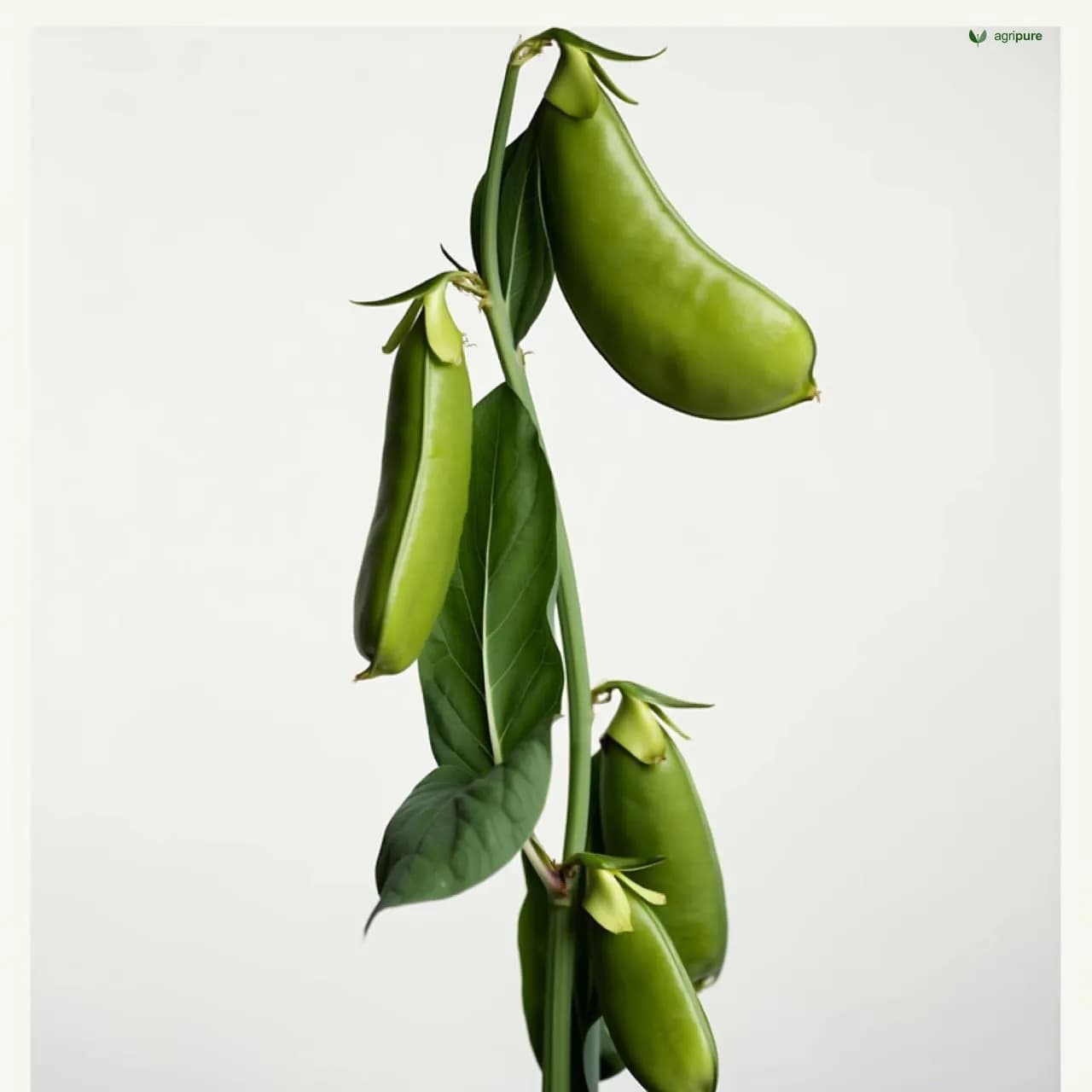
It is an easy plant to recognize in the bed. Broad bean grows as a stiffly erect annual, typically 2 to 6 feet (about 0.6 to 1.8 m) tall, on upright stems that are generally unbranched or only sparsely branched.12 The leaves are large and pinnate, made up of several broad oval leaflets that give the plant a lush, leafy look quite unlike the wiry vetches it is related to.23 Its flowers are showy and borne in the leaf axils, most often white with a black or dark purple blotch, sometimes uniformly purple, and they are self-fertile.12 The pods are long, thick, and often fleshy and padded, holding several large flattened seeds that are pale green when immature and turn tan or brown as they dry.23 Taken together, the tall upright habit, broad leaflets, white-and-black flowers, and thick padded pods with big flat seeds separate it from common beans and from the slender vetches in the same genus.
Growing broad bean
Broad bean is grown from seed and is almost always direct-sown; sources note it establishes best by direct drilling rather than transplanting.2 Because the seeds are large, the USDA plant guide suggests planting equipment suited to big seeds, of the kind used for lima beans, for the larger-seeded cultivars.2 It is a genuinely cool-season crop: grown as a winter annual in warm-temperate and subtropical climates, and as a spring or summer crop in cooler regions.3 For germination the optimum soil temperature is roughly 60 to 65°F (15 to 18°C), and the plant grows best at daytime temperatures in the 60s°F, broadly 65 to 85°F (18 to 29°C).123 Heat is its main enemy: growth and yield fall off where temperatures climb above the mid-70s°F, with clear suppression above about 90°F (32°C), which is why timing the crop for the cooler part of the year matters so much.23 For garden culture it is listed in USDA hardiness zones 4 to 8, though it is grown and harvested as an annual rather than overwintered as a perennial.1
On soil it is fairly forgiving. It prefers moist loams but tolerates clay and saline soils, and once established it will take some drought.1 It grows best on well-drained clay and silt soils and also does well on sandy soils provided there is enough moisture, across a wide pH band of about 6.5 to 9.2 Give it full sun for best production.1 Water is the lever that matters most: the plant performs best in moist soil, is only drought-tolerant after it is well established, and on lighter sandy ground especially needs steady moisture to crop well.12 Like other legumes, broad bean fixes its own atmospheric nitrogen through symbiotic root bacteria, so it does not call for nitrogen feeding and instead leaves the ground richer than it found it.12 Exact sowing depths, plant spacing, and days-to-maturity vary by cultivar and region and are not reliably fixed in the sources here, so they are left out rather than stated with false precision.
Harvest and uses
The harvest is the seed, taken either young and green as a fresh vegetable or left on the plant to mature and dry for storage; the immature seeds are pale green and the mature ones tan to brown.3 Different botanical varieties shape what you pick: var. faba, the broad or Windsor bean, carries one or two large pods with large seeds, while var. equina (field or horse bean) and var. minuta (bell or tick bean) bear more numerous pods with smaller seeds.26 Beyond the kitchen, broad bean earns its place in a rotation as a green manure and cover crop, valued specifically for the nitrogen its roots fix into the soil for the crop that follows.12 It is one of the more useful dual-purpose legumes a homesteader can grow, both a food crop and a soil-building crop in one cool-season slot.
Safety and cautions
Broad bean is widely eaten, but the sourced research is clear that it carries real safety considerations that should not be glossed over.14 The most important is favism: the seeds pose serious toxicity risks for people with G6PD deficiency, an inherited enzyme condition, and broad bean can also interact with certain drugs.14 Anyone with G6PD deficiency, and anyone unsure of their status who has a family history of it, should treat broad bean with caution and seek medical advice before eating it, since reactions can be severe. This profile makes no medical claims and offers no dosages; it simply flags that, unlike most garden beans, fava is a food that some people genuinely cannot eat safely.
Sources
- Vicia faba (Broad Bean) — Permapeople plant database
- Vicia faba (Faba Bean, Broad Bean) — NC State Extension Gardener Plant Toolbox
- Plant Guide: Faba Bean (Vicia faba) — USDA Natural Resources Conservation Service
- Broad Bean — ScienceDirect Topics (Food Science)
- Origin, distribution, taxonomy and botanical description of Vicia faba — International Journal of Current Research
- Vicia faba seed fact sheet — Seed ID Guide (Idaho Seed Lab)