secondary
Indian Cheese Maker
paneer booti
Withania coagulans
Also known as Paneer Booti (Pakistan).
- balochistan highlands
- sindh coast
International hardiness
- USDA 9-11
- RHS H2
- AU: Arid / semi-arid, Subtropical
Where it grows — regional guide
| Zones / rating | Regional notes |
|---|---|
USDA 9-11 | No region-specific data yet |
| Zones / rating | Regional notes |
|---|---|
H2 (1 to 5C) | No region-specific data yet |
| Zones / rating | Regional notes |
|---|---|
Arid / semi-arid, Subtropical | No region-specific data yet |
| Zones / rating | Regional notes |
|---|---|
USDA 9-11 (USDA scale) Canada uses its own zone system; Canadian zones run roughly one lower than USDA. | No region-specific data yet |
| Zones / rating | Regional notes |
|---|---|
Balochistan highlands, Sindh coast | Pakistan:A drought-hardy nightshade shrub of arid Balochistan and Sindh; dried berries curdle milk as vegetable rennet, but avoid casual or unguided medicinal use in pregnancy. India:An arid-zone perennial shrub native to northwestern drylands whose berries yield vegetarian rennet; avoid casual consumption or self-medication during pregnancy. |
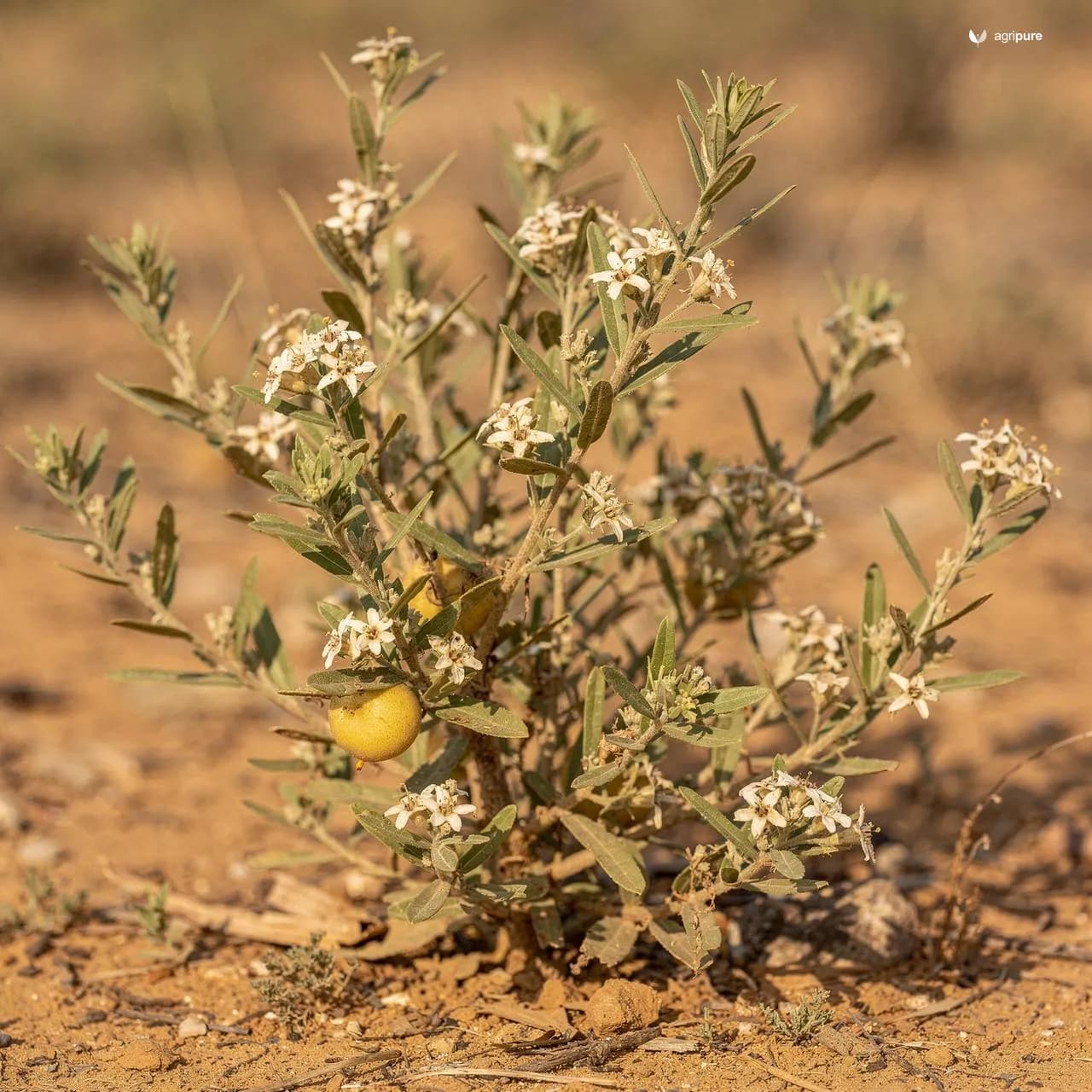
The Indian cheese maker (Withania coagulans) is a small perennial shrub in the nightshade family (Solanaceae), grown not for a vegetable but for its dried fruits, which have long been used as a plant-based rennet to curdle milk — hence the common names “vegetable rennet” and “Indian cheese producer.” It is native to the arid and semi-arid country running from northern Oman and southern Iran across to western Nepal, taking in Afghanistan, Pakistan, and northwest India along the way. For a homesteader working hot, dry, low-fertility ground, the appeal is unusual: a compact, drought-adapted shrub whose fruit doubles as a dairy ingredient and a long-used traditional medicine, earning its keep on land where thirstier crops would fail.
It is a small, woody, much-branched shrub or subshrub, typically 60 to 120 cm tall, with an overall gray-white cast to the foliage and stems. As a member of the genus Withania, the same genus as ashwagandha (W. somnifera), it carries the familiar Solanaceae signature of simple leaves, small inconspicuous flowers, and berry-type fruits, though precise leaf and flower dimensions are not consistently documented in the botanical literature and are best confirmed against living plants rather than stated with false precision. It also goes by the regional names “paneer phool” and “Rishyagandha.”
Growing Indian cheese maker
Honest sourcing matters here: most published work on this plant is pharmacological rather than horticultural, so formal cultivation trials (sowing dates, germination temperatures, plant spacing, density, and time to maturity) are simply not on record in the reputable literature. Rather than invent numbers, this profile sticks to what its native habitat reliably tells us and leaves the rest to be worked out on your own ground.
- Habit: A perennial shrub, so once established it is a standing plant rather than a replanted annual.
- Sun: Give it full sun. It is a plant of open desert and dry shrubland, growing in fully exposed positions in the wild.
- Soil and drainage: Its desert and dry-shrubland habitat points to a strong preference for well-drained, low-fertility soils; it is not adapted to heavy, wet, or waterlogged ground.
- Water: As an arid-zone shrub it expects low to moderate rainfall and dry conditions rather than regular irrigation.
Because soil pH, texture preferences, irrigation regimes, and propagation protocols are not specified in the sources consulted, treat this plant as you would any warm-climate dryland shrub: a hot, open, free-draining site on the lean side, kept well clear of standing water. Given its native range across hot arid to semi-arid lowlands, it suits frost-free or near-frost-free climates; no source assigns it a formal USDA hardiness zone, so any zone figure would be an inference rather than a sourced fact.
Harvest and uses
The crop is the fruit. The dried fruits (berries) of Withania coagulans contain milk-clotting activity and are traditionally used as a vegetable rennet to coagulate milk, which is the origin of every “cheese maker” name attached to the species — a way to set curds and traditional soft cheese without animal rennet. Because the harvest is the fruit rather than the whole plant, picking berries and leaving the shrub standing lets it crop again in following seasons. Beyond the dairy use, the dried fruit has a long record in Ayurvedic and Unani traditional medicine, which is the second reason it is grown. Reliable, modern figures for per-plant or per-area yield were not found in the literature surveyed, so no yield number is given here rather than a guessed one.
Safety and cautions
This is a medicinal and food-processing plant, not a salad vegetable, and a few grounded cautions apply:
- It belongs to the nightshade family (Solanaceae), a family that includes both staple crops and genuinely toxic species; the fruit is used in prepared, traditional ways (as a milk coagulant and a folk remedy), not casually eaten as a raw vegetable.
- Its long history in Ayurvedic and Unani practice reflects traditional use, which is not the same as a proven, regulated treatment; this profile makes no medical claim that the plant treats, prevents, or cures any condition, and gives no dosages.
- As a general principle with any potent traditional herb, anyone who is pregnant or breastfeeding, and anyone on prescription medication, should seek qualified medical advice before use, given the potential for interactions.
Sources
- Withania coagulans (Stocks) Dunal — Plants of the World Online, Royal Botanic Gardens, Kew
- Withania coagulans — ScienceDirect Topics (Agricultural and Biological Sciences)
- Withania coagulans: traditional uses and pharmacology (review) — Unique Scientific Publishers
- Withania coagulans — iNaturalist Taxon Page
Sourcing notes
Raise it from seed rather than collecting wild plants, which are under enough pressure to be treated as endangered; it suits cultivation on dry, sandy ground. Harvest the berries and leave the shrub standing so it crops again.