secondary
Ashwagandha
asgand
Withania somnifera
Also known as Asgand (Pakistan).
- punjab plains
- sindh coast
- pothohar
International hardiness
- USDA 9-12
- RHS H2
- AU: Subtropical, Arid / semi-arid, Warm temperate
Where it grows — regional guide
| Zones / rating | Regional notes |
|---|---|
USDA 9-12 | Perennial only in the frost-free USDA 9 to 12 range and otherwise grown as a warm-season annual on lean, free-draining soil; it is a nightshade grown for its root, not a vegetable, and carries real toxicity cautions. |
| Zones / rating | Regional notes |
|---|---|
H2 (1 to 5C) | Frost-tender (RHS H2): it is usually grown as a one-season pot plant under glass or in a warm, dry, sunny spot, with roots lifted before the first frost; a nightshade with real toxicity cautions, it is not for casual eating. |
| Zones / rating | Regional notes |
|---|---|
Subtropical, Arid / semi-arid, Warm temperate | No region-specific data yet |
| Zones / rating | Regional notes |
|---|---|
USDA 9-12 (USDA scale) Canada uses its own zone system; Canadian zones run roughly one lower than USDA. | No region-specific data yet |
| Zones / rating | Regional notes |
|---|---|
Punjab plains, Sindh coast, Pothohar | Pakistan:A drought-tolerant shrub of the dry plains and Pothohar, grown for its roots on lean, free-draining ground in full sun; as a nightshade with real toxicity cautions, no part of it should be casually eaten. India:Grown as a field medicinal crop on dry, open ground across the drier plains for roots that are dried for the herbal trade rather than eaten; as a nightshade with real toxicity cautions, it should not be casually consumed. |
Grows alongside
Species that appear with Ashwagandha in 3 of our published guides — a starting list for a guild, not a planting plan.
Ashwagandha (Withania somnifera) is a drought-tolerant, short-lived perennial shrub in the nightshade family (Solanaceae), the same family as tomato, potato, and deadly nightshade.1 It is grown mainly for its long, fleshy roots, which become firm and woody with age and are the part used in traditional herbal practice and commerce.23 For a homesteader, the appeal is practical: it is a xerophytic (dry-adapted) plant that thrives on dry, open, free-draining ground where thirstier crops struggle, so it turns marginal, sun-baked corners of a property into a useful medicinal crop rather than wasted space.46 It is not a major food plant, and its value is medicinal rather than culinary.12
Growing ashwagandha
Ashwagandha is an evergreen, woody subshrub that grows roughly 1 to 2 m tall and about a metre wide, with green branches covered in a layer of fine white woolly hairs.16 Its native and naturalized range stretches in a broad belt from North Africa and the Middle East through the Indian subcontinent to parts of China and Southeast Asia, and across parts of sub-Saharan Africa and southern Europe.123 Kew’s Plants of the World Online lists it as native across a wide span of warm regions, including Pakistan, India, Afghanistan, Egypt, and several southern African and Mediterranean areas.2 It has also been introduced and cultivated in parts of the Mediterranean, the Indian Ocean islands, and Australia.23
Primary scientific and floristic sources describe its climate but do not assign USDA hardiness zones directly. Based on its perennial habit in warm, frost-free to light-frost climates and its description as a subtropical, semi-arid shrub, horticultural references typically treat it as a perennial in roughly USDA zones 9 to 11 (mild winters, light or no frost), often grown instead as a tender annual in cooler zones, where freezing temperatures kill the top growth. This zone range is an informed horticultural inference, not a figure taken from primary literature.236
The plant is well suited to dry, open habitats and naturally occurs on disturbed land, grassland, open woodland, and even termite mounds.246 To grow it well at homestead scale:
- Propagation: Grow from seed. Botanical and horticultural sources describe it as easily propagated from seed, and seed is the standard method used in both cultivation and commercial production.346
- Sun: Give it full sun. Sources note it grows “fully exposed to the sun” in open, disturbed sites.4
- Soil: It tolerates “a great variety of soils” but shows a clear preference for dry, stony ground.4
- Water and drainage: Being xerophytic, it thrives in dry conditions rather than wet, and its natural occurrence on well-drained sites points to a strong preference for free-draining soils. It is not adapted to waterlogged ground.46
Detailed sowing dates, sowing temperatures, plant spacing, and time-to-harvest figures vary by region and are not consistently documented in the general botanical sources here, so they are intentionally left out rather than stated with false precision. In practice, treat ashwagandha like other warm-season dryland shrubs: sow into a warm, well-drained bed, keep it on the lean and dry side, and avoid heavy, wet soils that risk rotting the roots.46
Harvest and uses
The roots are the main harvest. They are long and fleshy when young and become firm and woody as the plant ages; these roots are the principal medicinal part used in commerce and in traditional practice.23 The plant also produces small, greenish-yellow to yellow tubular flowers in the leaf axils, followed by a small red berry — a true berry, as in other nightshades — enclosed in an enlarged papery calyx that swells into a bladder-like husk as it matures.125 The leaves are simple, oval to oblong, up to about 10 cm long, and arranged alternately along the stems.26 Within the herbal trade, the dried root is the commodity, and ashwagandha is best understood as a low-input medicinal crop rather than a food or forage plant.12
How to identify it
Ashwagandha is recognizable as a many-branched, somewhat spreading subshrub with the following combination of features:1246
- Habit: Evergreen, woody, short perennial shrub, about 1 to 2 m tall and a metre wide, with a spreading, well-branched form.
- Stems: Green branches clothed in a layer of fine white woolly hairs.
- Leaves: Simple, entire, oval to oblong, up to roughly 10 cm long, borne alternately; surfaces may be slightly hairy.
- Flowers: Small, greenish-yellow tubular flowers in the leaf axils.
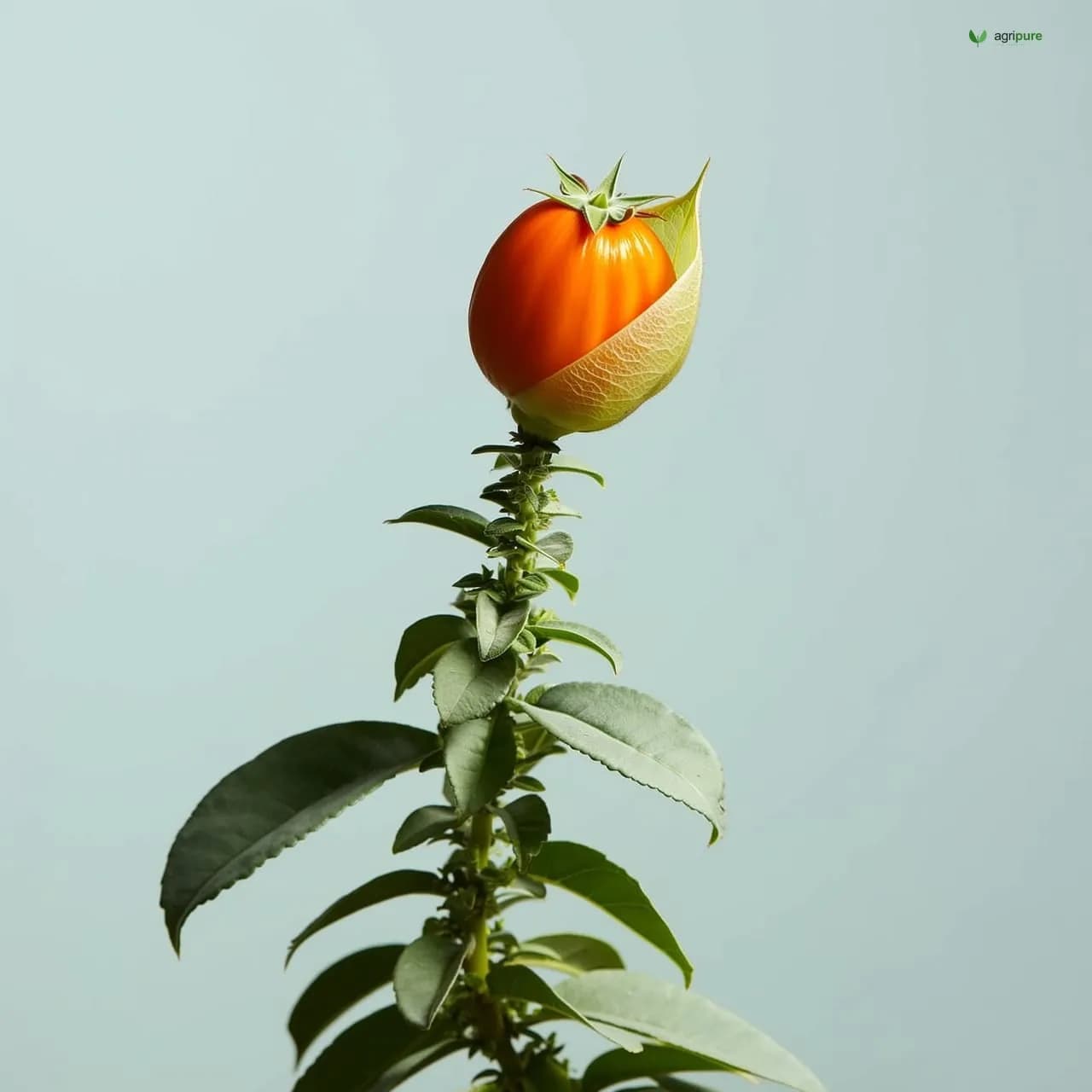
- Fruit: A small red berry wrapped in an enlarged, papery, bladder-like calyx.
Because it sits in the nightshade family alongside tomato, potato, and deadly nightshade, its bladder-husked red berry is a helpful field cue, echoing the inflated husks seen in some related Solanaceae.12
Safety and cautions
Ashwagandha is a medicinal herb, not a food plant, and the sources are explicit that its use carries important safety and toxicity cautions.126 A few grounded points for any homesteader considering it:
- It belongs to the nightshade family (Solanaceae), which includes deadly nightshade; the plant is grown for the prepared root, not eaten as a vegetable, and its various parts should not be casually consumed.1
- It has a long history of traditional use as a medicinal plant, and its compounds have been the subject of scientific study, but that is not the same as a proven treatment; this profile makes no claim that it treats or cures any condition.346
- Sources emphasise that the plant’s use is “primarily medicinal, with important safety and toxicity cautions,” so it should be approached conservatively and not self-administered without informed guidance.6
As a general principle with any potent medicinal herb in the nightshade family, those who are pregnant or breastfeeding, and anyone taking prescription medication, should seek qualified medical advice before use, given the potential for interactions. Grow it, learn it, and respect that the value and the risk both sit in the same root.16