Key takeaways

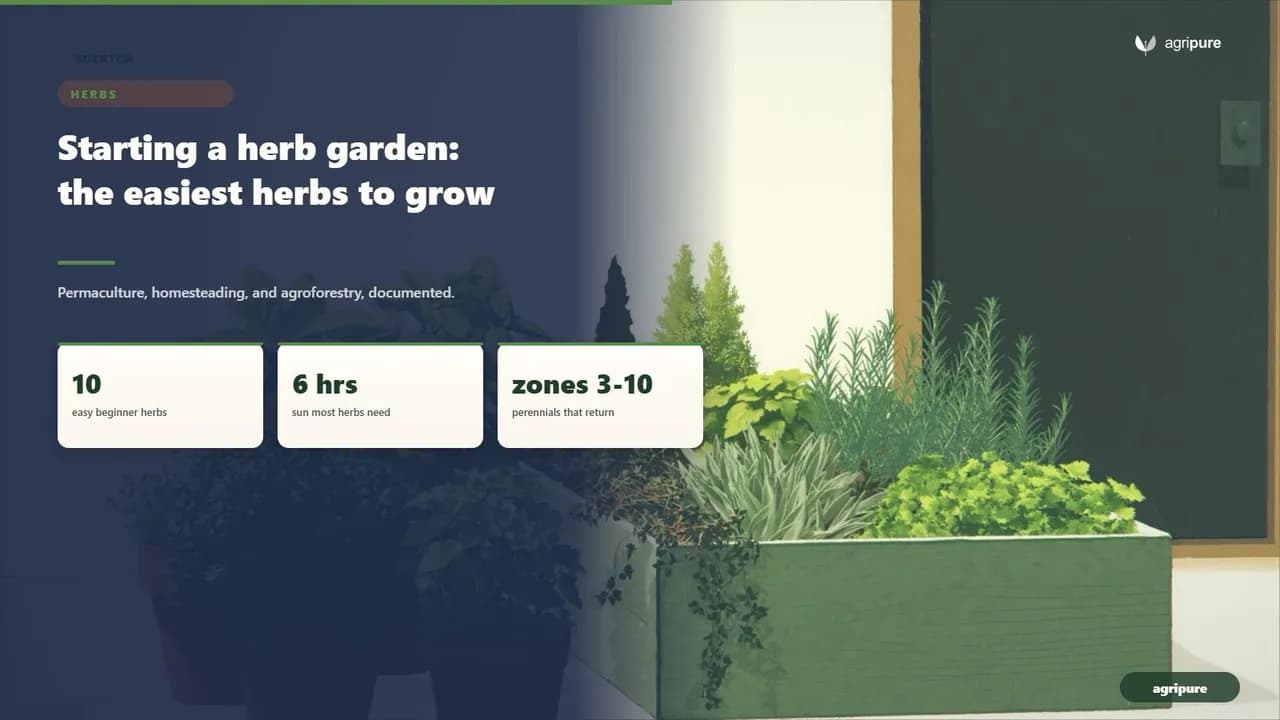
A kitchen window herb garden providing a fresh culinary harvest of culinary herbs.
- A herb garden needs one thing above all: sun. Almost every culinary herb wants at least 6 hours of direct light a day, so the brightest spot near your kitchen door beats a tidy bed you never walk past.
- Start small with proven easy herbs — basil, chives, dill, parsley, cilantro, mint, oregano, thyme, sage, and rosemary — and learn which are annuals you replant each year and which are perennials that return.
- Containers and raised beds are the beginner-friendly path: they give you the fast-draining soil that Mediterranean herbs like thyme, sage, and rosemary demand, and they keep aggressive mint from taking over.
- Indoors, a south window giving 6 hours of sun, or a shop light run 14 to 16 hours a day, will hold chives, basil, and parsley through winter — as long as every pot has a drainage hole.
- Harvest often and pinch before plants flower; most herbs hold their best flavor just before bloom, and regular cutting is what keeps a plant bushy instead of leggy.
A 4 dollar packet of basil seed, a sunny windowsill, and a few weeks is all it takes to put fresh herbs on the counter for a season — the kind of return on a garden that nothing else matches. Herbs are the gentlest place for a beginner to start growing food. Most ask only for sun, drainage, and the occasional pinch, and the worst mistakes are cheap to fix. This guide covers where to put a herb garden, the 10 easiest herbs to grow and exactly what each one needs, how to keep herbs alive on a windowsill, and how to harvest, overwinter, and preserve them so the plants stay productive. The numbers here trace to university extension sources, and they are zone-aware, because what overwinters in Atlanta dies in Minnesota.
Where to put a herb garden — beds, pots, or a windowsill
Before you buy a single plant, settle the location, because it decides almost everything else. Most herbs like lots of sun: Penn State Extension orients herb gardens south and west for 4 to 6 hours of sunlight a day, while Clemson Extension sets the bar higher, noting almost all herbs grow best in a spot that is sunny for at least 6 hours each day. Pick the sunniest place you have within a few steps of the kitchen — a herb you can snip while cooking gets used, and a herb that gets used gets harvested, which keeps it productive.
In-ground beds, raised beds, and containers
You have 3 honest options, and none is wrong:
- In the ground. Cheapest and lowest-maintenance once established. A small 4 by 4 foot no-dig bed of loose, sunny soil grows most culinary herbs well. The catch is drainage — heavy clay that puddles after rain will rot the Mediterranean herbs.
- A raised bed. The beginner sweet spot. A raised bed gives you control over the soil, warms earlier in spring, and drains freely, which is exactly what thyme, sage, oregano, and rosemary want.
- Containers and pots. The most flexible, and ideal for a patio, balcony, or small yard. Pots let you give each herb its own soil and move tender plants indoors before frost. Every container needs at least 1 drainage hole.
For the Mediterranean herbs especially, drainage beats fertility. These 4 — thyme, sage, oregano, and rosemary — evolved on dry, rocky hillsides, so they want gritty, free-draining soil and resent wet feet; Iowa State Extension notes thyme does best in coarse, gritty soils that would be unsuitable for many other plants. A raised bed or a pot of fast-draining mix solves that problem in one move, which is why so many beginners skip the in-ground bed entirely.

Spacing and a simple beginner layout
Give each plant room for air to move through it — crowded herbs trap humidity and invite disease. A workable beginner layout is a 4 by 4 foot raised bed or a cluster of pots: put the tall, bushy annuals like basil and dill toward the back, the perennials like sage, thyme, and chives along one edge where they will live for years, and keep mint in its own pot entirely. Spacing runs from about 6 inches for basil to nearly 2 feet for a mature sage, so plan for the grown size, not the nursery start. The whole plot can fit in a few square feet — a herb garden is the rare food garden that thrives on a patio.
The 10 easiest herbs for a beginner
These 10 culinary herbs reward beginners because they germinate readily, tolerate imperfect care, and earn their space in the kitchen. The single most useful thing to know about each is whether it is an annual you replant every year, a biennial, or a perennial that returns — that, plus its sun and water needs, tells you how to treat it. The table sets the pattern; the notes that follow add the detail for each.
Herb | Life cycle | Sun | Spacing | Beginner difficulty |
|---|---|---|---|---|
Basil | Annual (tender) | 6 to 8 hours | 6 to 12 in | Easy |
Chives | Perennial (zone 3) | Full sun | 12 to 20 in | Very easy |
Mint | Perennial (contain) | Sun to part shade | Pot it | Very easy |
Parsley | Biennial, grown annual | Sun to part shade | 15 to 18 in rows | Easy |
Cilantro | Annual (bolts) | Full sun, cool | Sow in pinches | Easy |
Thyme | Perennial (zones 5 to 9) | Full sun | Gritty soil | Easy |
Rosemary | Perennial (zone 8+) | Full sun | Pot in cold zones | Easy |
Oregano | Perennial (zone 5) | Full sun | Good drainage | Very easy |
Sage | Perennial (zones 4a to 10b) | Full sun | 18 to 24 in | Very easy |
Dill | Annual (self-seeds) | Full sun | 3 to 6 in | Easy |
Basil — the beginner’s annual
Basil is the herb most people start with, and for good reason. It is a tender annual that grows fast from seed and dies at the first frost. University of Maryland Extension grows it in 6 to 8 hours of sun in well-drained, fertile soil, planting out only after the soil warms to 60 degrees F; seeds germinate in 8 to 14 days at 65 to 80 degrees F. Space plants 6 to 12 inches apart and pinch the growing tips often to keep basil bushy. Water at the base about once a week so the leaves stay dry. Difficulty: easy.
Chives — the hardiest perennial
Chives are nearly foolproof. They are an herbaceous perennial hardy all the way to USDA zone 3, so they come back every spring across almost all of North America. The University of Wisconsin-Madison Extension grows chives in full sun in rich, well-drained soil, spacing the clumps 12 to 20 inches apart. Snip the hollow leaves like scissors-grass and the purple flowers are edible too. Difficulty: very easy.
Mint — vigorous, but contain it
Mint grows so well it becomes a problem. It is a hardy perennial that spreads by runners and will swallow a 4-foot bed in a season or 2 if planted loose. The fix is simple: grow mint in a pot, or sink a bottomless bucket into the ground as University of Minnesota Extension suggests to contain invasive mints. Mint tolerates partial shade — Clemson lists it among the few herbs that prefer it — and wants steadier moisture than the Mediterranean herbs. Difficulty: very easy, almost too easy.
Parsley — a biennial grown as an annual
Parsley is a biennial: it produces leaves the first year and flowers the next, so most gardeners grow parsley as an annual and replant each spring. It tolerates partial shade and is one of the few herbs Clemson notes prefers it. Seed is slow to germinate — soak it overnight to speed things along — and rows sit about 15 to 18 inches apart. Both curly and flat-leaf (Italian) types grow the same way. Difficulty: easy, with patience at the start.
Cilantro — fast, but it bolts
Cilantro is an easily grown annual that rewards quick harvest. Its weakness is heat: the onset of summer warmth makes it bolt — shoot up and go to seed — within 3 to 4 weeks, which is why it frustrates beginners who expect a season-long crop. Sow cilantro in cool spring and fall weather, sow a fresh pinch every 2 to 3 weeks, and harvest young. Let it bolt and the seeds become coriander. Difficulty: easy, if you stop fighting the heat.
Thyme — tough and drought-tolerant
Thyme is a low-growing, wiry perennial hardy in USDA zones 5 to 9. It thrives on neglect: Iowa State Extension keeps thyme in full sun and coarse, gritty, well-drained soil, and warns it can melt out in hot, humid summers, so cut it back to help it recover. Once established it needs little water. Difficulty: easy in the right soil.
Rosemary — a tender perennial in most zones
Rosemary is an evergreen shrub, but only a perennial in zone 8 and above. The University of Illinois Extension warns it is not reliably hardy in zone 6 or colder, so most North American gardeners grow rosemary in a pot and overwinter it indoors. Give it full sun and well-drained soil amended with compost. Difficulty: easy in the garden, with one extra step come winter.
Oregano — a hardy perennial
Oregano is a sprawling perennial, marginally hardy in zone 5 per Illinois Extension, that does well in containers. Plant oregano in full sun with good drainage; it asks for little once rooted. Its flavor concentrates in warm, dry conditions, so do not overwater or overfeed it. Difficulty: very easy.
Sage — the woody anchor herb
Sage is the herb behind the high-volume search “herb garden sage,” and it is a fine anchor for a perennial bed. Salvia officinalis is a woody perennial subshrub hardy across USDA zones 4a to 10b. Wisconsin Extension grows sage in a sunny spot with well-drained soil, spaces plants 18 to 24 inches apart, and divides clumps every few years to rejuvenate them. Difficulty: very easy.
Dill — the self-seeding annual
Dill is an annual that grows so fast from seed that transplants are usually unnecessary — Wisconsin Extension direct-sows it in full sun and thins seedlings to 3 to 6 inches apart at three to four weeks old. Leave a few seed heads and dill will readily self-seed, returning on its own next year. It resents root disturbance, so sow it where it will grow. Difficulty: easy.
Growing herbs indoors on a windowsill
A windowsill herb garden keeps the kitchen stocked through winter, and it runs on the same 2 levers as starting seeds: light and drainage. The most common failure is too little light, which leaves plants pale and stretched. A close second is a pot with no drainage, which drowns the roots. Solve both and a row of 4 or 5 herbs on the sill is genuinely low-effort.
Light: a bright window or a cheap lamp
Most herbs need 6 hours of direct sunlight indoors, says Penn State Extension, which means a south- or west-facing window. Where the sun falls short, hang a shop light: Penn State places herbs 6 to 12 inches from two 40-watt cool-white fluorescent bulbs for 14 to 16 hours a day, and an LED equivalent works just as well. A few herbs forgive low light — chives, cilantro, and lemon balm get by on 2 to 6 hours — while sun-lovers like rosemary and thyme want every bright hour you can give them. Rotate windowsill pots regularly so each side grows evenly.
Drainage, temperature, and the right herbs
Indoor herbs live or die by their pots. Penn State is blunt: grow herbs in containers with a drainage hole and a potting mix that drains freely, never garden soil in a sealed pot. Keep rooms at 65 to 70 degrees F by day and 55 to 60 degrees F at night, and remember basil cannot survive temperatures lower than 50 degrees F, so keep it off a cold winter sill. The easiest herbs to grow indoors are chives, basil, parsley, cilantro, and mint — start with those rather than fighting a rosemary through a dark January.
Harvesting to keep herbs productive
Harvesting is not just collecting dinner — it is the pruning that keeps a herb productive. The rule that ties together all 10 herbs here: most hold their best flavor just before flowering, as University of Minnesota Extension notes, because the plant pours its aromatic oils into leaves before it shifts energy to bloom. Peer-reviewed work on basil backs this up, finding that harvest date and developmental stage significantly change a plant’s yield and essential-oil content. So harvest early and often, and head off flowering.

Pinch, cut, and stop the flowers
These 3 habits keep the kitchen supplied and the plants young:
- Pinch the leafy annuals. With basil, mint, and oregano, pinch out the top set of leaves above a leaf pair once plants reach 6 inches. The plant branches at the cut and grows bushier instead of taller and leggy.
- Cut the herbs you harvest in bunches. Snip chives, parsley, and dill near the base with scissors. Take no more than about a third of the plant at once so it can recover.
- Stop the bloom. Once a herb flowers, leaf flavor fades and annuals like basil and cilantro race to set seed. Pinch off flower buds the moment you see them to extend the leafy harvest by weeks.
A herb bed harvested weekly stays compact and leafy; one left alone for 3 or 4 weeks bolts, flowers, and turns woody or bitter. The plants want to be cut.
Overwintering perennial herbs by zone
The difference between an annual and a perennial herb is what happens in winter, and the answer depends on where you garden. The 5 perennials in this guide split cleanly by USDA hardiness zone, and knowing your zone tells you which herbs return on their own and which need help — or a pot and a windowsill.
Hardy, borderline, and tender
- Reliably hardy. Chives (to zone 3), sage (zones 4a to 10b), and thyme (zones 5 to 9) overwinter outdoors across most of North America. Cut them back after frost; many keep some leaf in milder zones.
- Borderline. Oregano is only marginally hardy in zone 5, so in colder gardens give it a sheltered, well-drained spot or grow it in a pot you can protect.
- Tender. Rosemary survives winter outdoors only in zone 8 and above. In zone 6 or colder, the Illinois Extension advice is to grow it in a container and bring it inside before hard frost.
Herb | Hardy to USDA zone | Overwintering |
|---|---|---|
Chives | Zone 3 | Outdoors, most of North America |
Sage | Zones 4a to 10b | Outdoors in most zones |
Thyme | Zones 5 to 9 | Outdoors; needs winter drainage |
Oregano | ~Zone 5 | Shelter or pot in cold zones |
Rosemary | Zone 8+ | Pot and bring indoors in zone 6 or colder |
The real winter killer is wet, not cold. Sage, thyme, and rosemary rot in soggy soil long before they freeze. The same free-draining bed or gritty pot that grows them well in summer is exactly what carries them through winter — so if a perennial herb dies over winter in a mild zone, suspect drainage before you blame the cold.
Winter wet kills more perennial herbs than winter cold. All 3 Mediterranean herbs — sage, thyme, and rosemary — rot in soggy soil over winter, so the same free-draining bed or pot that grows them well in summer is what carries them through. The annuals — basil, dill, and cilantro — will not overwinter at all; save their seed or plan to replant.
Preserving the harvest — drying and freezing
A productive herb garden gives you more than you can use fresh, and the surplus is worth keeping. Just 2 methods cover almost everything, and which you choose depends on the herb. As a rule, the woody Mediterranean herbs dry well, while soft, leafy herbs keep their flavor better frozen.
Drying the woody herbs
Thyme, oregano, sage, and rosemary dry beautifully and store for months. The National Center for Home Food Preservation dries herbs in a dehydrator set to 95 to 115 degrees F — as high as 125 degrees F in humid areas — for 1 to 4 hours, and they are done when the leaves crumble and the stems snap when bent. You can also air-dry small bunches hung in a warm, dark, well-ventilated spot, though that takes far longer. Store dried herbs whole in a sealed jar out of the light and crush them as you cook.
Freezing the soft herbs
Basil, parsley, dill, chives, and mint lose their texture when dried but freeze well. Penn State Extension freezes them two ways: spread clean leaves in a single layer on a tray, freeze, then bag them; or chop the leaves, pack about 1 tablespoon into each well of an ice cube tray, top with water, and freeze into ready-to-cook cubes. Drop a basil or parsley cube straight into a pot of sauce or soup. Frozen herbs are best for cooking rather than garnish, since they soften on thawing — but the flavor holds far better than a dried soft herb.
The takeaway
A herb garden is the most forgiving food garden a beginner can grow, and the rules are short. Give your herbs at least 6 hours of sun, plant them in soil or pots that drain freely, and start with the easy 10 — basil, chives, mint, parsley, cilantro, thyme, rosemary, oregano, sage, and dill. Treat the annuals as one-season crops and let the perennials anchor a corner of the bed for years. Harvest weekly and pinch before the flowers come, and the plants stay leafy and generous. Then dry the woody herbs and freeze the soft ones, and a single summer’s growing seasons the whole year. Plant a pot this week — basil on the sill, sage by the door — and you will cook differently by next month.
Frequently asked questions
What are the easiest herbs for a beginner to grow?
The easiest herbs are chives, mint, oregano, sage, basil, and dill. Chives, mint, oregano, and sage are hardy perennials that return each year with little care, while basil and dill grow fast from seed in a single season. All want at least 6 hours of sun and soil that drains well. Start with 3 or 4 rather than a dozen, and grow them in pots or a raised bed for the easiest results.
How much sun does a herb garden need?
Most culinary herbs need a lot of sun. Penn State Extension recommends 4 to 6 hours a day, and Clemson Extension says almost all herbs grow best with at least 6 hours of direct sun. A few — parsley, mint, cilantro, and chives — tolerate partial shade, but the Mediterranean herbs like rosemary, thyme, sage, and oregano want full sun. Choose the brightest spot you have, ideally near the kitchen.
Can I grow herbs indoors on a windowsill?
Yes. Place herbs in a south- or west-facing window that gets about 6 hours of direct sun, or run a fluorescent or LED shop light 6 to 12 inches above them for 14 to 16 hours a day. Every pot needs a drainage hole and a free-draining mix. Chives, basil, parsley, cilantro, and mint are the easiest indoors; keep basil off cold sills, since it cannot survive below 50 degrees F.
Which herbs come back every year?
Perennial herbs return each year where they are hardy. Chives are hardy to USDA zone 3, sage to zones 4a through 10b, and thyme to zones 5 through 9, so they overwinter across most of North America. Oregano is hardy to about zone 5, and rosemary only in zone 8 and warmer — in colder zones, grow rosemary in a pot and bring it indoors. Basil, dill, and cilantro are annuals that must be replanted.
When should I harvest herbs for the best flavor?
Harvest most herbs just before they flower, when their leaves hold the most aromatic oil, as University of Minnesota Extension advises. Cut in the morning after the dew dries, take no more than about a third of the plant at a time, and pinch off flower buds as they appear to keep leafy growth coming. Cutting roughly every 1 to 2 weeks keeps plants bushy and productive rather than tall and woody.
References
- University of Minnesota Extension. “Growing herbs in home gardens.” extension.umn.edu
- Clemson Cooperative Extension, Home & Garden Information Center. “Herbs.” hgic.clemson.edu
- University of Maryland Extension. “Growing Basil in a Home Garden.” extension.umd.edu
- University of Wisconsin-Madison Division of Extension. “Sage, Salvia officinalis.” hort.extension.wisc.edu
- University of Wisconsin-Madison Division of Extension. “Chives, Allium schoenoprasum.” hort.extension.wisc.edu
- Iowa State University Extension and Outreach. “Growing and Using Thyme.” yardandgarden.extension.iastate.edu
- University of Illinois Extension. “Herbs: Rosemary.” extension.illinois.edu
- University of Illinois Extension. “Herbs: Oregano.” extension.illinois.edu
- University of Wisconsin-Madison Division of Extension. “Dill, Anethum graveolens.” hort.extension.wisc.edu
- Penn State Extension. “Growing Herbs Indoors.” extension.psu.edu
- National Center for Home Food Preservation, University of Georgia. “Drying Herbs.” nchfp.uga.edu
- Penn State Extension. “Freezing Herbs.” extension.psu.edu
- Penn State Extension (Chester County Master Gardeners). “Herb Gardening.” extension.psu.edu
- University of Massachusetts Amherst (CAFE). “Parsley.” ag.umass.edu
- Vázquez, A., et al. “Agronomic performance and essential oil composition of Ocimum basilicum L.: Effect of genotype and date of harvest.” Advances in Horticultural Science (2013). doi.org
- Vallverdú-Queralt, A., et al. “A comprehensive study on the phenolic profile of widely used culinary herbs and spices: Rosemary, thyme, oregano, cinnamon, cumin and bay.” Food Chemistry (2014). doi.org