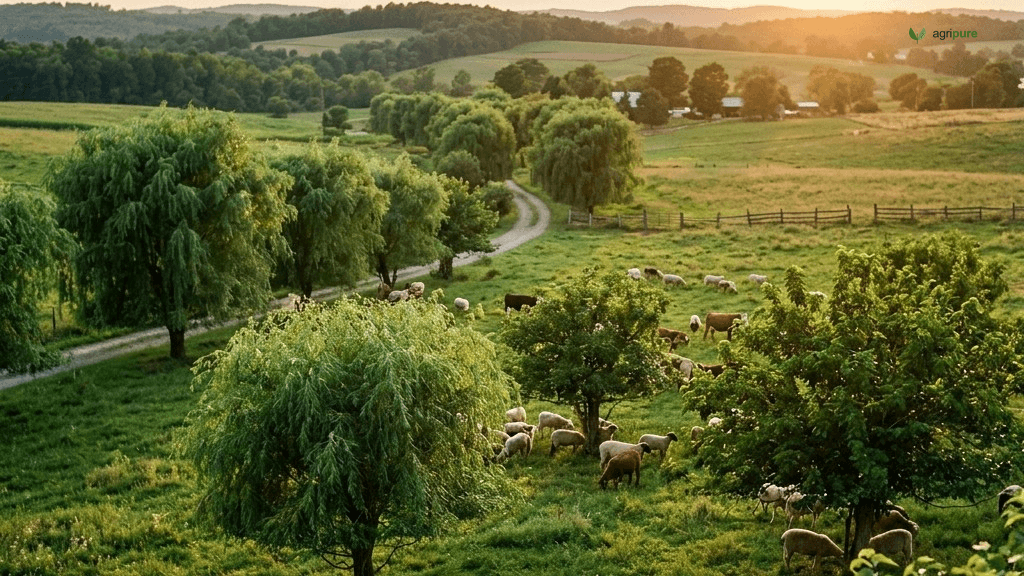
A general silvopasture plan tells you to integrate trees with grazing. It rarely tells you which tree will still be alive after your coldest night, or how much protein its leaf actually carries. This guide closes that gap. Below is a practical shortlist of fodder trees for livestock organized the way the decision is really made: by how cold your winter gets. Each species is keyed to its USDA hardiness zone (with UK RHS and Australian climate equivalents for international readers), with a crude-protein note and the frost limit that determines whether it overwinters or has to be replanted.
The focus here is cut-and-carry (also called “browse blocks” or fodder banks): trees you cut and feed, rather than turn animals loose to graze. Cut-and-carry protects young trees from being ringbarked, lets you harvest at the leaf’s protein peak, and works on tiny holdings where a grazed silvopasture would not.
How to read the hardiness numbers
A pile of freshly harvested green fodder tree branches ready to feed livestock.
Nutritious fodder leaves harvested from high-protein woody perennials for animal feed.
USDA zones describe average annual minimum temperature. The boundary that matters for an evergreen or semi-evergreen fodder tree is its frost limit: cross it and you lose the standing leaf you were counting on through winter. Three quick translations:
- USDA zone: each zone step is about 5.6°C of minimum temperature. Zone 9 bottoms out near -3 to -7°C; zone 4 near -34°C.
- UK / RHS: H1c-H2 species are tender (greenhouse or frost-free only); H5-H6 shrug off hard British frosts; H7 is fully hardy.
- Australia: tropical and subtropical zones suit the frost-tender legumes; cool-temperate and Mediterranean zones need the deciduous, cold-hardy species.
Cold-climate fodder: USDA 4-7 (RHS H5-H7)
If you get a real winter, your fodder strategy is deciduous trees that drop their leaf and resprout, plus evergreen shrubs bred for cold deserts. You harvest in the growing season and conserve (dry or ensile) for the dormant months.
White mulberry (Morus alba): the cold-hardy benchmark
White mulberry is the standout temperate fodder tree. It is reliably hardy to USDA zone 4 (roughly -30°C, RHS H6), so it survives continental winters that kill every tropical legume on this list. The payoff is quality: mulberry leaf typically runs 20-25% crude protein on a dry-matter basis, with very high digestibility, putting it on par with good alfalfa as a ruminant protein source. Coppice or pollard it and feed the leafy regrowth fresh, or dry it into leaf meal for winter. It tolerates sandy through clay soils and handles drought once established.
Fourwing saltbush (Atriplex canescens): the cold, dry, salty answer
Fourwing saltbush is the species for cold arid and saline rangeland where mulberry would struggle. This evergreen North American shrub is hardy down to about USDA zone 4 (cold tolerance varies by ecotype) yet thrives in deserts with only 200-360 mm of rainfall, tolerating salinity and alkalinity that would kill most fodder. Its winter browse runs roughly 10-15% crude protein (the leaf alone can reach the high teens) and stays green and carotene-rich through the dormant season, providing important feed when grass has cured off. It is one of the few shrubs that delivers usable protein in winter and in drought simultaneously.
European hackberry (Celtis australis): the Mediterranean pollard
European hackberry is a deciduous tree (USDA 6-9, RHS H5) traditionally pollarded for leaf fodder across the Mediterranean, North Africa and the Himalayas. Its leaf is more modest at roughly 12-15% crude protein; young leaves are palatable to cattle while mature leaves turn unpalatable, making harvest timing important. It earns its place as a long-lived, drought-hardy backbone tree that also yields fuel and edible fruit.
Warm-temperate and Mediterranean fodder: USDA 8-9
Here the frost line is the decisive variable. Light, brief frosts are survivable for the tougher legumes; a hard freeze still resets them.
Leucaena (Leucaena leucocephala): high protein, with a caveat
Leucaena is among the most productive fodder legumes in the world, with foliage at roughly 22% crude protein (leaf meal higher still) and excellent palatability for cut-and-carry feeding of cattle and goats. The caveats are real and worth planning around:
- It is frost-tender, reliable only in USDA 9-11 (RHS H1c). Frost kills the top growth, though established plants often resprout.
- Leaves contain mimosine, a non-protein amino acid that is toxic in large amounts; limit it to part of the ration (or inoculate ruminants with the detoxifying rumen microbe) rather than feeding it as the sole diet.
Saltbush and clovers for the off-season
In Mediterranean climates, pair a frost-tender protein tree with cold-tolerant ground fodder. Fourwing saltbush (above) extends into zone 8-9 arid sites, and winter-active legumes like berseem and red clover fill the cool-season feed gap that a deciduous or frost-cut tree leaves open.
Tropical and subtropical fodder: USDA 9-12 (frost-free)
With no winter frost limit, productivity is year-round without a dormancy buffer, so the main constraints are water and management rather than cold.
Moringa (Moringa oleifera): fast, rich, frost-fatal
Moringa is a fast-growing, multi-cut fodder shrub whose dried leaf carries a high crude-protein content, commonly cited around 25-30% on a dry-matter basis, alongside useful vitamins and minerals. It suits intensive cut-and-carry: cut every few weeks in the warm season for a steady protein supply. The hard limit is cold. Moringa has poor frost resistance, which is precisely why it is confined to USDA 9-12 (RHS H1c) and cannot be pushed north. Treat any frost as potentially fatal to young plants.
Siris (Albizia lebbeck): the dry-season workhorse
Siris is a nitrogen-fixing fodder tree prized in semi-arid tropics (USDA 9-11). Green leaves run about 17-26% crude protein, and most livestock readily eat the leaves and young twigs, especially camels, buffalo and cattle. Mature trees withstand grass fires and even night frosts that kill young stems back (with regrowth following), but it is fundamentally a frost-tender, warm-climate species. Its deep value is providing nutritious browse in the dry season when grass has failed.
Quick zone-to-species table
Species | USDA zone | RHS | Leaf crude protein (approx., DM) | Key constraint |
|---|---|---|---|---|
White mulberry (Morus alba) | 4-9 | H6 | 20-25% | Deciduous; conserve for winter |
Fourwing saltbush (Atriplex canescens) | 4-9 | H6 | ~10-15% | Needs salt/drought niche |
European hackberry (Celtis australis) | 6-9 | H5 | 12-15% | Feed young leaves only |
Leucaena (Leucaena leucocephala) | 9-11 | H1c | ~22% | Frost-tender; mimosine limit |
Siris (Albizia lebbeck) | 9-11 | H1c | 17-26% | Frost-tender; dry-season feed |
Moringa (Moringa oleifera) | 9-12 | H1c | 25-30% | No frost tolerance at all |
Planting and harvesting for cut-and-carry
- Match the frost limit first, protein second. A 30% protein leaf is worthless if the tree dies every winter. Pick what overwinters in your zone, then optimize quality.
- Stack hardiness tiers. A cold-hardy backbone (mulberry, saltbush) plus a high-protein warm-season pulse (leucaena, moringa where frost-free) gives year-round feed and resilience.
- Cut at the leaf’s peak, not the stem’s. Protein concentrates in young leaves; lignified twigs and mature leaves drop in value and palatability.
- Introduce new browse gradually and cap species with anti-nutritional factors (mimosine in leucaena, tannins in many tree leaves) at a sensible share of the ration.
Frequently asked questions
What is the most cold-hardy fodder tree?
Among high-quality options, white mulberry (Morus alba) is the benchmark, reliably hardy to USDA zone 4 (around -30°C) while delivering 20-25% crude protein. For cold, dry, saline ground, fourwing saltbush matches that hardiness with evergreen winter browse.
Can I grow moringa or leucaena outside the tropics?
Only where frost is rare. Both are frost-tender (USDA 9 and up). In USDA 8 or colder they will be killed back or killed outright. Established plants may resprout after a light frost, but you cannot rely on them for standing winter feed; use deciduous, cold-hardy trees instead.
How much tree fodder can I feed?
Treat tree leaf as a protein supplement, not the whole diet. Several species carry anti-nutritional compounds (mimosine in leucaena, saponins in siris pods, tannins broadly), so introduce gradually and keep any single browse to a portion of the ration unless local research supports more.
Sources
- Feedipedia, Animal Feed Resources Information System – Leucaena (Leucaena leucocephala) and Lebbek (Albizia lebbeck) datasheets. feedipedia.org/node/282
- USDA Forest Service, Fire Effects Information System – Atriplex canescens (fourwing saltbush) species review. fs.usda.gov
- USDA NRCS Plant Guide – Fourwing saltbush (Atriplex canescens), forage value and adaptation. plants.usda.gov
- Welch & Monsen, Great Basin Naturalist – “Winter crude protein among accessions of fourwing saltbush.” scholarsarchive.byu.edu
- Feedipedia, Animal Feed Resources Information System – European hackberry / Celtis australis leaf datasheet. feedipedia.org/node/171
- Frontiers in Veterinary Science – “Current Status and Potential of Moringa oleifera Leaf as an Alternative Protein Source for Animal Feeds.” pmc.ncbi.nlm.nih.gov/articles/PMC7054280
- Springer, Tropical Animal Health and Production – “The nutritive value of mulberry leaves (Morus alba) as a feed supplement for sheep.” pubmed.ncbi.nlm.nih.gov/19052898