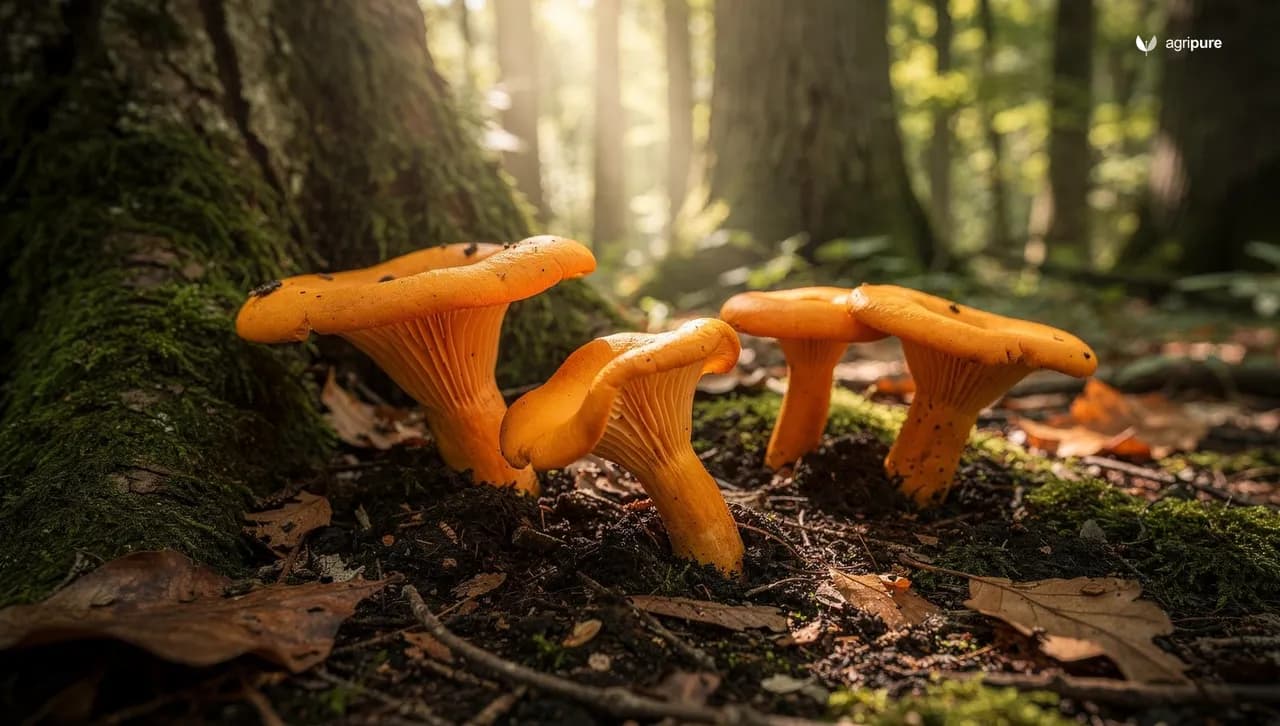
Key takeaways
A close-up photograph shows a hand touching the blunt, false gills of a golden chanterelle mushroom, which appear as folds in the flesh. In the background, a cluster of orange jack-o'-lantern mushrooms with sharp, true gills grows on decaying wood to show the differences for identification.
The main difference between an edible chanterelle and its toxic lookalikes lies in their gills: chanterelles have blunt, false gills that feel like folds, while dangerous lookalikes like the jack-o’-lantern mushroom have sharp, true gills.
- A true chanterelle has blunt false gills — forked ridges that run down the stem — not the thin, sharp, knife-edge true gills of its dangerous lookalikes.
- Look for the full set of 4 traits: egg-yolk color, a solid stem, white stringy flesh, and a fruity apricot smell. One trait alone is never enough.
- The toxic jack-o’-lantern grows in clusters on wood, has true sharp gills, and contains illudin S — its poisoning has sent foragers to the emergency room.
- The false chanterelle has thin, crowded, separable true gills and a brighter orange cap; it is far less dangerous but still not the prize.
- Chanterelles are mycorrhizal and grow singly from soil near hardwoods and conifers — never in tight clumps on a stump.
A golden chanterelle and a poisonous jack-o’-lantern can look almost identical from 3 feet away — same egg-yolk color, same trumpet shape, same yellow-orange glow against dark leaf litter. The difference that matters is on the underside, and it takes about 10 seconds to check. Run a thumb across the ridges: a chanterelle’s are blunt and feel like folds in the flesh, while a jack-o’-lantern’s are thin, sharp blades you could almost lift with a fingernail.
That single check separates a prized edible from a night of violent vomiting. Chanterelles are one of the safest mushrooms for a beginner to learn precisely because their key feature is so distinct — but only if you demand 100% certainty on every trait before anything reaches a pan. Here is the complete identification checklist, the 2 lookalikes that catch people every season, and the habitat clues that confirm the find.
The false gills that define a true chanterelle
The whole identification rests on 1 feature: the underside. A true chanterelle does not have gills in the usual sense. UF/IFAS Extension is explicit that chanterelle mushrooms have blunt false gills, which sets them apart from other mushrooms that carry bladelike true gills. These false gills are decurrent (running down the stem instead of stopping cleanly where the cap meets the stalk), and a single ridge often forks 2 or 3 times as it travels outward.
The test is tactile and takes 2 seconds. UF/IFAS notes that false gills cannot be individually plucked and do not move freely; they are more like rounded ridges molded into the flesh than separate blades. According to the chanterelle literature, these forked folds run almost all the way down the stipe. If you can catch a single blade with a fingernail and peel it like a page, you are not holding a chanterelle.
The four-point feature check
No single trait confirms a chanterelle. Demand all 4 of these before you trust a find, because the lookalikes each copy one or two of them but never the whole set.
- Blunt forked ridges: decurrent false gills that run down the stem, the same color as the cap, that you cannot pluck off as 1 individual blade.
- Egg-yolk color: a uniform yellow to golden-orange across cap and ridges — most species sit in the deep yellow range.
- Solid stem and white flesh: tear one open. The stem is fleshy and solid, not hollow, and the inner flesh is white and slightly stringy.
- Fruity apricot smell: many chanterelles carry a pleasant fruity aroma often compared to apricots — a clue, not proof on its own.
The one-trait trap: beginners get fooled because a lookalike matches the color or the smell. Color alone fails roughly 100% of the time as a standalone test — always confirm the blunt ridges, the solid stem, and the white flesh together.
A close-up of the underside of a golden chanterelle shows blunt forking ridges running down the stem instead of thin sharp gills.
The jack-o’-lantern: the lookalike that lands foragers in the ER
The most dangerous chanterelle impersonator is the jack-o’-lantern (Omphalotus). It carries the same orange-gold color and trumpet flare, which is exactly why these 2 mushrooms get confused. The mycological literature is blunt: unlike chanterelles, Omphalotus species contain the toxin illudin S and are poisonous to humans. The eastern species also yields illudin M, and eating it brings on vomiting, cramps, and diarrhea within 3 hours.
Two features give the jack-o’-lantern away every time. First, the gills: the Missouri Department of Conservation describes them as narrow, sharp-edged, crowded, and nonbranching — real knife-edge true gills, the opposite of a chanterelle’s blunt forks. Second, the habit: it grows in clusters from wood or buried wood, often a dense clump of 20 or more caps fused at the base on a stump or buried root. A chanterelle never does this.
Why the poisoning is so memorable
This is not a mild upset. Clinical reports describe onset within 30 minutes to 3 hours, with violent vomiting and cramping that often ends in a hospital visit for rehydration. It is rarely fatal to a healthy adult, but the 2 to 3 days of illness are severe enough that the species has its own body of case literature. The Missouri Department of Conservation puts the contrast plainly: the 2 delicious chanterelles are similar in color and shape, but their undersides have blunt ridges, not gills, and they grow singly on the forest floor, not in clusters on wood.
Check the substrate first: before you even flip the cap, ask what it is growing from. A tight cluster fused to a stump or root is a jack-o’-lantern until proven otherwise; chanterelles rise one at a time from open soil.
A side-by-side comparison of chanterelles and their lookalikes
Three mushrooms account for nearly every chanterelle mix-up. This table sorts them by the 4 features that settle the question: gills, color, where they grow, and the risk if you get it wrong.
Mushroom | Underside | Grows on | Risk if eaten |
|---|---|---|---|
True chanterelle (Cantharellus) | Blunt forked ridges, decurrent | Soil, singly, near trees | None — choice edible |
Jack-o’-lantern (Omphalotus) | Sharp, crowded, true gills | Wood — clusters on stumps/roots | High — illudin S, severe vomiting |
False chanterelle (Hygrophoropsis) | Thin, crowded, forking true gills | Decaying wood and debris | Low — can cause mild upset |
Smell test | Apricot vs generic mushroom | Confirms, never decides | Use alongside the ridge check |
Read across the rows and the pattern is clear: the underside column does about 90% of the work, the substrate column catches the jack-o’-lantern, and color does almost none of it. When 2 features disagree, trust the gills over the color every time.
The false chanterelle and the smell test
The second impostor is gentler but still worth knowing: it is the 1 lookalike that fools more people than the jack-o’-lantern. The false chanterelle (Hygrophoropsis) shares the orange tone but gives itself away under the cap. Mushroom-Appreciation describes its underside as true gills that are much more crowded and can be easily separated: thin, soft, deeply forked blades, unlike the molded ridges of the real thing. Its cap also runs a brighter, more rust-orange than the even egg-yolk of a true chanterelle, and it tends to grow on decaying wood instead of open soil.
The apricot smell is your final confirmation, never your first of the 4 checks. A genuine chanterelle gives off a fruity, pleasant aroma that many foragers compare to apricots; the false chanterelle smells generically mushroomy instead. Pair a digging tool with a soft brush so you can lift the whole stem and check the base before cutting — a lightweight hand trowel frees the mushroom from soil without snapping the 1 stem you need to inspect.
Building the harvest habit
Follow a 4-step identification process for every find instead of relying on a quick glance. Once you have learned the workflow, a positive ID takes under 1 minute and a confident forager rarely needs more than that.
- Check the substrate: soil and singly, or wood and clustered? Clustered on wood ends the inspection; leave it.
- Flip and feel the ridges: blunt forked folds that you cannot pluck, running down the stem.
- Tear the stem: confirm a solid, fleshy stem and white stringy flesh inside.
- Smell it last: a fruity apricot note seals an ID that the ridges have already made.
Where chanterelles grow, and where they never do
Habitat is roughly 50% of the identification. Chanterelles are mycorrhizal, meaning they form a root partnership with living trees, so they fruit from the soil near a host rather than from dead wood. The mushroom literature notes they tend to grow in clusters in mossy coniferous forests but are also found in birch and other hardwood stands — which is why both oak and pine woods are worth scouting.
That tree partnership is the clue that rules out the jack-o’-lantern. Around hardwoods such as Holm oak and conifers such as blue pine, scan the open soil and moss within 3 to 6 feet of the trunks, not the stumps. Productive ground often re-fruits in the same spot year after year, so a mapped patch in a managed food forest or woodland edge can yield for 10 or more seasons with zero replanting.
When 100% certainty fails, stop: if any of the 4 features is off (sharp gills, a hollow stem, wood substrate, or no apricot note), do not eat it. There is no prize worth 2 days of illudin poisoning.
A foraging basket of golden chanterelles rests on moss beside a hardwood trunk in a dappled forest.
Conclusion
Identifying a chanterelle comes down to refusing to be satisfied with one trait. The blunt forked ridges that run down the stem are the anchor; the egg-yolk color, solid stem, white flesh, and apricot smell confirm it; and the habitat (singly from soil near hardwoods or conifers, never clustered on wood) rules out the toxic jack-o’-lantern. Learn those 4 checks cold, demand 100% certainty before anything reaches a pan, and chanterelles become one of the safest wild foods you can harvest.
Frequently asked questions
What is the single most reliable way to identify a chanterelle?
Check the underside, the 1 feature that settles it. A true chanterelle has blunt false gills (forked ridges that run down the stem and cannot be plucked off) instead of the thin, sharp, separable true gills found on its 2 toxic lookalikes. That single feature separates it from a jack-o’-lantern in under 10 seconds.
How do I tell a chanterelle from a poisonous jack-o’-lantern?
Two checks settle it in under 30 seconds. The jack-o’-lantern has sharp, crowded true gills and grows in dense clusters on wood, stumps, or buried roots, while a chanterelle has blunt ridges and grows singly from soil near living trees. It also contains the toxin illudin S.
Do chanterelles really smell like apricots?
Many do. A genuine chanterelle gives off a fruity, pleasant aroma often compared to apricots, whereas the false chanterelle smells generically mushroomy. Treat the smell as the last of your 4 checks, never as your first or only identification step.
Where do chanterelle mushrooms grow?
They are mycorrhizal and fruit from soil within a few feet of living trees, growing in mossy coniferous forests and hardwood stands such as oak and birch. They appear singly on the forest floor, never in tight clusters of 20 or more caps fused to a stump or dead log.
Is the false chanterelle dangerous to eat?
It is far less dangerous than the jack-o’-lantern but can still cause mild stomach upset in some people. It has thin, crowded, easily separated true gills and a brighter rust-orange cap, so it is 1 of the 2 lookalikes to rule out before you trust an ID.
References
- UF/IFAS Extension — The Common Chanterelles of Florida (PP369)
- Chanterelle — identification, aroma, and habitat
- Missouri Department of Conservation — Jack-o’-Lantern field guide
- Omphalotus olearius — toxin illudin S and true gills
- Omphalotus illudens — eastern jack-o’-lantern toxicity and habit
- Mushroom-Appreciation — True vs false chanterelle identification