secondary
Garlic
lehsan
Allium sativum
Also known as Lehsan (Pakistan).
- punjab plains
- pothohar
- kpk hills
International hardiness
- USDA 4-9
- RHS H5
- AU: Warm temperate, Cool temperate, Mediterranean, Subtropical
Where it grows — regional guide
| Zones / rating | Regional notes |
|---|---|
USDA 4-9 | Planted in autumn to overwinter and harvest in summer; handling raw cloves can cause contact dermatitis, and scraps are toxic to pets. |
| Zones / rating | Regional notes |
|---|---|
H5 (-15 to -10C) | Fully hardy under RHS H5 for autumn allotment planting; cloves can trigger contact dermatitis in sensitive skin and are toxic to pets. |
| Zones / rating | Regional notes |
|---|---|
Warm temperate, Cool temperate, Mediterranean, Subtropical | Planted in autumn across temperate and Mediterranean regions for a summer harvest; handling can irritate skin, and cloves are toxic to pets. |
| Zones / rating | Regional notes |
|---|---|
USDA 4-9 (USDA scale) Canada uses its own zone system; Canadian zones run roughly one lower than USDA. | Overwinters successfully under mulch in cold zones when planted in autumn; handling can cause dermatitis, and culls are toxic to animals. |
| Zones / rating | Regional notes |
|---|---|
Punjab plains, Pothohar, KPK hills | Pakistan:Planted in autumn as a staple rabi bulb crop across the plains; handling can irritate sensitive skin, and culls are toxic to pets and stock. India:Grown as an autumn-sown rabi crop across northern and central plains; handling causes skin irritation in some, and cloves are toxic to pets. |
Grows alongside
Species that appear with Garlic in 140 of our published guides — a starting list for a guild, not a planting plan.
Garlic (Allium sativum) is a bulb-forming, cool-season member of the onion family (Amaryllidaceae), grown almost everywhere for its pungent, multi-cloved bulb. It is native to Central Asia, northeastern Iran, and the foothills of the Himalayas, and over centuries of cultivation it has spread across the temperate, warm-temperate, and boreal zones of the Northern Hemisphere. For a homesteader, garlic earns its keep as a low-bulk, high-value crop: you plant it in autumn while the rest of the garden is winding down, leave it to overwinter, and lift cured bulbs the following summer that keep for months in a cool, dry pantry.
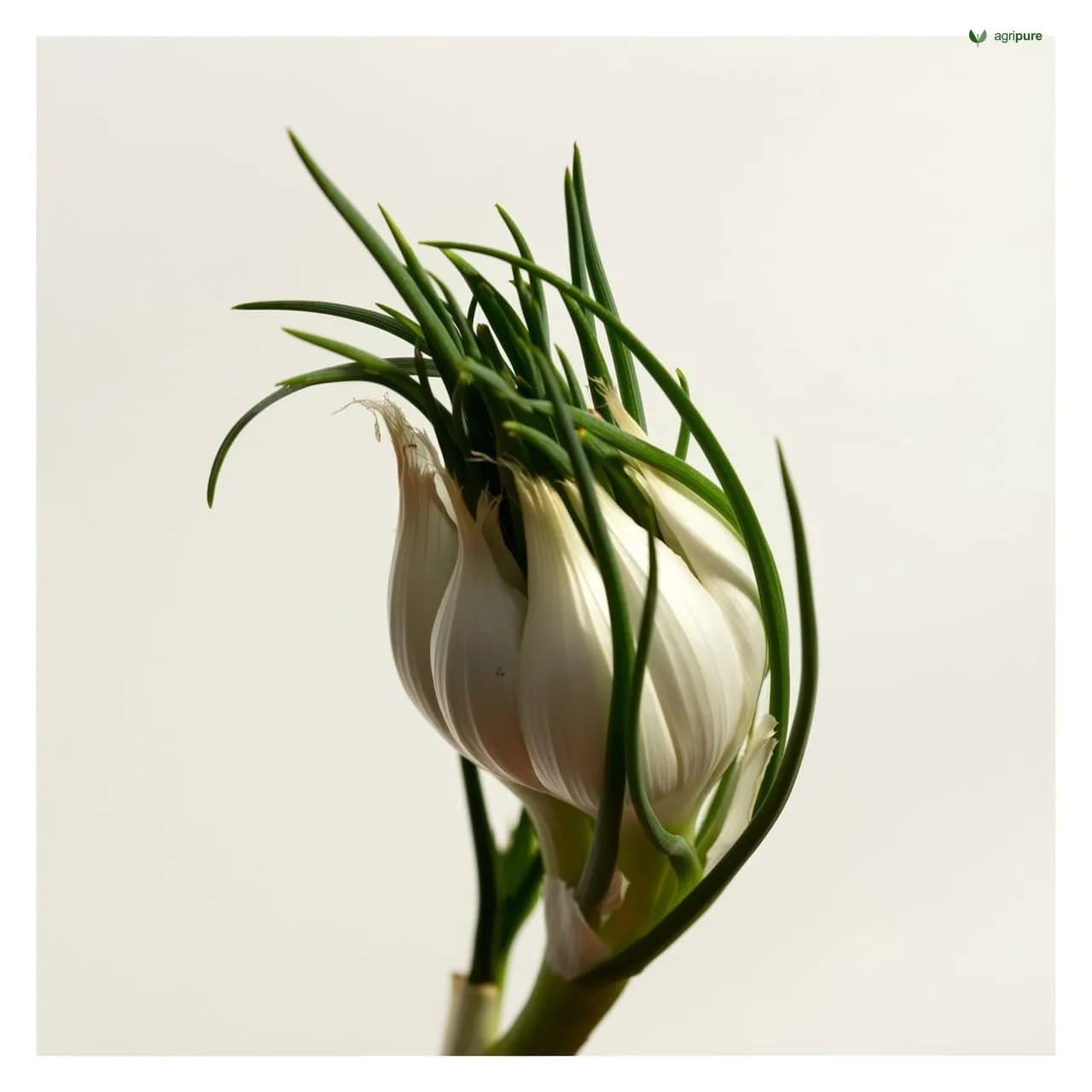
The plant grows as a herbaceous perennial but is almost always raised as an annual. It forms an underground bulb made up of several wedge-shaped cloves, each wrapped in a papery skin, with the whole bulb enclosed in a dry tunic. The leaves are linear, flat, and grass-like, rising directly from the bulb and giving off the unmistakable sulfurous garlic odor when crushed. An erect flowering stem, or scape, can reach roughly a metre tall; in hardneck types this scape coils before straightening, and its terminal umbel is often partly replaced by small aerial bulbils rather than true seed. When flowers do form, they carry six look-alike tepals, typically white to pinkish, in the pattern common to alliums.
Growing garlic
Garlic is propagated almost exclusively from cloves, not from true seed. Break a healthy, disease-free bulb into individual cloves just before planting and set only firm, undamaged ones; the largest cloves give the best bulbs. Plant cloves about 2 to 3 inches deep and 6 to 8 inches apart, spacing that supports good bulb size and air flow around the plants. Garlic wants full sun and loose, fertile, well-drained soil; bulbs are prone to rot in soils that stay too wet, so drainage matters more than richness. A mulch laid over the bed suppresses weeds and steadies soil moisture and temperature through the season.
Timing is the part most worth getting right, because garlic is planted in autumn to overwinter. The cloves need roughly 4 to 6 weeks to establish roots before the ground freezes. In colder regions the rule of thumb is to plant in late summer or fall, within a week or two of the first killing frost. In milder areas, planting from late October into November (and even into December where winters are warm) sets the crop up for a harvest the following May or June. Garlic is shallow-rooted and needs consistent moisture, especially as the bulbs are forming, but it remains sensitive to waterlogging throughout. Extension growers treat it as hardy through cold winters from the upper Midwest to the Carolinas, provided it is planted in fall and mulched; primary sources do not assign firm USDA zone numbers, so none are claimed here.
Harvest and uses
Garlic planted in fall is typically lifted the following early summer, a May-to-June harvest in milder climates after a winter and spring in the ground. The cured bulb is both food and traditional remedy. Its characteristic pungency and much of its reputation come from sulfur compounds, notably allicin, which form when the cloves are cut or crushed. Beyond the kitchen, garlic’s organosulfur chemistry is the subject of an extensive scientific literature examining its bioactive properties. For the home grower the practical payoff is storage: well-cured bulbs hold for months in cool, dry conditions, turning a single autumn planting into a winter-long supply.
How to identify it
Garlic is told apart from other alliums by a clear combination of features:3
- Bulb: A compound underground bulb of several wedge-shaped cloves, each in its own papery skin, the whole wrapped in a dry tunic; bulbs are white to off-white.
- Leaves: Linear, flat, grass-like, rising from the bulb, with a strong garlic odor when crushed.
- Scape: An erect flowering stem up to about a metre tall; in hardneck types it coils before straightening.
- Inflorescence: A terminal umbel, often partly replaced by small bulbils; any true flowers have six white-to-pinkish tepals.
The multi-cloved bulb and culinary pungency are the surest cues that separate A. sativum from onions, leeks, and ornamental alliums.
Safety and cautions
Garlic is broadly edible for people and a normal kitchen staple, but the sourced research notes some real cautions worth respecting. Handling and eating garlic can cause contact dermatitis in sensitive people, and it carries documented low-severity toxicity. Concentrated or medicinal preparations carry their own safety considerations distinct from ordinary culinary use. Garlic is also noted to be of toxicity concern for some animals, so keep bulbs and trimmings away from pets and livestock. This profile describes garlic’s traditional and culinary roles only and makes no medical claims; anyone considering garlic in medicinal amounts, or who is pregnant, breastfeeding, or taking medication, should seek qualified advice rather than self-dose.
Sources
- Allium sativum (Garlic) — NC State Extension Plant Toolbox
- Garlic, Allium sativum — University of Wisconsin–Madison Division of Extension
- Garlic — Wikipedia
- Allium sativum bioactive review — PMC (National Library of Medicine)