secondary
Onion
pyaaz
Allium cepa
Also known as Pyaaz (Pakistan).
- punjab plains
- sindh coast
- pothohar
- kpk hills
International hardiness
- USDA 3-9
- RHS H6
- AU: Cool temperate, Warm temperate, Mediterranean, Subtropical
Where it grows — regional guide
| Zones / rating | Regional notes |
|---|---|
USDA 3-9 | Grown as an annual bulb vegetable across cold and warm zones; keep culls and kitchen scraps away from dogs, cats and livestock due to toxicity. |
| Zones / rating | Regional notes |
|---|---|
H6 (-20 to -15C) | Fully hardy under RHS H6 for allotment planting from sets or seed; never feed allium trimmings or culls to household pets or livestock. |
| Zones / rating | Regional notes |
|---|---|
Cool temperate, Warm temperate, Mediterranean, Subtropical | Grown through the cooler months across temperate and Mediterranean zones; allium tops and bulb culls are toxic to livestock and pets. |
| Zones / rating | Regional notes |
|---|---|
USDA 3-9 (USDA scale) Canada uses its own zone system; Canadian zones run roughly one lower than USDA. | Hardy across cold-winter provinces as a short-season annual crop; keep harvested bulbs and trimmings away from dogs, cats and livestock. |
| Zones / rating | Regional notes |
|---|---|
Punjab plains, Sindh coast, Pothohar, KPK hills | Pakistan:Grown as a major cool-season rabi crop across the plains and hills; all scraps and culls are toxic to dogs, cats and livestock. India:Cultivated across plains and peninsular belts as a staple rabi and kharif vegetable; culls and trimmings are toxic to domestic livestock and pets. |
Grows alongside
Species that appear with Onion in 64 of our published guides — a starting list for a guild, not a planting plan.
The onion (Allium cepa) is a cool-season bulb crop in the family Amaryllidaceae, biologically a biennial but grown almost everywhere as an annual for its edible swollen bulb and hollow green tops. The species is unusual in that it is known only from cultivation, with no confirmed truly wild populations, and it was most likely domesticated in Central Asia, with a probable wild ancestry in Allium vavilovii and a native range spanning Iran, Turkmenistan, and neighbouring regions. For a homesteader it is one of the most forgiving and useful staples to grow: it stores for months after curing, slots into the cool shoulders of the season, and asks for little more than full sun, loose ground, and patience while the bulb sizes up.
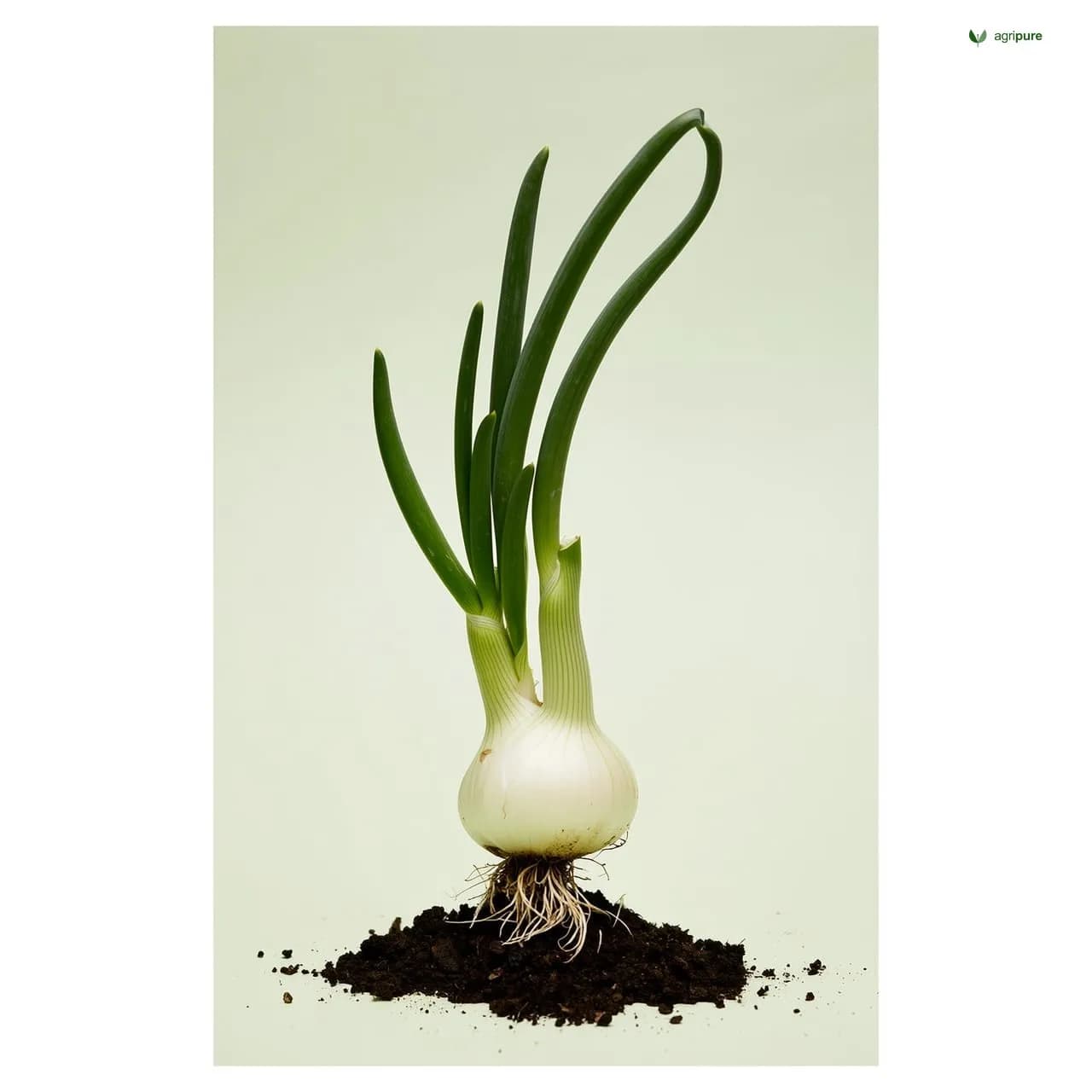
The plant forms a concentric, layered bulb at the base of a short compressed stem (the basal plate), from which a fan of hollow, tubular, bluish-green leaves rises in a rosette. If left to grow into its second year, it sends up a hollow flowering scape topped with a spherical umbel of small whitish flowers, then sets a globular-to-egg-shaped seed capsule holding black, trigonous seeds roughly 2.7–3.3 mm long with a distinctly wrinkled, grooved surface. Cultivars fall into two broad groups: the Common Onion Group, with larger, usually solitary bulbs grown from seed or sets, and the Aggregatum Group (which includes most shallots), whose smaller bulbs form clusters off a single mother bulb.
Growing onions
Onions are a cool-season crop; NC State Extension lists the species as hardy across USDA zones 5a to 10b. The single most important quirk of the plant is that bulb formation is triggered by day length rather than by size or age alone — the bulb begins to swell only once a specific daylength is reached, and cultivars are accordingly classed as short-, intermediate-, or long-day types. Matching the cultivar to your latitude is therefore the first decision: a long-day onion grown too far south will never bulb properly, and a short-day type grown too far north bulbs prematurely.
There are three propagation routes. Most common onions are grown from seed, sown directly or raised in seedbeds and plug trays and then transplanted. Common Onion Group cultivars are also produced from sets — small seed-grown bulblets that are replanted to finish into full bulbs. Aggregatum (shallot-type) onions are propagated by division, planting out the individual bulbs from a cluster. Give the crop full sun for the best bulb formation, and plant into moist but well-drained, fertile, loose soil; poor drainage is the main pitfall, since onions readily rot in waterlogged ground. For sets, NC State Extension recommends planting about half an inch to an inch deep and six inches apart, a spacing that yields full-size bulbs. Closer spacing is sometimes used to grow scallions, but the sourced references do not specify those dimensions.
Harvest and uses
The harvest is the bulb itself, lifted once it has sized up at the end of its single growing season; the hollow green tops can also be cut and used at any stage. Onion is one of the most widely cultivated vegetables on earth, now grown in over 140 countries, with the largest production in China, India, the United States, and Turkey. Its history as a food plant is ancient: from Central Asia it spread to Mesopotamia, where onions appear in Sumerian writing around 2500 BC, then to Egypt by roughly 1600 BC, on to India and Southeast Asia, and eventually around the Mediterranean and the wider world. In the kitchen the layered bulb is eaten raw, cooked as the aromatic base of countless dishes, or preserved, while the shallot-type Aggregatum onions and the green tops widen the range a single bed can supply.
How to identify it
Onion is recognisable by a combination of features that separate it from the other alliums:1234
- Habit: a herbaceous biennial grown as an annual, forming a single rosette of leaves above an underground bulb.
- Leaves: hollow, tubular, and bluish-green, arranged in a fan and arising from a short basal plate.
- Bulb: a concentric, layered bulb at the stem base — solitary and large in Common Onion types, or clustered and smaller in Aggregatum (shallot) types.
- Flowers and seed: a spherical umbel of small whitish flowers on a hollow scape in the second year, followed by a globular-to-egg-shaped capsule of black, wrinkled, trigonous seeds.
Safety and cautions
For people, the onion is an everyday food with only low-severity toxicity concerns in normal culinary use. The important caution is for animals: onions and other alliums are seriously toxic to many domestic animals, so trimmings, scraps, and culls should be kept away from dogs, cats, and livestock rather than tossed onto a paddock or fed out with kitchen waste. This profile makes no medical claims about onions; it simply flags the well-documented animal-toxicity risk that comes with growing alliums around a homestead.
Sources
- Allium cepa L. — GBIF (Global Biodiversity Information Facility)
- Allium cepa — PROTA (Plant Resources of Tropical Africa)
- Onion — Wikipedia
- Allium cepa L. — Seed ID Guide (Identification of seeds)
- Allium cepa — PubChem, National Center for Biotechnology Information
- Allium cepa (Onion) — NC State Extension Gardener Plant Toolbox