secondary
Garlic Chives
gandhana
Allium tuberosum
- pothohar
- kpk hills
- punjab plains
International hardiness
- USDA 4-9
- RHS H6
- AU: Cool temperate, Warm temperate, Subtropical, Mediterranean
Where it grows — regional guide
| Zones / rating | Regional notes |
|---|---|
USDA 4-9 | Grown as a perennial kitchen herb across temperate zones; deadhead flowers to prevent weedy spread and keep off pets as it is toxic. |
| Zones / rating | Regional notes |
|---|---|
H6 (-20 to -15C) | Hardy under RHS H5 for sunny herb borders; deadhead flowers to stop invasive self-seeding and keep foliage away as it is toxic to pets. |
| Zones / rating | Regional notes |
|---|---|
Cool temperate, Warm temperate, Subtropical, Mediterranean | Grown across temperate and subtropical gardens; deadhead flowers promptly to prevent weedy escape, and keep foliage away from toxic pets. |
| Zones / rating | Regional notes |
|---|---|
USDA 4-9 (USDA scale) Canada uses its own zone system; Canadian zones run roughly one lower than USDA. | A hardy perennial herb across Canadian zones; cut spent flower umbels to prevent garden weediness and keep leaves away from toxic pets. |
| Zones / rating | Regional notes |
|---|---|
Pothohar, KPK hills, Punjab plains | Pakistan:Suited to the KPK hills, Balochistan highlands, and Pothohar plateau (sown in autumn/winter on the plains); provide afternoon shade or mulch during May–June pre-monsoon heat and ensure free drainage during the July–August monsoon. |
Grows alongside
Species that appear with Garlic Chives in 8 of our published guides — a starting list for a guild, not a planting plan.
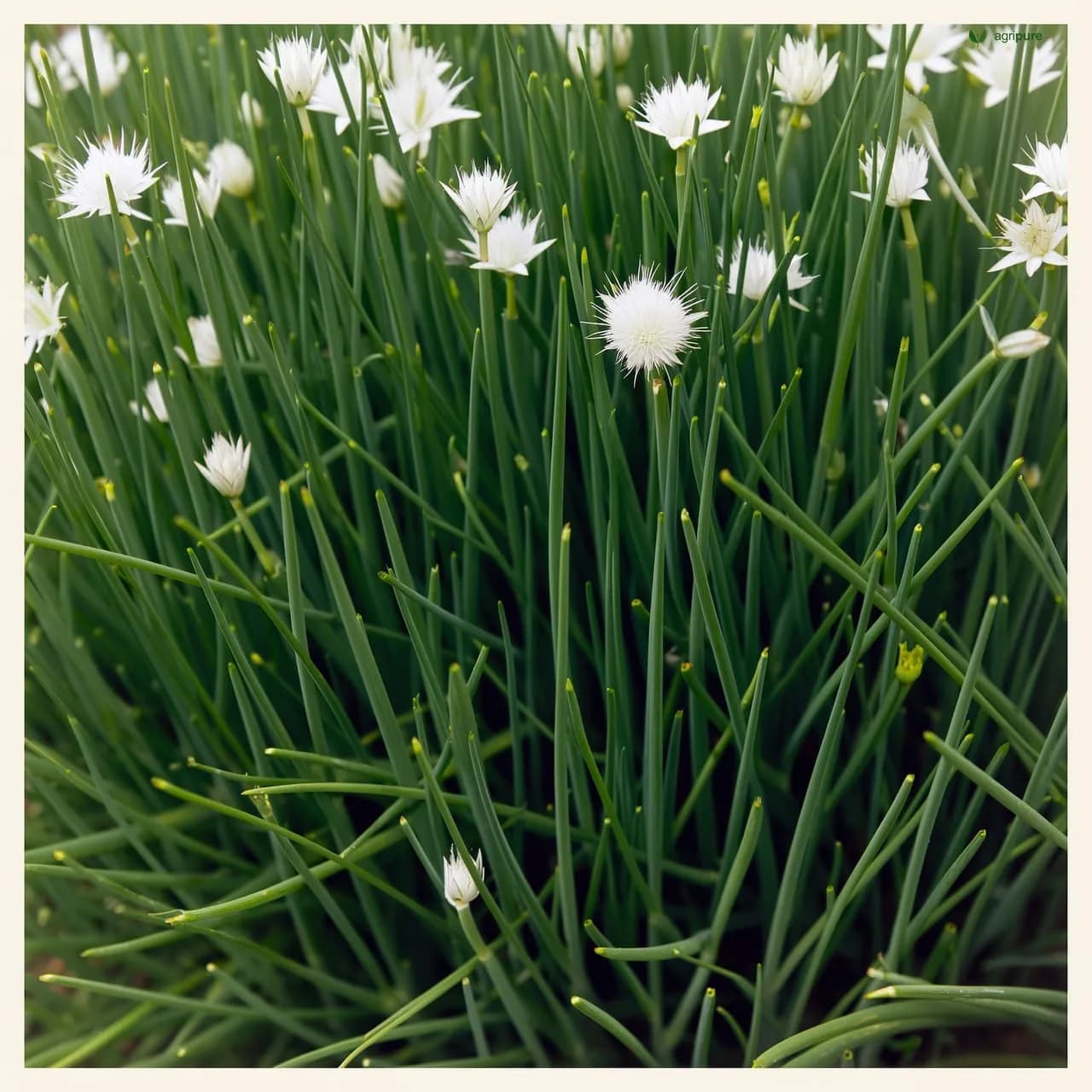
Garlic chives (Allium tuberosum) are a hardy, clump-forming perennial in the amaryllis family (Amaryllidaceae), grown for their flat, mildly garlic-flavoured leaves and their froth of small white late-summer flowers. They are native to southeastern Asia, described as ranging from the Himalaya to China and centred on the Chinese province of Shanxi and the surrounding Siberian-Mongolian-North Chinese steppe, and they are now widely cultivated and naturalized around the world. For a homesteader the appeal is durability: this is a low-input, cut-and-come-again kitchen herb that establishes into a tidy clump, returns on its own every year, and shrugs off heat, cold, and dry spells once settled.
Identifying garlic chives
Garlic chives form herbaceous, rhizomatous clumps that arise from small, elongated, tough, fibrous bulbs spreading on short rhizomes and tuberous rootstocks. The leaves are flat, strap-like, and grey-green, growing from the crown rather than being hollow, and typically reach about 10 to 20 inches (25 to 50 cm) tall in a foliage clump. All the edible parts carry a distinct onion-and-garlic smell and flavour, strongest when the leaves are crushed. In late summer to autumn the plant sends up leafless flowering stalks, or scapes, roughly 1.5 to 2 feet (45 to 60 cm) tall, topped with umbels of numerous tiny, star-shaped white flowers; unlike common chives (Allium schoenoprasum), which have hollow tubular leaves and mauve-to-purple flowers in late spring, garlic chives are recognised by their flat leaves and white late-season blooms.
Growing garlic chives
Garlic chives can be raised two ways. They are easily started from seed, sown directly in late autumn so the seed gets natural stratification, or in early spring once the soil has warmed; established clumps can also be lifted and divided, and University of Wisconsin Extension advises dividing clumps about every three years to keep them blooming and vigorous. Give the plant a spot in full sun, where it performs best, though it will take some shade, particularly in hot climates. It prefers well-drained soil; in nature it grows in rich, moist sites but adapts readily in the garden. Keep new sowings and seedlings evenly moist while they establish, after which the plants become drought tolerant and handle a wide range of moisture, even if they grow best with moderate, regular water.
In terms of habit and spacing, foliage clumps stand about 10 to 20 inches tall with flower stalks rising to 1.5 to 2 feet, while each clump spreads to roughly a foot across and expands only slowly by rhizome. Because the clumps stay tight rather than running, garlic chives make a clean perennial edging or herb-layer plant that holds its patch without sprawling into its neighbours. Once established they are heat, cold, and drought tolerant and grow in regions with both very cold winters and hot summers; University of Wisconsin Extension lists the species as hardy in USDA zones 3 to 9.3
Harvest and uses
Garlic chives are a cut-and-come-again herb: the flat leaves are snipped for the kitchen, where their mild garlic flavour suits eggs, soups, salads, and stir-fries, and the foliage regrows from the clump for repeated cuttings through the season. All parts share the characteristic onion-garlic taste and aroma. The plant is valued as both a culinary herb and an ornamental, and its late-summer flush of white flowers is a useful nectar source when much else has finished blooming. Because each clump can be lifted and divided to make more plants, a single planting becomes a free, self-renewing supply for new beds.
One thing to manage is its readiness to spread. Garlic chives can self-sow freely from their seed, so on a homestead it is worth removing spent flower heads before they shed if you do not want volunteers appearing around the patch.
Safety and cautions
Garlic chives are a well-established culinary plant, but a couple of grounded cautions belong on any honest profile. Like other alliums, they contain sulfur compounds, and overconsumption can cause low-severity stomach upset in people, while sulfide-based poisoning of some animals from onion- and garlic-family plants is also documented — so cuttings and trimmings should be kept away from animals. The strong garlic smell makes them easy to tell apart from genuinely harmful look-alikes, but as with any wild or volunteer allium, confident identification before eating is the sensible rule. This profile describes traditional culinary and ornamental use only and makes no medical claims.
Sources
- Allium tuberosum (Garlic Chives) — NC State Extension Gardener Plant Toolbox
- Allium tuberosum — Wikipedia
- Garlic Chives, Allium tuberosum — University of Wisconsin-Madison Division of Extension