climax
Apple — Granny Smith
saib sabz (سیب سبز)
Malus domestica cv. Granny Smith
Also known as Saib Sabz (Pakistan).
- kpk hills
- balochistan highlands
International hardiness
- USDA 4-8
- RHS H6
- AU: Cool temperate, Warm temperate, Mediterranean
Where it grows — regional guide
| Zones / rating | Regional notes |
|---|---|
USDA 4-8 | Grown in warmer temperate zones with a long growing season; the tart green fruit keeps well through winter storage. |
| Zones / rating | Regional notes |
|---|---|
H6 (-20 to -15C) | Hardy under RHS H6: requires a warm, sheltered sunny wall or polytunnel to fully mature its late-ripening tart green fruit. |
| Zones / rating | Regional notes |
|---|---|
Cool temperate, Warm temperate, Mediterranean | An Australian heirloom originating in New South Wales, grown in temperate orchards for crisp, tart green cooking and eating apples. |
| Zones / rating | Regional notes |
|---|---|
USDA 4-8 (USDA scale) Canada uses its own zone system; Canadian zones run roughly one lower than USDA. | Grown in warm microclimates and southern valleys, requiring a long frost-free autumn to mature its tart green fruit. |
| Zones / rating | Regional notes |
|---|---|
KPK hills, Balochistan highlands | Pakistan:Cultivated in the highland valleys of Balochistan and KPK for firm green fruit that stores well through the winter. |
The Granny Smith apple (Malus domestica cv. Granny Smith) is one of the most recognizable apples in the world: a bright-green, firm, sharply tart cultivar of the domesticated apple, a member of the rose family (Rosaceae). Unlike most heirloom apples, it has a precise origin story. It arose as a chance seedling around 1868 on the property of Maria Ann “Granny” Smith in Ryde, New South Wales, Australia, reportedly springing up from a heap of discarded fruit. From that single accidental tree it has become one of the leading commercial apples grown in Australia, Europe, New Zealand, South America, and the United States. For a homesteader, its appeal is straightforward: it is a versatile kitchen apple that holds its firm texture and tart flavor well, and it stores for a long time, making it a dependable keeper rather than a fruit that must be eaten the week it is picked.
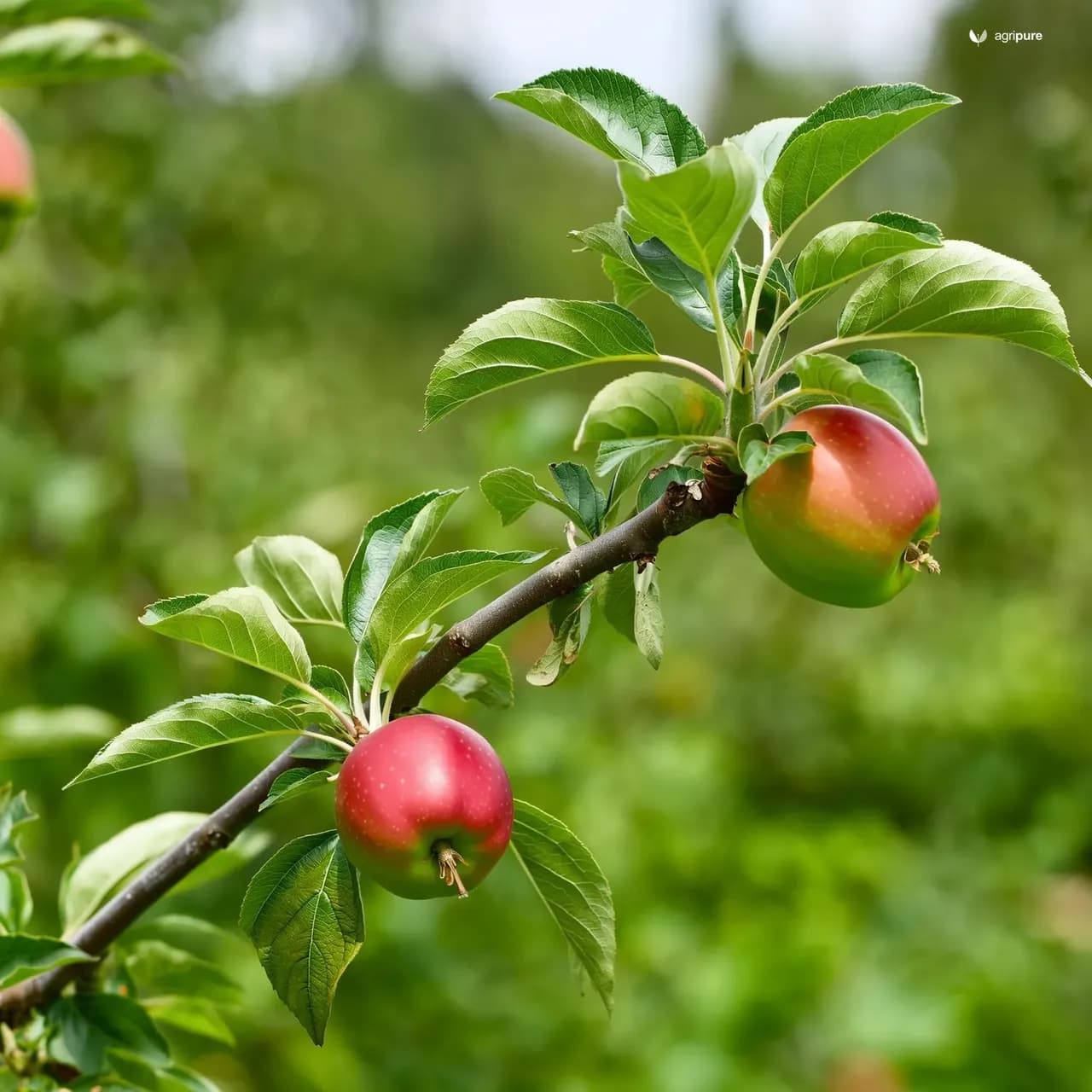
The fruit is small to medium in size, roughly 5 to 7 cm across, and round to oval or somewhat conical in shape. Its skin is smooth, firm, thick, and a distinctive bright green when ripe, dotted with many small white lenticels (the tiny pores in the skin). In cooler climates the side of the fruit facing the sun can take on a yellow to pink blush. Cut one open and the flesh is white, dense, and very crisp, mildly juicy with a fine, slightly grainy texture, surrounding a fibrous central core that holds small brown-black seeds. The flavor is the cultivar’s signature: markedly tart and acidic, often described as having a lemon-like sharpness, with just enough underlying sweetness to keep it balanced. Because it keeps its green color so reliably, it is among the easiest apple varieties to identify on sight.
Growing Granny Smith
Granny Smith is not grown from its own seed. Like other apple cultivars, it is a single clone that must be propagated vegetatively to stay true to type, which is why it is universally grown as a grafted tree in commercial orchards and home plantings alike. A seed from a Granny Smith apple will not reliably grow into a Granny Smith tree; the named variety only continues through grafting scion wood onto a rootstock. For the home grower, this means buying a young grafted tree rather than attempting to raise one from pips.
In terms of climate, Granny Smith performs across a broad sweep of cool-temperate to warm-temperate regions. It is grown successfully in the major apple-producing areas of Australia, Europe, New Zealand, South America, and the United States, and Washington State University lists it among the top commercial apple varieties in Washington, a major cool-temperate apple region. A reliable practical guide for siting it is simple: plant Granny Smith where other common dessert apples already grow well in your area. If standard apples are a proven crop locally, it is a strong climatic indicator that Granny Smith will succeed too.
It is worth being honest about the limits of the available cultivar-specific research here. Trustworthy, Granny-Smith-specific figures for soil type, soil pH, sun exposure, irrigation, plant spacing, rootstock choice, chill-hour requirements, and exact days to maturity are not documented in the sources used for this profile, so they are deliberately left out rather than stated with false precision. For those region-dependent specifics, your local agricultural extension service’s general guidance on apple culture will be far more accurate for your conditions than any single number quoted out of context.
Harvest and uses
Granny Smith is prized in the kitchen for the same qualities that define the fruit: it is firm, tart, and long-keeping. That combination makes it one of the most versatile cooking and dessert apples available. The crisp, dense flesh holds its shape when baked, so it is a classic choice for pies, tarts, and other cooked dishes where a softer, sweeter apple would collapse, and its sharp acidity gives baked goods backbone. Eaten fresh, it delivers a bracing, crunchy tartness that many people seek out specifically.
Its long storage life is a genuine homestead advantage. Granny Smith is valued for keeping well, which means a harvest can be drawn down gradually over an extended period rather than all at once, stretching the usefulness of a single tree’s crop well past picking time. For a household trying to put up its own food, an apple that stores reliably and cooks well is more useful than one that is sweeter but short-lived.
Specific per-tree yield figures and a precise harvest window are not given in the cultivar-specific sources here, and rather than invent numbers, this profile notes only what the sources support: that the fruit is a firm, tart, long-storing apple suited to both fresh eating and cooking.
Sources
- Granny Smith Apples – Specialty Produce
- Granny Smith apple variety – Orange Pippin
- Apple Varieties – Washington State University Tree Fruit
- Granny Smith Apples – Stemilt
- Apple Varieties – New York Apple Association